Every m×4 biquadratic sum of squares is a sum of 3m−1 squares (5 ≤ m ≤ 16)
At a glance
What the paper contributes
BSR(m,4) ≤ 3m − 1 for 5 ≤ m ≤ 16 (Theorem 1): every real m×4 biquadratic sum of squares is a sum of at most 3m − 1 squares of bilinear forms, one square below the previous bound 3m. In particular BSR(5,4) ≤ 14, the upper half of the conjecture BSR(5,4) = 14 of Qi and Ouyang; with the known lower bounds, 13 ≤ BSR(5,4) ≤ 14 and 16 ≤ BSR(6,4) ≤ 17. The paper does not decide whether BSR(5,4) is 13 or 14.
- A boundary inertia inequality (Lemma 17): at a boundary point of the sums of N squares inside the cone, the negative index q of the Hankel multiplier satisfies N(q − 1) ≤ dim R2 − C(N+2, 2). The paper says it is, in substance, Theorem 3.4 of Boumal, Voroninski and Bandeira, transported to this setting; its case q = 1 recovers the Barvinok–Pataki bound. For m×4 forms it gives q ≤ ⌊(m+13)/6⌋, which is at most 4 exactly for m ≤ 16.
- A case analysis over the support triples (a, b, r) (Theorem 25): compression to fewer rows for a ≤ m − 2, with the base values BSR(k,4) ≤ 3k − 1 for k = 2, 3, 4; a four-row isotropic lemma (Lemma 20) and a low-negative-index lemma for q ≤ 4 (Lemma 23) for the rest.
- Explicit regular tuples for every m (Lemma 24) and a boundary selection lemma whose codimension-two hypothesis is sharp (Lemma 12).
- Where the method stops: at m = 17 the inertia bound allows q = 5.
- Machine checks: the arithmetic, the enumeration of cases and several linear-algebra steps are checked in Isabelle/HOL (six sessions) or by exact computation; these checks cover individual steps, not the whole theorem.
🚀 Start here: Theorem 1: BSR(m,4) ≤ 3m − 1 for 5 ≤ m ≤ 16.
Main results:
- Theorem 1: BSR(m,4) ≤ 3m − 1 for 5 ≤ m ≤ 16
- Lemma 14: boundary inertia inequality: Nq ≤ M − 1 − C(N+1, 2) for the negative index q
- Theorem 22: the proof for 5 ≤ m ≤ 16, by induction on m
🗺️ Map of the results (click a box to go to it)
Dependencies in the written proof: an arrow A → B means that this proof of B uses A. Every result rests on its written proof; the tags record what was checked besides, and each statement's “Evidence & scope” block says how far. The colour of a box is its strongest tag, in the order above; the tags in the box give the rest. Boxes with a thick border are the main results; click a box to read the statement.
📐 Setting (copied from the paper: abstract, §2 and §3)
Let \(\operatorname {BSR}(m,n)\) be the least \(r\) such that every real biquadratic sum of squares in \(m+n\) variables is a sum of \(r\) squares of bilinear forms. (Abstract.)
Put \(A=\mathbb R^5\), \(B=\mathbb R^4\), \(V=A\otimes B\), and
Thus \(\dim V=20\) and \(\dim R_2=150\). Write \(\Sigma _k=\operatorname {im}\Phi _k\), \(\Sigma =\bigcup _k\Sigma _k\). For \(F\in \Sigma \), the least \(k\) with \(F\in \Sigma _k\) is \(\operatorname {SOS}_{\mathbb R}(F)\); \(\operatorname {BSR}(m,n)\) is the largest real SOS length in size \(m\times n\). (§2)
A Hankel multiplier is a symmetric bilinear form \(H\) on \(V\) with
Such forms are precisely the functionals on \(R_2\), evaluated on products of bilinear forms. The first radical consists of the \(x\) such that \(H(x\otimes B,V)=0\); the first support is its codimension. Define the second radical and second support in the other factor. The image of \(H:V\to V^*\) is called product-free if its complexification contains no nonzero decomposable covector. (§2)
Factor a rank-\(r\) multiplier as
where \(J\) is nondegenerate symmetric. Set \(T_bx=T(x\otimes b)\); write \(\langle \, ,\, \rangle \) for \(J\). Condition (H) becomes
(§2)
… extend to \(m\times 4\) biquadratic forms after the following modifications, with \(14\) replaced by \(N=3m-1\), \(\dim V=20\) by \(4m\), \(\dim R_2=150\) by \(M=5m(m+1)\), the bound \(r\le 6\) by \(r\le 4m-N=m+1\), and \(\operatorname {BSR}(5-a,4)\) by \(\operatorname {BSR}(m-a,4)\) … Throughout, effective supports \((a,b)\) means the first and second supports of \(H\) (codimensions of the two radicals). (§3)
Throughout the argument, \(q\) denotes the negative index of this oriented multiplier. The orientation is fixed by
(§3.1, «Orientation and inertia».)
Abstract.
Let \({\operatorname {BSR}}(m,n)\) be the least \(r\) such that every real biquadratic sum of squares in \(m+n\) variables is a sum of \(r\) squares of bilinear forms. We prove \({\operatorname {BSR}}(m,4)\le 3m-1\) for \(5\le m\le 16\), one square below the previous bound \(3m\). In particular \({\operatorname {BSR}}(5,4)\le 14\), the upper half of the conjecture \({\operatorname {BSR}}(5,4)=14\) proposed by two of the present authors, Qi and Ouyang; with the known lower bounds this gives \(13\le {\operatorname {BSR}}(5,4)\le 14\) and \(16\le {\operatorname {BSR}}(6,4)\le 17\). As a corollary, \({\operatorname {BSR}}(m,5)\le 4m-1\) for every \(m\ge 2\), one below the Choi–Lam–Reznick bound \(4m\) for \(5\le m\le 10\). The proof studies boundary points of the sets of sums of a fixed number of squares. Minimality of a representation bounds the negative index \(q\) of its Hankel multiplier through the dimension of its syzygies: \(N(q-1)\le \dim R_2-\binom {N+2}{2}\) for a boundary of the sums of \(N\) squares, a boundary inertia inequality (a transport to this setting of the negative-index bound of Boumal, Voroninski and Bandeira for Burer–Monteiro critical points) whose case \(q=1\) recovers the Barvinok–Pataki bound. For \(m\times 4\) forms it gives \(q\le \lfloor (m+13)/6\rfloor \), which is at most \(4\) exactly for \(m\le 16\). A classification of isotropic restrictions involving at most four rows and a low-negative-index lemma for \(q\le 4\) then exclude the remaining boundary configurations; compression to fewer rows, with the base values \({\operatorname {BSR}}(k,4)\le 3k-1\) for \(k=2,3,4\), handles the smaller supports; and an explicit inductive family of tuples gives the regular points. The argument first fails at \(m=17\), where the inertia bound allows \(q=5\). The arithmetic, the enumeration of cases and several linear-algebra steps are checked in Isabelle/HOL or by exact computation; these checks cover individual steps, not the whole theorem.
tabular longtable
[enhanced,breakable,before skip=8pt,after skip=4pt,colback=accent!4,colframe=accent!60,boxrule=0.6pt,arc=3pt,left=4pt,right=8pt,top=4pt,bottom=4pt,title=Results at a glance,coltitle=white,colbacktitle=accent!85,fonttitle=] \({\operatorname {BSR}}(m,4)\le 3m-1\) for \(5\le m\le 16\) (Theorem 1), by the boundary strategy of Blekherman, Dunbar and Sinn
[
1
]
: one square fewer than the previous bound \(3m\); in particular \({\operatorname {BSR}}(5,4)\le 14\), the upper half of the conjecture \({\operatorname {BSR}}(5,4)=14\) proposed by two of the present authors in
[
13
]
, and \(13\le {\operatorname {BSR}}(5,4)\le 14\), \(16\le {\operatorname {BSR}}(6,4)\le 17\) (Figure 1). , pieces Five columns: \({\operatorname {BSR}}(m,5)\le 4m-1\) for every \(m\ge 2\) (Corollary 2), one below the Choi–Lam–Reznick bound for \(5\le m\le 10\). , arithmetic , chain A boundary inertia inequality \(N(q-1)\le \dim R_2-\binom {N+2}{2}\) for the negative index \(q\) of the Hankel multiplier at a boundary point of the sums of \(N\) squares (Lemma 14; in substance the negative-index bound of Boumal, Voroninski and Bandeira
[
8
]
, with a self-contained proof here); its case \(q=1\) is the Barvinok–Pataki bound, and for \(m\times 4\) it gives \(q\le \lfloor (m+13)/6\rfloor \) (Figure 3). , arithmetic The case analysis over the support triples \((a,b,r)\): compression for small row support, a four-row isotropic lemma and a low-negative-index lemma for \(q\le 4\) for the rest (Lemmas 17, 20 and Theorem 22; Figure 5). , enumeration , Schur coefficients (L2) in the free algebra Explicit regular tuples for every \(m\) (Lemma 21) , and a self-contained boundary selection lemma, the stratification argument of
[
1
,
§
2
]
made self-contained, whose codimension-two hypothesis is sharp (Lemma 9, Figure 4) Toward \({\operatorname {BSR}}(5,4)=13\): a negative-syzygy obstruction for boundary points of \(\Sigma _s\) (Proposition 23) , trace step ; exact certificates at one rational multiplier of each of 11 subtypes (Appendix B) . It does not decide \(13\) versus \(14\). Where the method stops: at \(m=17\) the inertia bound allows \(q=5\); slope \(n-1\) cannot persist beyond four columns. Inputs: \({\operatorname {BSR}}(2,4)\le 5\), \({\operatorname {BSR}}(3,4)\le 8\), \({\operatorname {BSR}}(4,4)\le 11\) from earlier papers.
pieces in Isabelle/HOL exact computation proof in the text, read in AI-assisted referee-style rounds (not journal peer review).
1 The results
Boundary_Inertia_Arith.inertia_m4, Boundary_Inertia_Arith.q_values, Boundary_Inertia_Arith.incidence, Boundary_Inertia_Arith.compression_count, BSR_m4_Pieces.support_triples_m4, BSR_m4_Pieces.regular_point_m4 For \(5\le m\le 16\), every real \(m\times 4\) biquadratic sum of squares is a sum of at most \(3m-1\) squares of real bilinear forms: \({\operatorname {BSR}}(m,4)\le 3m-1\).
Isabelle · ours · partshow
Only a part is in Isabelle: pieces only: the m×4 arithmetic of the inertia inequality and the values of ⌊(m+13)/6⌋, the incidence and compression counts, the enumeration of the support triples and the regular tuples; the theorem as a whole is a written proof (the paper: «these checks cover individual steps, not the whole theorem»)
inertia_m4 · Isabelle/BoundaryInertia/Boundary_Inertia_Arith.thy, line 36
lemma inertia_m4:
  fixes m q :: int
  shows "2*(3*m-1)*(q-1) + (3*m+1)*(3*m) \<le> 2*(5*m*(m+1)) \<longleftrightarrow> 2*(3*m-1)*(q-1) \<le> m*(m+7)"
q_values · Isabelle/BoundaryInertia/Boundary_Inertia_Arith.thy, line 77
lemma q_values:
  "\<forall>m::int \<in> {5..10}. (m+13) div 6 = 3" "\<forall>m::int \<in> {11..16}. (m+13) div 6 = 4" "(17+13) div 6 = (5::int)"
incidence · Isabelle/BoundaryInertia/Boundary_Inertia_Arith.thy, line 82
lemma incidence: fixes M m :: int shows "M - 2*(m+3) + 2*((m-1)+3) = M - 2" by simp
lemma compression_count: fixes a m :: int shows "(4*a - (a+1)) + (3*(m-a) - 1) = 3*m - 2" by simp
lemma psi_counts: fixes m :: int shows "4*(m+1) - (m-1) = 3*m + 5" "4*m - (m-1) = 3*m + 1" by simp_all
compression_count · Isabelle/BoundaryInertia/Boundary_Inertia_Arith.thy, line 83
lemma compression_count: fixes a m :: int shows "(4*a - (a+1)) + (3*(m-a) - 1) = 3*m - 2" by simp
lemma psi_counts: fixes m :: int shows "4*(m+1) - (m-1) = 3*m + 5" "4*m - (m-1) = 3*m + 1" by simp_all
support_triples_m4 · Isabelle/BSRFourColumnsPieces/BSR_m4_Pieces.thy, line 50
theorem support_triples_m4:
  fixes m a b r :: nat
  assumes m: "5 \<le> m" and "(a,b,r) \<in> triples m" and "m \<le> a + 1" and "3 \<le> b"
  shows "(a,b,r) \<in> {(m,4,m+1), (m-1,4,m), (m-1,4,m+1), (m,3,m+1), (m-1,3,m+1), (m-1,3,m)}"
regular_point_m4 · Isabelle/BSRFourColumnsPieces/BSR_m4_Pieces.thy, line 381
theorem regular_point_m4:
  fixes H :: "nat \<Rightarrow> nat \<Rightarrow> nat \<Rightarrow> nat \<Rightarrow> real" and n :: nat
  assumes sym: "\<And>a b c d. a < 5 + n \<Longrightarrow> b < 4 \<Longrightarrow> c < 5 + n \<Longrightarrow> d < 4 \<Longrightarrow> H a b c d = H c d a b"
    and hankel: "\<And>a b c d. a < 5 + n \<Longrightarrow> b < 4 \<Longrightarrow> c < 5 + n \<Longrightarrow> d < 4 \<Longrightarrow> H a b c d = H a d c b"
    and ann: "\<forall>h \<in> S n. \<forall>c < 5 + n. \<forall>d < 4. av (5 + n) H h c d = 0"
  shows "\<forall>a < 5 + n. \<forall>b < 4. \<forall>c < 5 + n. \<forall>d < 4. H a b c d = 0"
Trust base: ⚙️ kernel + code evaluation — only part of the statement is formal (see the box). Isabelle: 5 results, no oracles · Isabelle, oracles: q_values (Code_Generator.holds_by_evaluation)
Proof: in this note·Formalized: Isabelle/HOL, by the author (public formalizations repository)·Covers: part: pieces only: the m×4 arithmetic of the inertia inequality and the values of ⌊(m+13)/6⌋, the incidence and compression counts, the enumeration of the support triples and the regular tuples; the theorem as a whole is a written proof (the paper: «these checks cover individual steps, not the whole theorem»)
🆕 Classical and new: the paper: one square below the previous bound 3m, which follows from BSR(m,3) = 2m [Mar3]; it proves the upper half BSR(5,4) ≤ 14 of the conjecture BSR(5,4) = 14 of Qi and Ouyang [QO, Conjecture 1] and the upper bound 3m − 1 of their progression for m ≤ 16; it does not decide their Question 1 (13 or at least 14).
↳ Used in: Corollary 2
💡 In plain words (commentary, not part of the paper)
Take a biquadratic form in \(x_1,\dots ,x_m\) and \(y_1,\dots ,y_4\) that is a sum of squares of bilinear forms, however many. The theorem says that \(3m-1\) squares always suffice when \(5\le m\le 16\): \(14\) for \(m=5\), \(47\) for \(m=16\). The previous bound was \(3m\), obtained from \(\operatorname {BSR}(m,3)=2m\) by adding one column. For \(m=5\) this is the upper half of the conjecture \(\operatorname {BSR}(5,4)=14\) of Qi and Ouyang; with the lower bound \(13\) it leaves \(13\le \operatorname {BSR}(5,4)\le 14\), and the paper does not decide which.
The proof does not search for representations. If the sums of \(N=3m-1\) squares were not the whole cone, a boundary point inside the cone would carry a Hankel multiplier \(H\) that kills every summand (so its rank is at most \(4m-N=m+1\)), whose image contains no nonzero decomposable covector \(\alpha \otimes \beta \), even over \(\mathbb C\) (product-free), and whose negative index \(q\) is at most \(\lfloor (m+13)/6\rfloor \) by the boundary inertia inequality (Lemma 17). The proof lists the possible triples of row support, column support and rank of \(H\) and excludes each one (Theorem 25). It stops at \(m=16\) because at \(m=17\) the inertia bound allows \(q=5\), and the low-negative-index lemma is proved only for \(q\le 4\).
The arithmetic, the enumeration of the cases and several linear-algebra steps are checked in Isabelle/HOL or by exact computation; in the paper’s words, these checks cover individual steps, not the whole theorem.
🛡️ Evidence & scope
Program: the claims of the two language tabs (14 and 15 at m = 5, the lower bound 13, 47/48/43 at m = 16; 210 Gram entries, dim R₂ = 150 and a kernel of dimension 60 at m = 5), with controls that must fail. lab/comprueba_pestanas.py
Program: Figures 1 and 2 recomputed against the paper’s table and the output of its figure script (r_P, the gaps, the four numerically rank-four points of the 2×3 form), with controls that must fail. lab/comprueba_lab.py
🧪 Lab: Figure 1 live: the bounds on BSR(m,4) for the range of m you choose
The lab draws, for the \(m\) you choose, the bound \(3m-1\) of Theorem 1 (only for \(5\le m\le 16\)), the previous bound \(3m\), the lower bounds of the table of Section 1 (for \(m=5,6,7\) the values \(z_2(m,4)=13,16,19\) from the literature the paper cites; for \(8\le m\le 14\) it computes \(\lfloor 8m/3\rfloor \) and for \(m=15,16\) it computes \(\lfloor (5m+6)/2\rfloor \), the rules stated there), the known values \(5,8,11\) for \(m=2,3,4\) and the Barvinok–Pataki rank \(r_P=\max \{ r:\binom {r+1}2\le 5m(m+1)\} \). The table adds, for every \(m\), the gap to the lower bound and the exact real bound \(q_*\) of the inertia inequality along \(N=3m-1\): where \(\lfloor q_*\rfloor \) reaches \(5\) the method stops.
🧪 Lab: Figure 2 live: the Gram spectrahedron of a 2×3 form and its numerically rank-four points
The seed draws an integer \(6\times 6\) matrix \(V\) (entries \(-2,\dots ,2\), redrawn until invertible; seed \(5\) is the paper’s), and \(F=\sum _k\ell _k^2\) with \(\ell _k\) the bilinear form of the \(k\)-th row of \(V\) in \(x_1,x_2\), \(y_1,y_2,y_3\). Its Gram matrices form the affine three-dimensional family \(G_0+t_1L_1+t_2L_2+t_3L_3\), \(G_0=V^\top V\), cut by \(G\succeq 0\). Along each ray from \(G_0\) the lab finds the boundary point (one zero eigenvalue) and colours it by \(\log _{10}(\lambda _2/\lambda _6)\); then, from the best of \(2000\) random rays, a Nelder–Mead search minimises \(\lambda _2\) and reports the points where \(\lambda _2{\lt}10^{-8}\lambda _6\): numerically rank-four points, i.e. representations of \(F\) by four squares. Floating point, as the paper says of its figure: an illustration, not a proof.
🔤 Read this theorem in another mathematical language
Commentary, not part of the paper. Take \(m=5\). Every biquadratic form in \(x_1,\dots ,x_5\), \(y_1,\dots ,y_4\) that is a sum of squares of bilinear forms is a sum of \(14\) of them. Before, adding one column to \(\operatorname {BSR}(5,3)=10\) gave \(5+10=15\); the lower bound is \(z_2(5,4)=13\), so \(\operatorname {BSR}(5,4)\) is \(13\) or \(14\). For \(m=16\): \(47\) against \(48\) before, and the lower bound \(43\).
Commentary, not part of the paper. The same statement for matrices, \(m=5\): a form is \(v^\top Gv\) with \(v=x\otimes y\) and \(G\) a symmetric \(20\times 20\) matrix (\(210\) entries), and the coefficients are a linear image onto the \(150\)-dimensional space \(R_2\), with a kernel of dimension \(210-150=60\). The positive semidefinite \(G\) with \(v^\top Gv=F\) form the Gram spectrahedron of \(F\), and \(F\) is a sum of \(r\) squares exactly when it contains a matrix of rank at most \(r\). The theorem says: the Gram spectrahedron of every \(5\times 4\) sum of squares contains a matrix of rank at most \(14\) (for \(m\times 4\), \(5\le m\le 16\): at most \(3m-1\)).
BSR_m4_Cor5.clr_bound, BSR_m4_Cor5.clr_bound_choose, BSR_m4_Cor5.add_column_arith, BSR_m4_Cor5.small_cases, BSR_m4_Cor5.cor_five \({\operatorname {BSR}}(m,5)\le 4m-1\) for every \(m\ge 2\). For \(5\le m\le 10\) this is one below the bound \(4m\) of Choi, Lam and Reznick [ 22 ] , also in the strict form of Blekherman, Sinn, Smith and Velasco [ 9 , Theorem 2.1 ] .
Isabelle · ours · partshow
Only a part is in Isabelle: the arithmetic of the proof; the cited inputs (adding one column, the Choi–Lam–Reznick bound, the values for m = 2, 3, 4) enter as hypotheses
clr_bound · Isabelle/BSRFourColumnsCor5/BSR_m4_Cor5.thy, line 21
lemma clr_bound:
  fixes m r :: nat
  assumes m: "12 \<le> m" and r: "r * (r + 1) \<le> 15 * m * (m + 1)"
  shows "r \<le> 4 * m - 1"
clr_bound_choose · Isabelle/BSRFourColumnsCor5/BSR_m4_Cor5.thy, line 45
lemma clr_bound_choose:
  fixes m r :: nat
  assumes m: "12 \<le> m" and r: "(r + 1) choose 2 \<le> 15 * ((m + 1) choose 2)"
  shows "r \<le> 4 * m - 1"
add_column_arith · Isabelle/BSRFourColumnsCor5/BSR_m4_Cor5.thy, line 85
lemma add_column_arith:
  fixes m :: nat
  assumes "5 \<le> m" "m \<le> 16"
  shows "m + (3 * m - 1) = 4 * m - 1"
small_cases · Isabelle/BSRFourColumnsCor5/BSR_m4_Cor5.thy, line 91
lemma small_cases: "(6::nat) \<le> 4 * 2 - 1" "(10::nat) \<le> 4 * 3 - 1" "(14::nat) \<le> 4 * 4 - 1"
cor_five · Isabelle/BSRFourColumnsCor5/BSR_m4_Cor5.thy, line 96
theorem cor_five:
  fixes bsr :: "nat \<Rightarrow> nat \<Rightarrow> nat"
  assumes add_col: "\<And>m. 5 \<le> m \<Longrightarrow> m \<le> 16 \<Longrightarrow> bsr m 5 \<le> m + bsr m 4"
    and main: "\<And>m. 5 \<le> m \<Longrightarrow> m \<le> 16 \<Longrightarrow> bsr m 4 \<le> 3 * m - 1"
    and clr: "\<And>m. 12 \<le> m \<Longrightarrow> \<exists>L. bsr m 5 \<le> L \<and> L * (L + 1) \<le> 15 * m * (m + 1)"
    and v2: "bsr 2 5 \<le> 6" and v3: "bsr 3 5 \<le> 10" and v4: "bsr 4 5 \<le> 14"
    and m2: "2 \<le> m"
  shows "bsr m 5 \<le> 4 * m - 1"
🆕 Classical and new: new for 5 ≤ m ≤ 10, one below the Choi–Lam–Reznick bound 4m (also in the strict form of Blekherman–Sinn–Smith–Velasco); confirmed as new by L. Qi.
↳ Not used by another result of the paper.
For \(5\le m\le 16\), adding one column (see below) gives \({\operatorname {BSR}}(m,5)\le m+{\operatorname {BSR}}(m,4)\le m+3m-1\). For \(m\ge 12\), the bound \(\Lambda \) of [ 22 ] (the largest \(r\) with \(\binom {r+1}2\le \dim R_2=15\binom {m+1}2\)) is at most \(4m-1\), since \(r=4m\) would need \(4m(4m+1)\le 15m(m+1)\), that is, \(m\le 11\). For \(m=2,3,4\), symmetry gives \({\operatorname {BSR}}(m,5)={\operatorname {BSR}}(5,m)\), which is \(6\), \(10\) and at most \(14\) by [ 24 ] , [ 3 ] and Theorem 1.
|
\(m\) |
5 |
6 |
7 |
8 |
9 |
10 |
11 |
12 |
13 |
14 |
15 |
16 |
|
\({\operatorname {BSR}}(m,4)\le \) |
14 |
17 |
20 |
23 |
26 |
29 |
32 |
35 |
38 |
41 |
44 |
47 |
|
previous, \(3m\) |
15 |
18 |
21 |
24 |
27 |
30 |
33 |
36 |
39 |
42 |
45 |
48 |
|
lower bound |
13 |
16 |
19 |
21 |
24 |
27 |
29 |
32 |
35 |
37 |
40 |
43 |
Colour: blue shade = the number’s size within its column.
The previous bounds come from \({\operatorname {BSR}}(m,3)=2m\) [ 3 ] by adding one column: \({\operatorname {BSR}}(m,n)\le m+{\operatorname {BSR}}(m,n-1)\), because an orthogonal change of summand coordinates puts the coefficients of one column in at most \(m\) summands, and the others use only the remaining \(n-1\) columns. The lower bounds are the recursive-line Zarankiewicz numbers \(z_{RL}(m,4)\le {\operatorname {BSR}}(m,4)\), whose known values are collected in [ 26 ] :
and \(z_{RL}(m,4)=\lfloor (5m+6)/2\rfloor \) for \(m\ge 15\), by Chen and Chen [ 14 ] . For \(m=5,6,7\) these are the second-order Zarankiewicz numbers \(z_2(m,4)\) (see [ 11 ] for \(m=5,6\) and Xu and Yan [ 12 ] for \(m=7\)); the extended number \(z_{2M}\) introduced in [ 6 ] has the same values [ 5 ] . The quadratic persistence of \(\mathbb P^{m-1}\times \mathbb P^3\) gives the weaker bound \(\lfloor 8m/3\rfloor \) [ 15 ] , equal to \(z_{RL}(m,4)\) for \(m=5,6,8,9,11,12,15\) (and for \(m=14\) if \(z_{RL}(14,4)=37\)). The gap between \(3m-1\) and the lower bound is \(1,1,1,2,2,2,3,3,3,4,4,4\) for \(m=5,\dots ,16\) (at \(m=14\) relative to \(z_{RL}(14,4)\ge 37\), whose exact value is open). The notation \({\operatorname {BSR}}\) and the general bound \({\operatorname {BSR}}(m,n)\le mn-1\) were introduced and established, respectively, in [ 23 ] ; the augmented Zarankiewicz numbers studied in [ 24 ] give the earlier lower bounds \(z_L(4,4)=10\) and \(z_L(5,4)\ge 12\) [ 24 ] , so \({\operatorname {BSR}}(4,4)=11\) [ 4 ] shows that \(z_L\) and \({\operatorname {BSR}}\) differ at \(4\times 4\). In [ 13 ] , two of the present authors (L.Q. and C.O.) discuss \(5\times 4\) as the frontier case. Motivated by the progression \({\operatorname {BSR}}(m,4)=3m-1\) for \(m=2,3,4\), they formulate the conjecture \({\operatorname {BSR}}(5,4)=14\) [ 13 , Conjecture 1 ] and ask whether \({\operatorname {BSR}}(5,4)\) is \(13\) or \(14\) [ 13 , Question 1 ] . Theorem 1 proves the upper half of this conjecture, \({\operatorname {BSR}}(5,4)\le 14\), and the upper bound \(3m-1\) of the progression for \(m\le 16\); it does not settle the exact value.
The frontier.
The known exact values and bounds form the chain
so \(5\times 4\) is the first open case. Together with the known lower bound \({\operatorname {BSR}}(5,4)\ge z_{2A}(5,4)=13\), our main theorem yields \(13\le {\operatorname {BSR}}(5,4)\le 14\), and the exact value remains open. Every form produced by the admissible augmented displays counted by \(z_{2A}(5,4)=13\) [ 25 , 13 ] has an explicit representation by at most \(13\) squares of bilinear forms; so a \(5\times 4\) form that needs \(14\) squares, if one exists, cannot arise from such a construction. Section 4 discusses the slope of \({\operatorname {BSR}}(m,4)\) and partial results toward \({\operatorname {BSR}}(5,4)=13\).
🖼️ Figure 1
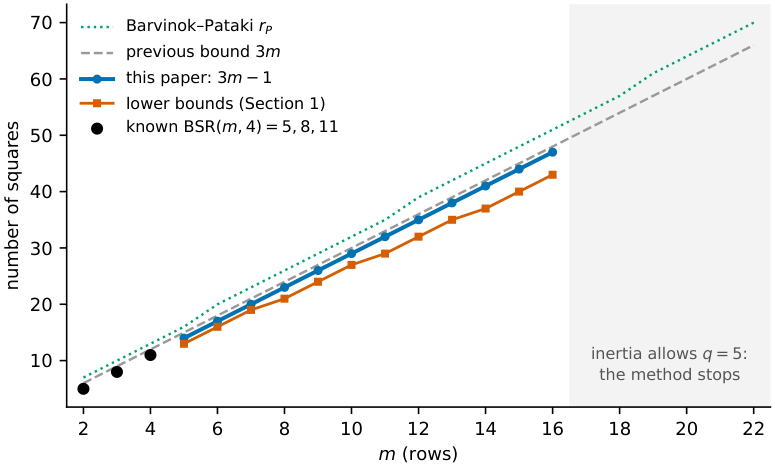
Bounds on \({\operatorname {BSR}}(m,4)\). Blue: Theorem 1; grey dashed: the previous bound \(3m\); vermilion: the lower bounds of the table; black: the known values \(5,8,11\) for \(m=2,3,4\), which the induction uses; green dotted: the Barvinok–Pataki rank \(r_P\). In the shaded range the inertia bound allows \(q=5\) and the method stops. The gap to the lower bound is \(1\) for \(m=5,6,7\) and grows to \(4\) at \(m=16\).
Method.
We follow the boundary strategy of Blekherman, Dunbar and Sinn [ 1 , § § 2–3 ] in the form of [ 3 , Proposition 3 ] , as in the case \({\operatorname {BSR}}(4,4)=11\) [ 4 ] ; a supporting functional at a boundary point of the sums of \(N\) squares is also Scheiderer’s tool for quaternary quartics [ 21 , § 4.6 ] . Section 2 sets up the boundary method and its algebraic lemmas at \(m=5\); Section 3 adds the boundary inertia inequality, the four-row isotropic lemma and the low-negative-index lemma, which prove the theorem for every \(5\le m\le 16\) with a uniform case analysis. Appendix A gives an alternative proof for \(m=5\) with a case analysis specific to \(5\times 4\); it shares the preliminaries of Section 2.
How the proof goes.
Put \(N=3m-1\) and let \(\Sigma _N\) be the set of sums of \(N\) squares. If \(\Sigma _N\) were not the whole cone \(\Sigma \), its boundary would meet the interior of \(\Sigma \). At a well-chosen boundary point \(F\) the supporting hyperplane gives a linear functional \(\ell \), and \(H(u,v)=\ell (uv)\) is a symmetric form on bilinear forms (a Hankel multiplier). Three facts about \(H\) drive everything: it kills every summand of every representation of \(F\), so \({\operatorname {rank}}H\le \dim V-N=m+1\); its image contains no product \(\alpha \otimes \beta \), because \(F\) has no complex singular point off the real locus (product-free); and it is indefinite, with a second-order sign condition along syzygies. The proof then lists the possible triples \((a,b,r)\) of row support, column support and rank of \(H\) and excludes each one: small row support by compression (most summands live on fewer rows, where induction applies), large row support by isotropic-row lemmas (rows of \(H\) cannot map into a totally isotropic space) and by counting the syzygies that the sign condition makes nonnegative. The boundary inertia inequality is the count that keeps the negative index \(q\) small enough for the isotropic lemmas we can prove.
The mechanism in three counts.
Three numbers decide where the method works, and why it stops where it does.
(a) The rank budget. The summands of a shortest representation span an \(N\)-dimensional space of bilinear forms killed by \(H\), so \({\operatorname {rank}}H\le \dim V-N=4m-(3m-1)=m+1\). At \(N=3m-1\) the multiplier is therefore small: its rank grows like \(m\), while \(V\) has dimension \(4m\), and its image, being product-free, has dimension at most \((a-1)(b-1)\) by Parthasarathy’s bound [ 7 ] .
(b) The room for negative directions. Indefiniteness forces one negative direction of \(H\); by Lemma 14 each further one costs \(N\) dimensions of syzygies, out of a room of \(M-\binom {N+2}{2}\). For \(m\times 4\) forms and \(N=3m-1\) this room is exactly \(m(m+7)/2\), so
which grows by one every six rows (the table below and Figure 3). The isotropic and low-negative-index lemmas handle \(q\le 4\), and \(\lfloor q_*\rfloor \le 4\) exactly for \(m\le 16\). This is where the theorem stops: the first failure, at \(m=17\), is that \(q=5\) becomes possible (remark (iii) below says what a version for \(q=5\) would need).
(c) The induction line. Compression puts all but at most \(4a-r\) summands on the \(m-a\) rows outside the row support, so \({\operatorname {SOS}}_{\mathbb R}(F)\le 4a-r+{\operatorname {BSR}}(m-a,4)\). With \(r\ge a+1\) this is at most \(3m-2{\lt}N\) precisely when \({\operatorname {BSR}}(k,4)\le 3k-1\) for \(k=m-a\). The known values \(5,8,11\) for \(k=2,3,4\) lie exactly on that line, so the induction closes; it cannot start from \(k=1\), since \({\operatorname {BSR}}(1,4)=4{\gt}2\). That is why the two largest row supports, \(a=m-1\) and \(a=m\), are excluded by the isotropic lemmas instead of compression (Figure 5).
|
\(m\) |
\(N=3m-1\) |
rank budget \(m+1\) |
room \(m(m+7)/2\) |
\(q_*\) |
\(\lfloor q_*\rfloor \) |
|
5 |
14 |
6 |
30 |
\(22/7\approx 3.14\) |
3 |
|
10 |
29 |
11 |
85 |
\(114/29\approx 3.93\) |
3 |
|
16 |
47 |
17 |
184 |
\(231/47\approx 4.91\) |
4 |
|
17 |
50 |
18 |
204 |
\(127/25=5.08\) |
5 |
|
22 |
65 |
23 |
319 |
\(384/65\approx 5.91\) |
5 |
|
23 |
68 |
24 |
345 |
\(413/68\approx 6.07\) |
6 |
Colour: blue shade = the number’s size within its column.
🖼️ Figure 2
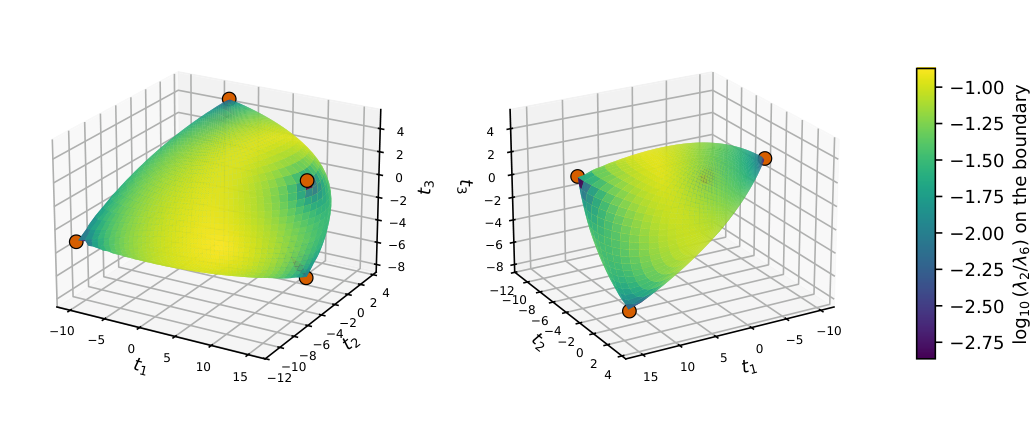
The Gram spectrahedron [ 27 ] of a \(2\times 3\) biquadratic sum of squares \(F=\sum _{k=1}^6\ell _k^2\) (integer coefficients, two views): the positive semidefinite \(6\times 6\) matrices \(G\) with \(F=v^tGv\), an affine three-dimensional family (\(21\) entries, \(18\) monomials). Representations of \(F\) by \(r\) squares are the points of rank \(r\). On the boundary the colour is \(\log _{10}(\lambda _2/\lambda _6)\). This is a numerical illustration in floating point: on all \(9800\) rays drawn the boundary point has one numerically zero eigenvalue (rank \(5\)), and a local search finds four numerically rank-four points (vermilion), at the corners; four is \({\operatorname {BSR}}(2,3)\). The form, the Gram directions and the search are in the supplementary script laboratorio.py. In this language Theorem 1 says that the Gram spectrahedron of every \(m\times 4\) sum of squares, \(5\le m\le 16\), contains a point of rank at most \(3m-1\).
What the proof rests on.
Besides the boundary strategy of [ 1 ] , the proof uses three earlier values: \({\operatorname {BSR}}(2,4)\le 5\) [ 2 , Theorem 1.1 ] , \({\operatorname {BSR}}(3,4)={\operatorname {BSR}}(4,3)\le 8\) [ 3 ] and \({\operatorname {BSR}}(4,4)\le 11\) [ 4 ] . These lie exactly on the line \(3k-1\) (\(5,8,11\) for \(k=2,3,4\)), which is why the induction on \(m\) closes: compression reduces to \({\operatorname {BSR}}(k,4)\) with \(k\ge 2\), and every such value is at most \(3k-1\). These three numbers are the only inputs taken from other papers. The two from our notes [ 3 , 4 ] are published with complete proofs and permanent identifiers; each note has a companion site that maps every statement to its proof and to the parts checked in Isabelle/HOL. The existence of a suitable boundary point (Proposition 10) follows the stratification argument of [ 1 , § 2 ] and [ 3 , Proposition 3 ] ; here it is proved in full through Lemma 9. The rest is proved here. The inertia inequality is, in substance, known (remark (i) below); the bound \({\operatorname {rank}}H\le (a-1)(b-1)\) is Parthasarathy’s (remark (ii)).
What is checked by machine.
The proof uses no numerical optimization or finite search. Its displayed computations C1–C12 (Section 2 and Appendix A) and the counts of Section 3 are of three kinds. The integer counts and evaluations (C5, C7, C9–C11, and the general-\(m\) counts: incidence \(M-2\), compression \(3m-2\), the ranks of the alternating maps) are rechecked by an exact script. Exact symbolic computation rechecks, in small dimensions: the step from (4) to (5) in C1 (Jacobi’s identity), C2 (the Schur coefficients), C4 (the polar map \(X\mapsto \frac12({\operatorname {tr}}X\, I+X^{t})\) and its rank \(16\)), and the scalar case of (L2), including the coefficient \(-5p^tA^2p\). The Schur formula (M1) of Lemma 18 is checked symbolically in dimension \(2\) and, in dimensions \(3\) and \(4\), at random rational points in exact arithmetic (a spot check, not a proof). The matrix case of (L2) is computed in the free algebra generated by the blocks, with an indefinite metric on \(W_0\), so it holds in every dimension; a wrong coefficient is rejected. It is also checked at exact points over \(\mathbb Q(i)\) of the relevant variety (dimensions \(3\) and \(4\) of \(W_0\)). The regular point C6, an explicit identity, is also confirmed by an exact rank computation. Formalized in Isabelle/HOL, each session without unproved steps (this says nothing about the links between these components, which are in the written proof), in six sessions of our public repository of formalizations (BoundaryInertia, BSRFourColumnsPieces, BSRFourColumnsLinear, BSRFourColumnsLinear2, BSRFourColumnsLinear3, BSRFourColumnsSmallRows): the three algebraic steps of Lemma 17 (the rank-one row observation, the evaluation step and the final contradiction, with the dimension counts and the common eigenvector of Lemma 15 as hypotheses); the arithmetic of the inertia inequality, its \(m\times 4\) form \(2(3m-1)(q-1)\le m(m+7)\) and its equivalence with \(6q\le m+13\) for \(m\ge 5\); the enumeration of the support triples for every \(m\ge 5\); the regular tuples of Lemma 21 for every \(m\); the kernel of the polar map (9); the factorization in Lemma 3; the polarization of symmetric trilinear, \(4\)-linear and \(5\)-linear forms; the \(2\times 2\) step of Lemma 16; the key step of Lemma 15; the last step of Lemma 4 (a binary form of positive degree has a zero); the averaging step of Lemma 11; the classification of linear spaces of matrices of rank at most one used in Lemma 7; and the support count. Three further sessions, not yet in the public repository, are in the supplementary material: the algebraic core of Lemma 6 (Jacobi’s identity turns (4) into (5), which gives \(K_{ij}=t_iu_j-t_ju_i\) for independent \(u_i\), and the bordered maps commute), computation C3 (the tensor \(p_i^t(A_j-t_jI)p_k\) vanishes and \(A_cP\subset P\) when \(P^\perp =P\)), and the two steps of computation C8 (single-wedge pairings give \(S\succeq 0\) and the radical statement for \(n\ge 3\); inertia subtraction for a diagonal metric \(\operatorname {diag}(I_p,-I_q)\)); the reduction of \(J^{\oplus n}\) to that diagonal form and the remaining steps of Lemma 11 stay in the text. Four more sessions, also in the supplementary material, cover (the last two items share one session):
the arithmetic of Corollary 2, with the cited inputs as hypotheses;
the trace inequality behind Proposition 23;
the algebraic core of Lemma 18: the unperturbed coefficients and the induction over the moments, with the word analysis of the Neumann expansion as a hypothesis;
every polarization and positivity step of Lemma 19;
the polarization steps, the rank-two case and the integer counts of Lemma 20. Its Schur coefficients (L2) remain an exact computation.
Everything else (the identity C12 and the remaining arguments of Lemmas 5, 6, 7, 25, 11, 17 and 20) is proved in the text only. Scripts and theory files are in the supplementary material. These formal components check individual steps; they are not a machine-checked proof of Theorem 1 as a whole. Table 1 lists them, at revision 28dfc47 of the repository.
|
Session |
Main statements |
Used in |
|
BoundaryInertia |
inertia_pataki_form, inertia_m4, inertia_m4_floor, q_values; incidence, compression_count, psi_counts |
Lemma 14, remark (i); counts of Section 3 |
|
BSRFourColumnsPieces |
support_triples_m4, regular_point_m4, cross_product_identity |
|
|
BSRFourColumnsLinear |
rank5_polar_kernel, singular_2x2_space, symmetric_trilinear_polarization |
(9), Lemma 16 |
|
BSRFourColumnsLinear2 |
line_decomposable, rank_one_sum_minor, common_line_step_kernel, common_line_step_image, pencil_core |
|
|
BSRFourColumnsLinear3 |
symmetric_4linear_polarization, symmetric_5linear_polarization; positive_averaging_nonneg, diagonal_terms_vanish; rank_le_one_space_full, support_count_inequality |
|
|
BSRFourColumnsSmallRows |
row_rank_one_simple, evaluation_step, row_in_line, small_rows_contradiction |
Lemma 17 |
Four remarks.
(i) The inertia inequality reads \(N(q-1)\le M-\binom {N+2}{2}\) with \(M=\dim R_2\). It is, in substance, Theorem 3.4 of Boumal, Voroninski and Bandeira [ 8 ] (a bound on the number of negative eigenvalues of the dual multiplier at second-order critical points of the Burer–Monteiro factorization), applied at a boundary point of \(\Sigma _N\), where the boundary multiplier satisfies the second-order conditions described by Blekherman, Sinn, Velasco and Zhang [ 10 ] ; Lemma 14 gives the self-contained proof we need, without a constant-rank assumption. Since the multiplier is indefinite, \(q\ge 1\), and for \(q=1\) it says that a boundary of \(\Sigma _N\) inside the cone exists only if \(\binom {N+2}{2}\le M\), that is, only if \(N+1\le r_P\) for the Barvinok–Pataki rank \(r_P=\max \{ r:\binom {r+1}{2}\le M\} \) of extreme Gram matrices; so it recovers the Barvinok–Pataki bound \(\Sigma _N=\Sigma \) for \(N\ge r_P\); for the full set of bilinear monomials this is also the bound of Choi, Lam and Reznick for sums of squares with prescribed monomials [ 22 ] , and for \(m\times 4\) it exceeds \(3m-1\) by \(2\) to \(4\) when \(5\le m\le 16\), so it does not give Theorem 1. Each further negative direction costs \(N\) dimensions. For \(m\times 4\) forms (\(N=3m-1\), \(M=5m(m+1)\)) the bound is \(q\le \lfloor (m^2+13m-2)/(6m-2)\rfloor =\lfloor (m+13)/6\rfloor \) for \(m\ge 5\), since the difference of the two fractions is \((m+7)/(6(3m-1)){\lt}1/6\). Thus the admissible negative index grows by one every six values of \(m\); to go further one needs the low-negative-index lemma for larger \(q\) (see (iii)). (ii) The image of a Hankel multiplier is product-free exactly when it is a completely entangled subspace of \({\mathbb C}^a\otimes {\mathbb C}^b\) in the sense of quantum information; the bound \({\operatorname {rank}}H\le (a-1)(b-1)\) used below is Parthasarathy’s maximal dimension of such a subspace [ 7 ] . (iii) Where the method stops, and why four columns. At \(m=17\) the inertia bound allows \(q=5\). The low-negative-index lemma (Lemma 20) needs \(q\le 4\): its proof maps several rows into a totally isotropic space of dimension at most four, excludes this with the small-row lemma (Lemma 17), which we prove for at most four rows, and uses Lemma 19, which needs negative index at most three on a hyperplane. A version for \(q=5\) (which needs at least a five-row small-row lemma, an invariant-plane lemma for negative index four, and the new cases of the \((k,h)\) table) would carry the theorem to \(m\le 22\), since \(\lfloor (m+13)/6\rfloor \le 5\) exactly for \(m\le 22\). More generally, in the \(m\times n\) setting the Barvinok–Pataki bound gives \({\operatorname {BSR}}(m,n)\le r_P\le \sqrt{n(n+1)/2}\, m+O(1)\). The known values \({\operatorname {BSR}}(m,2)=m+1\) (the upper bound from [ 2 , Theorem 1.1 ] ; see [ 13 ] for the known exact values) and \({\operatorname {BSR}}(m,3)=2m\) [ 3 ] , and the bound \(3m-1\) here, grow with slope \(n-1\) (for \(n=4\) this is the progression of [ 13 ] , who caution that the linear pattern may hold only for small grids); since \((n-1)^2{\gt}n(n+1)/2\) exactly when \(n\ge 5\), slope \(n-1\) cannot persist beyond four columns, and four columns is the last width where it fits under the Pataki slope (\(3{\lt}\sqrt{10}\)). For \(N=cm\) the inertia inequality asks for roughly \(q\approx \frac{n(n+1)-2c^2}{4c}\, m\) negative directions, which is \(m/6\) for \((n,c)=(4,3)\) but \(m/2\) for \((n,c)=(3,2)\): this is why the boundary-inertia route suits four columns, while \({\operatorname {BSR}}(m,3)=2m\) needed a different argument. We do not know the slope of \({\operatorname {BSR}}(m,n)\) for \(n\ge 5\). (iv) Two observations for going beyond \(m=16\). First, the proof of Lemma 14 gives more than (I): it bounds the kernel of multiplication on \(W\otimes K\) by \(N\dim K-\dim (WK)\) and only then uses \(\dim (WK)\ge \binom {N+1}2\). Keeping \(\dim (WK)\) gives \(Nq\le M-1-\dim (WK)\), that is, \(N(q-1)\le M-\binom {N+2}2-\delta \) with \(\delta =\dim (WK)-\binom {N+1}2\ge 0\). For \(m=17\) (\(N=50\), \(M=1530\)) this reads \(50q\le 254-\delta \), so \(q\le 4\) as soon as \(\delta \ge 5\); the case \(q=5\) needs \(\delta \le 4\), and \(\delta =0\) when \(K=W\). Second, a five-dimensional version of Lemma 16 cannot hold without using flatness: a five-dimensional subspace \(S\subset \Lambda ^2{\mathbb C}^4\) of skew-symmetric matrices contains no matrix of rank one, yet every evaluation \(A\mapsto Ab\) has image in \(b^\perp \) and so rank at most \(3{\lt}\dim S-1\). Any extension of the method to \(q=5\) must use the Hankel identities, not only the absence of simple tensors.
🖼️ Figure 3
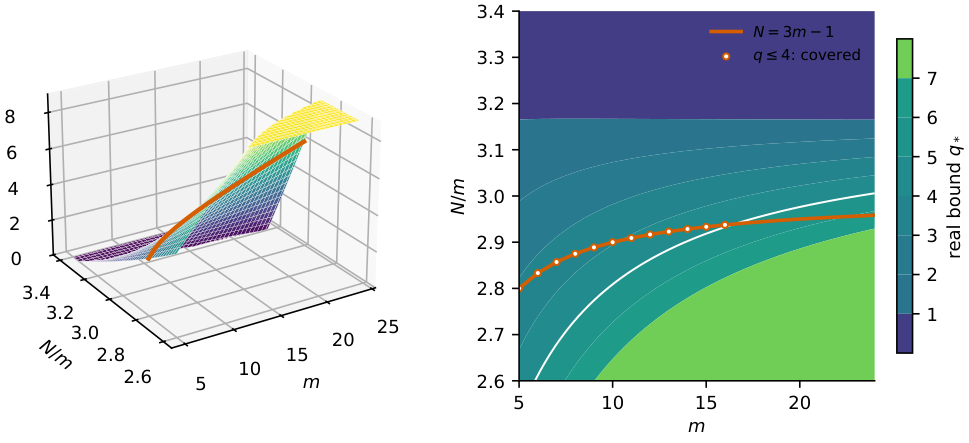
The boundary inertia inequality for \(m\times 4\) forms: the real bound \(q_*=1+\bigl(5m(m+1)-\binom {N+2}{2}\bigr)/N\), so that the negative index (an integer) satisfies \(q\le \lfloor q_*\rfloor \), as a function of \(m\) and \(N/m\) (left, surface; right, its level sets). Along \(N=3m-1\) (vermilion) \(q_*=22/7\approx 3.14\) at \(m=5\), \(231/47\approx 4.91\) at \(m=16\) and \(127/25=5.08\) at \(m=17\), so \(\lfloor q_*\rfloor \le 4\) exactly for \(5\le m\le 16\) (white dots), the range of Theorem 1; the white curve is \(q_*=5\).
2 The boundary method at \(m=5\)
Put \(A={\mathbb R}^5\), \(B={\mathbb R}^4\), \(V=A\otimes B\), and
Thus \(\dim V=20\) and \(\dim R_2=150\). Write \(\Sigma _k={\operatorname {im}}\Phi _k\), \(\Sigma =\bigcup _k\Sigma _k\). For \(F\in \Sigma \), the least \(k\) with \(F\in \Sigma _k\) is \({\operatorname {SOS}}_{{\mathbb R}}(F)\); \({\operatorname {BSR}}(m,n)\) is the largest real SOS length in size \(m\times n\). We use \({\operatorname {BSR}}(2,4)\le 5\). By [ 2 , Theorem 1.1 ] , if \(X\subset \mathbb P^N\) is a nondegenerate irreducible variety of minimal degree with Zariski-dense real points, every quadratic form nonnegative on \(X\) is a sum of \(\dim X+1\) squares in \({\mathbb R}[X]\). Biquadratic forms in \(2+4\) variables are the quadratic forms on the Segre variety \(\mathbb P^1\times \mathbb P^3\subset \mathbb P^7\), which has dimension \(4\) and degree \(4=\operatorname {codim}+1\) (minimal), and a biquadratic sum of squares is nonnegative on it; hence it is a sum of \(5\) squares of linear forms on the Segre variety, i.e. of bilinear forms.
A Hankel multiplier is a symmetric bilinear form \(H\) on \(V\) with
Such forms are precisely the functionals on \(R_2\), evaluated on products of bilinear forms. The first radical consists of the \(x\) such that \(H(x\otimes B,V)=0\); the first support is its codimension. Define the second radical and second support in the other factor. The image of \(H:V\to V^*\) is called product-free if its complexification contains no nonzero decomposable covector.
For the next algebraic lemmas all spaces are over \({\mathbb C}\). Factor a rank-\(r\) multiplier as
where \(J\) is nondegenerate symmetric. Set \(T_bx=T(x\otimes b)\); write \(\langle \, ,\, \rangle \) for \(J\). Condition (H) becomes
BSR_m4_Linear2.line_decomposable, BSR_m4_Linear2.line_decomposable_nonzero If \(x\ne 0\) and \(T_cx=\beta (c)e\) for all \(c\), with \(\beta \ne 0\), \(e\ne 0\), then \({\operatorname {im}}(T^*J)\) contains a nonzero decomposable covector.
Isabelle · ours · partshow
Only a part is in Isabelle: the factorization (the paper lists «the factorization in Lemma 2» among the formal components)
line_decomposable · Isabelle/BSRFourColumnsLinear2/BSR_m4_Linear2.thy, line 27
theorem line_decomposable:
  fixes J :: "'e::ab_group_add \<Rightarrow> 'e \<Rightarrow> 'k::field"
    and sm :: "'k \<Rightarrow> 'e \<Rightarrow> 'e"
    and T :: "'c \<Rightarrow> 'a \<Rightarrow> 'e" and beta :: "'c \<Rightarrow> 'k"
  assumes Jsm: "\<And>a u w. J (sm a u) w = a * J u w"
    and sm1: "\<And>u. sm 1 u = u"
    and flat: "\<And>b c x y. J (T b x) (T c y) = J (T c x) (T b y)"
    and Tx: "\<And>c. T c x = sm (beta c) e"
    and bd: "beta d = 1"
  shows "J e (T c y) = beta c * J e (T d y)"
line_decomposable_nonzero · Isabelle/BSRFourColumnsLinear2/BSR_m4_Linear2.thy, line 49
corollary line_decomposable_nonzero:
  fixes J :: "'e::ab_group_add \<Rightarrow> 'e \<Rightarrow> 'k::field"
    and sm :: "'k \<Rightarrow> 'e \<Rightarrow> 'e"
    and T :: "'c \<Rightarrow> 'a \<Rightarrow> 'e" and beta :: "'c \<Rightarrow> 'k"
  assumes "\<And>a u w. J (sm a u) w = a * J u w" "\<And>u. sm 1 u = u"
    and "\<And>b c x y. J (T b x) (T c y) = J (T c x) (T b y)"
    and "\<And>c. T c x = sm (beta c) e" "beta d = 1" and "J e (T d y0) \<noteq> 0"
  shows "\<exists>phi. (\<forall>c y. J e (T c y) = beta c * phi y) \<and> phi y0 \<noteq> 0"
Trust base: 🔒 kernel only — only part of the statement is formal (see the box). Isabelle: 2 results, no oracles
Proof: in this note·Formalized: Isabelle/HOL, by the author (public formalizations repository)·Covers: part: the factorization (the paper lists «the factorization in Lemma 2» among the formal components)
Choose \(d\) with \(\beta (d)=1\). Equation (F) gives \(\langle e,T_cy\rangle =\beta (c)\langle e,T_dy\rangle \). This is decomposable and nonzero, because \(T\) is onto.
Choose a generic \(b\) where \(s={\operatorname {rank}}T_b\) is maximal, and put \(U={\operatorname {im}}T_b\), \(Q(b)=T_b^*JT_b\). The linear terms of the bordered \((s+1)\)-minors of \(T_b+\tau T_c\) give \(T_c(\ker T_b)\subset U\). Equation (F) also gives orthogonality to \(U\). Thus
If the first radical is zero and the image is product-free, then, for every nonzero \(x\in \ker T_b\),
Indeed, dimension zero is excluded by the first radical and dimension one by Lemma 3. Moreover \(Q\) is not identically zero: otherwise separate polarization of \(H(x\otimes b,x\otimes b)=0\), using (H), gives \(H=0\). Therefore at generic \(b\),
BSR_m4_Linear2.binform_dehomog, BSR_m4_Linear2.pencil_core Let \(G_1,G_2:B\to S^*\) have the property that every nonzero linear combination \(G_\lambda \) is onto. If \(F:B\to S\) and \(F^*G_1,F^*G_2\) are symmetric, then \(F=0\).
Isabelle · ours · partshow
Only a part is in Isabelle: the last step: a binary form of positive degree has a zero (the paper, «What is checked by machine»)
binform_dehomog · Isabelle/BSRFourColumnsLinear2/BSR_m4_Linear2.thy, line 193
lemma binform_dehomog:
  "binform a q s 1 = poly (\<Sum>i\<le>q. monom (a i) i) s"
pencil_core · Isabelle/BSRFourColumnsLinear2/BSR_m4_Linear2.thy, line 197
theorem pencil_core:
  assumes q: "q > 0"
  shows "\<exists>s t. (s \<noteq> 0 \<or> t \<noteq> 0) \<and> binform a q s t = 0"
Trust base: 🔒 kernel only — only part of the statement is formal (see the box). Isabelle: 2 results, no oracles
Proof: in this note·Formalized: Isabelle/HOL, by the author (public formalizations repository)·Covers: part: the last step: a binary form of positive degree has a zero (the paper, «What is checked by machine»)
↳ Used in: Lemma 5
If \(k={\operatorname {rank}}F{\gt}0\), then \(F^*G_\lambda \) has rank \(k\). Symmetry gives \(F^*G_\lambda =G_\lambda ^*F\), so its kernel equals \(\ker F\). It induces a nondegenerate symmetric form on \(B/\ker F\) for every \([\lambda ]\in \mathbb P^1\). Its determinant is a homogeneous polynomial of positive degree \(k\) having no zero on \(\mathbb P^1\), impossible over \({\mathbb C}\).
BSR_m4_Pieces.cross_product_identity_real, BSR_m4_Pieces.isotropic_C4, BSR_m4_Pieces.isotropic_C4_independent Assume \(T\) is onto, the first radical is zero, and its dual image is product-free. There is no nonzero \(D\subset A\) for which \(S=T(D\otimes B)\) is totally isotropic and \(\dim (A/D)\le 2\).
Isabelle · ours · partshow
Only a part is in Isabelle: the named pieces; the remaining arguments of the lemma are proved in the text only (the paper, «What is checked by machine»)
cross_product_identity_real · Isabelle/BSRFourColumnsPieces/BSR_m4_Pieces.thy, line 496
corollary cross_product_identity_real:
  fixes G :: "nat \<Rightarrow> nat \<Rightarrow> real" and d :: "nat \<Rightarrow> real"
  assumes "i < 3" "j < 3"
  shows "(\<Sum>k<3. crossm d i k * G k j) + (\<Sum>k<3. G k i * crossm d k j) = crossm (trmul G d) i j"
isotropic_C4 · Isabelle/BSRFourColumnsPieces/BSR_m4_Pieces.thy, line 517
lemma isotropic_C4:
  "bf4 (\<lambda>k. s * v1 k + t * v2 k) (\<lambda>k. u * v1 k + w * v2 k) = 0"
isotropic_C4_independent · Isabelle/BSRFourColumnsPieces/BSR_m4_Pieces.thy, line 521
lemma isotropic_C4_independent:
  assumes "\<forall>k. s * v1 k + t * v2 k = 0"
  shows "s = 0 \<and> t = 0"
Trust base: 🔒 kernel only — only part of the statement is formal (see the box). Isabelle: 3 results, no oracles
Proof: in this note·Formalized: Isabelle/HOL, by the author (public formalizations repository)·Covers: part: the named pieces; the remaining arguments of the lemma are proved in the text only (the paper, «What is checked by machine»)
↳ Used in: Theorem 25
The injective map \(z\mapsto T^*Jz\), for \(z\in S\), takes values in \((A/D)^*\otimes B^*\). If the quotient has dimension zero, then \(S=0\); if it has dimension one, every nonzero image is decomposable. Both possibilities are excluded. For quotient dimension two choose lifts \(a_1,a_2\), and define
If \(G_\lambda \) were not onto, a nonzero \(z\in S\) annihilating its image would make the two rows of \(T^*Jz\) dependent. This would give a nonzero decomposable covector. Hence every \(G_\lambda \) is onto. For \(d\in D\), put \(F_d(b)=T(d\otimes b)\in S\). Equation (F) says \(F_d^*G_i\) is symmetric. Lemma 4 gives \(F_d=0\) for every \(d\), contradicting the zero first radical.
BSR_m4_Nonsingular.jacobi_gives_5, BSR_m4_Nonsingular.five_gives_K, BSR_m4_Nonsingular.bordered_commute, BSR_m4_Nonsingular.nonsingular_slice_core Let \(\dim A=d\ge 3\), \(\dim B=4\). A rank-\((d+1)\) multiplier with supports \((d,4)\) and an invertible \(Q(b)\) cannot have product-free image.
Isabelle · ours · partshow
Only a part is in Isabelle: the algebraic core (Jacobi turns (4) into (5), the form of K, the bordered maps commute); the reduction to that core is in the text
jacobi_gives_5 · Isabelle/BSRFourColumnsNonsingular/BSR_m4_Nonsingular.thy, line 167
theorem jacobi_gives_5:
  fixes A1 A2 A3 :: "'a::comm_ring_1^'n^'n" and u1 u2 u3 :: "'a^'n"
  assumes s1: "transpose A1 = A1" and s2: "transpose A2 = A2" and s3: "transpose A3 = A3"
    and c12: "comm A1 A2 = outer u2 u1 - outer u1 u2"
    and c23: "comm A2 A3 = outer u3 u2 - outer u2 u3"
    and c31: "comm A3 A1 = outer u1 u3 - outer u3 u1"
  shows "symp (A1 *v u2 - A2 *v u1) u3 + symp (A2 *v u3 - A3 *v u2) u1 + symp (A3 *v u1 - A1 *v u3) u2 = 0"
five_gives_K · Isabelle/BSRFourColumnsNonsingular/BSR_m4_Nonsingular.thy, line 272
theorem five_gives_K:
  fixes K12 K23 K31 u1 u2 u3 :: "'a::field^'n"
  assumes two: "(2::'a) \<noteq> 0"
    and ind: "\<forall>a b c. a *s u1 + b *s u2 + c *s u3 = 0 \<longrightarrow> a = 0 \<and> b = 0 \<and> c = 0"
    and five: "symp K12 u3 + symp K23 u1 + symp K31 u2 = 0"
  shows "\<exists>t1 t2 t3. K12 = t1 *s u2 - t2 *s u1 \<and> K23 = t2 *s u3 - t3 *s u2 \<and> K31 = t3 *s u1 - t1 *s u3"
bordered_commute · Isabelle/BSRFourColumnsNonsingular/BSR_m4_Nonsingular.thy, line 396
theorem bordered_commute:
  fixes Ai Aj :: "'a::comm_ring_1^'n^'n" and ui uj :: "'a^'n" and ti tj :: 'a
  assumes si: "transpose Ai = Ai" and sj: "transpose Aj = Aj"
    and cij: "comm Ai Aj = outer uj ui - outer ui uj"
    and kij: "Ai *v uj - Aj *v ui = ti *s uj - tj *s ui"
  shows "bord Ai ui ti \<circ> bord Aj uj tj = bord Aj uj tj \<circ> bord Ai ui ti"
nonsingular_slice_core · Isabelle/BSRFourColumnsNonsingular/BSR_m4_Nonsingular.thy, line 429
theorem nonsingular_slice_core:
  fixes A1 A2 A3 :: "'a::field^'n^'n" and u1 u2 u3 :: "'a^'n"
  assumes two: "(2::'a) \<noteq> 0"
    and s1: "transpose A1 = A1" and s2: "transpose A2 = A2" and s3: "transpose A3 = A3"
    and c12: "comm A1 A2 = outer u2 u1 - outer u1 u2"
    and c23: "comm A2 A3 = outer u3 u2 - outer u2 u3"
    and c31: "comm A3 A1 = outer u1 u3 - outer u3 u1"
    and ind: "\<forall>a b c. a *s u1 + b *s u2 + c *s u3 = 0 \<longrightarrow> a = 0 \<and> b = 0 \<and> c = 0"
  shows "\<exists>t1 t2 t3. bord A1 u1 t1 \<circ> bord A2 u2 t2 = bord A2 u2 t2 \<circ> bord A1 u1 t1
                  \<and> bord A2 u2 t2 \<circ> bord A3 u3 t3 = bord A3 u3 t3 \<circ> bord A2 u2 t2
                  \<and> bord A3 u3 t3 \<circ> bord A1 u1 t1 = bord A1 u1 t1 \<circ> bord A3 u3 t3"
Trust base: 🔒 kernel only — only part of the statement is formal (see the box). Isabelle: 4 results, no oracles
Proof: in this note·Formalized: Isabelle/HOL, by the author (public formalizations repository)·Covers: part: the algebraic core (Jacobi turns (4) into (5), the form of K, the bordered maps commute); the reduction to that core is in the text
↳ Used in: Lemma 20, Theorem 25, Lemma 27
Take \(E={\mathbb C}^d\perp {\mathbb C}\), \(J=I\), and \(T_bx=(x,0)\). For a complementary basis \(c_1,c_2,c_3\) write
Flatness gives the following exact identities, denoted computation \(\mathrm{C1}\):
Put \(K_{ij}=A_iu_j-A_ju_i\), \(v\odot w=vw^t+wv^t\). Substituting (4) into Jacobi’s identity gives
If the \(u_i\) span zero dimensions, \(T\) is not onto. If they span a line, the last coordinate of \(T\) is a nonzero decomposable covector.
If their span has dimension two, change the complementary basis so that \(u_3=0\) and \(u_1,u_2\) are independent. Equation (4) makes \(A_3\) commute with \(A_1,A_2\). Comparing coefficients of (5) in a basis beginning with \(u_1,u_2\) gives \(A_3u_1=tu_1,\ A_3u_2=tu_2\) for some \(t\). Put \(P={\operatorname {im}}(A_3-tI)\). This space is invariant under every \(A_i\) and is orthogonal to \(u_1,u_2\). It is nonzero: otherwise \(T_{c_3-tb}=0\), contradicting full second support. Equation (4) shows that the restricted operators commute on \(P\). A common eigenvector \(x\in P\setminus \{ 0\} \) then satisfies \(T_cx\in {\mathbb C}(x,0)\) for every \(c\), contrary to Lemma 3.
If \(u_1,u_2,u_3\) are independent, equation (5) implies
for scalars \(t_i\). To see this, complete the three \(u_i\) to a basis. Coefficients involving the additional basis vectors first remove those components of \(K_{ij}\). Coefficients of \(u_i^2\) and \(u_i u_j\) give the displayed expression. Consequently
are commuting symmetric matrices, by (4). Choose a common eigenvector \(z\ne 0\), with eigenvalues \(\lambda _i\). Since \(T_i=\widehat A_iT_b\), \(\langle z,T_ix\rangle =\lambda _i\langle z,T_bx\rangle \). Thus \(T^*Jz\) is decomposable; it is nonzero because \(T\) is onto. This is the final contradiction.
BSR_m4_Linear3.rank_le_one_space_full, BSR_m4_Linear3.two_rank_one_contra, BSR_m4_Linear2.rank_one_pair_not_in_rank_le_one_space If the symmetric polynomial matrix \(Q(b)\) has homogeneous quadratic entries and generic rank one, then
Here either \(L\) is independent of \(b\), and the first support is one, or \(g\) is constant and \(L\) is bilinear.
Isabelle · ours · partshow
Only a part is in Isabelle: the classification of linear spaces of matrices of rank at most one; the remaining arguments are proved in the text only
rank_le_one_space_full · Isabelle/BSRFourColumnsLinear3/BSR_m4_Linear3.thy, line 428
theorem rank_le_one_space_full:
  fixes S :: "(nat \<Rightarrow> nat \<Rightarrow> 'a::field) set"
  assumes n: "0 < n" and k: "0 < k"
    and add: "\<And>A B. A \<in> S \<Longrightarrow> B \<in> S \<Longrightarrow> (\<lambda>i l. A i l + B i l) \<in> S"
    and mz: "\<And>M. M \<in> S \<Longrightarrow> minors_zero M n k"
  shows "(\<exists>u. (\<exists>i<n. u i \<noteq> 0) \<and> (\<forall>M\<in>S. \<exists>\<phi>. \<forall>i<n. \<forall>l<k. M i l = u i * \<phi> l))
       \<or> (\<exists>a. (\<exists>l<k. a l \<noteq> 0) \<and> (\<forall>M\<in>S. \<exists>\<psi>. \<forall>i<n. \<forall>l<k. M i l = \<psi> i * a l))"
two_rank_one_contra · Isabelle/BSRFourColumnsLinear3/BSR_m4_Linear3.thy, line 389
lemma two_rank_one_contra:
  fixes M N :: "nat \<Rightarrow> nat \<Rightarrow> 'a::field" and u v :: "nat \<Rightarrow> 'a" and a b :: "nat \<Rightarrow> 'a"
  assumes add: "\<And>A B. A \<in> S \<Longrightarrow> B \<in> S \<Longrightarrow> (\<lambda>i l. A i l + B i l) \<in> S"
    and mz: "\<And>A. A \<in> S \<Longrightarrow> minors_zero A n k"
    and MS: "M \<in> S" and NS: "N \<in> S"
    and rM: "\<And>i l. i < n \<Longrightarrow> l < k \<Longrightarrow> M i l = u i * a l"
    and rN: "\<And>i l. i < n \<Longrightarrow> l < k \<Longrightarrow> N i l = v i * b l"
    and indu: "\<not> dep n u v" and indb: "\<not> dep k a b"
  shows False
rank_one_pair_not_in_rank_le_one_space · Isabelle/BSRFourColumnsLinear2/BSR_m4_Linear2.thy, line 104
corollary rank_one_pair_not_in_rank_le_one_space:
  fixes u v :: "nat \<Rightarrow> 'a::idom" and a b :: "nat \<Rightarrow> 'a"
  assumes "\<exists>i<n. \<exists>j<n. u i * v j \<noteq> u j * v i" "\<exists>l<k. \<exists>m<k. a l * b m \<noteq> a m * b l"
    and add: "\<And>M N. M \<in> S \<Longrightarrow> N \<in> S \<Longrightarrow> (\<lambda>i l. M i l + N i l) \<in> S"
    and "(\<lambda>i l. u i * a l) \<in> S" "(\<lambda>i l. v i * b l) \<in> S"
    and "\<And>M. M \<in> S \<Longrightarrow> minors_zero M n k"
  shows False
Trust base: 🔒 kernel only — only part of the statement is formal (see the box). Isabelle: 3 results, no oracles
↳ Used in: Theorem 25, Lemma 26, Lemma 27
Over the fraction field \({\mathbb C}(b)\), a symmetric rank-one matrix gives a scalar times the square of a linear form in \(x\). Clear denominators and make that linear form primitive over the UFD \({\mathbb C}[b]\). Gauss’s lemma makes the scalar a polynomial. Bihomogeneity permits \(L\) to be chosen homogeneous in \(b\); if its degree is \(e\), then \(\deg g+2e=2\), so \(e=0\) or \(1\). If \(e=0\), write \(L(x)=\lambda ^tx\). Separate polarization of \(q(x,b)=x^tQ(b)x=g(b)(\lambda ^tx)^2\) in both factors gives
with \(G\) the polar form of \(g\); hence every \(x\) with \(\lambda ^tx=0\) lies in the first radical, and the first support is at most one.
We now work over \({\mathbb R}\).
BSR_m4_Pieces.regular_point_m4 The differential \(d\Phi _{14}\) is onto at
Isabelle · ours · partshow
Only a part is in Isabelle: the regular tuple; the paper also confirms it by an exact rank computation (C6)
regular_point_m4 · Isabelle/BSRFourColumnsPieces/BSR_m4_Pieces.thy, line 381
theorem regular_point_m4:
  fixes H :: "nat \<Rightarrow> nat \<Rightarrow> nat \<Rightarrow> nat \<Rightarrow> real" and n :: nat
  assumes sym: "\<And>a b c d. a < 5 + n \<Longrightarrow> b < 4 \<Longrightarrow> c < 5 + n \<Longrightarrow> d < 4 \<Longrightarrow> H a b c d = H c d a b"
    and hankel: "\<And>a b c d. a < 5 + n \<Longrightarrow> b < 4 \<Longrightarrow> c < 5 + n \<Longrightarrow> d < 4 \<Longrightarrow> H a b c d = H a d c b"
    and ann: "\<forall>h \<in> S n. \<forall>c < 5 + n. \<forall>d < 4. av (5 + n) H h c d = 0"
  shows "\<forall>a < 5 + n. \<forall>b < 4. \<forall>c < 5 + n. \<forall>d < 4. H a b c d = 0"
↳ Used in: Proposition 10
Suppose a Hankel multiplier kills every element of \(S\). The last four elements make \(x_5\) a first-radical vector. The first ten span the symmetric tensors in the remaining identified \(4\times 4\) factors. For any \(x,y\) in these factors,
The first equality uses a symmetric tensor in the kernel; the second uses (H); the last uses \(x\otimes x\) in the kernel. Separate polarization gives \(H=0\). Thus the annihilator of \(S\cdot V\) is zero and \(S\cdot V=R_2\), proving surjectivity. This explicit identity, not a numerical rank test, is computation \(\mathrm{C6}\).
Let \(\Omega \subset \mathbb R^d\) be a connected open semialgebraic set, let \(K\subset \mathbb R^d\) be a closed semialgebraic set with \(\Omega \cap \operatorname {int}K\ne \varnothing \) and \(\Omega \not\subset K\), and let \(Z\subset \mathbb R^d\) be semialgebraic with \(\dim Z\le d-2\). Then there are a point \(F\in \Omega \cap \partial K\) with \(F\notin Z\), an open ball \(U\ni F\) and a \(C^\infty \) function \(g\) on \(U\) with \(g(F)=0\), \(dg_F\ne 0\) and \(K\cap U=\{ g\ge 0\} \).
↳ Used in: Proposition 10, Theorem 22
Put \(K'=\overline{\operatorname {int}K}\subset K\). Then \(\Omega \cap \operatorname {int}K'\ne \varnothing \), and \(\Omega \not\subset K'\) because \(K'\subset K\). A semialgebraic set \(E\subset \Omega \) with \(\dim E\le d-2\) does not disconnect \(\Omega \): two points of \(\Omega \setminus E\) are joined by a polygonal path in \(\Omega \), and the pairs of points whose segment meets \(E\) form a set of dimension at most \((d-2)+1+d{\lt}2d\), so the vertices can be moved off it. Since \(\Omega \cap \operatorname {int}K'\) and \(\Omega \setminus K'\) are disjoint, open and nonempty, the frontier \(\Omega \cap \partial K'\) therefore has dimension \(d-1\). Take a \(C^\infty \) semialgebraic Whitney stratification of \(\mathbb R^d\) compatible with \(K\), \(K'\) and \(Z\); it satisfies the frontier condition. Let \(S\) be a stratum of dimension \(d-1\) in \(\Omega \cap \partial K'\). The closure of another stratum meets \(S\) only if it has dimension \(d\), so the union \(Y\) of the closures of the strata of dimension at most \(d-1\) other than \(S\), together with the closure \(\overline Z\) (semialgebraic, with \(\dim \overline Z=\dim Z\le d-2\)), is closed and meets \(S\) in a set of dimension at most \(d-2\). Choose \(F\in S\setminus Y\) and a ball \(U\ni F\) disjoint from \(Y\) in which \(S\) is a connected hypersurface \(\{ g=0\} \) with \(dg\ne 0\). Each of the two components of \(U\setminus S\) is covered by open strata of dimension \(d\), hence lies in one of them, and so lies either in \(\operatorname {int}K\) or outside \(K\). If both lay in \(K\), \(F\) would be interior to \(K'\); if both lay outside \(K\), then \(\operatorname {int}K'\cap U\subset S\) would be empty, contradicting \(F\in \overline{\operatorname {int}K'}\). So one side lies in \(\operatorname {int}K\) and the other outside \(K\), and after changing the sign of \(g\), \(K\cap U=\{ g\ge 0\} \) (\(S\subset K\) since \(K\) is closed). Finally \(F\in \partial K\), and \(F\notin Z\).
🖼️ Figure 4
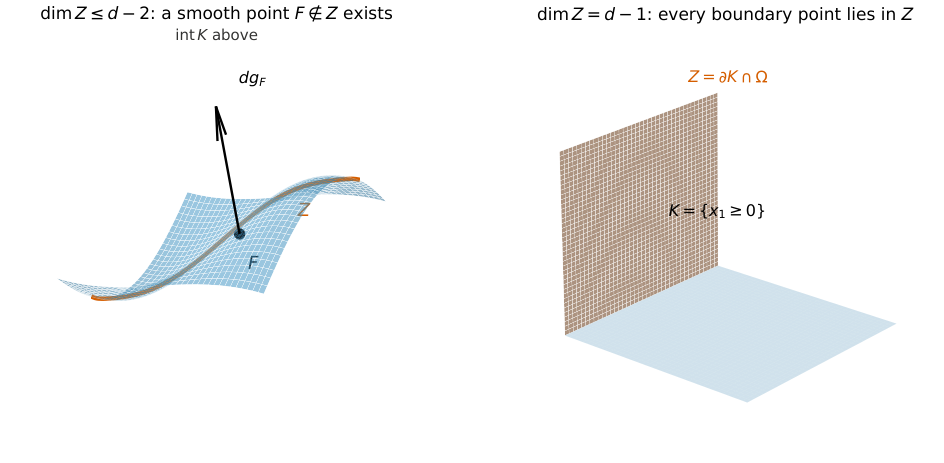
Lemma 9 in \(d=3\) (schematic). Left: \(\dim Z\le d-2\), a curve on the boundary; off it there is a smooth boundary point \(F\) with \(dg_F\ne 0\) and \(K\) on one side. Right: \(\dim Z=d-1\) is not enough: with \(K=\{ x_1\ge 0\} \) and \(Z=\partial K\cap \Omega \) every boundary point lies in \(Z\).
Boundary_Inertia_Arith.incidence If \(\Sigma _{14}\ne \Sigma \), there exist \(F\in \operatorname {int}\Sigma \cap \partial \Sigma _{14}\) and a nonzero indefinite real Hankel multiplier \(H\) with the following properties. The real SOS length of \(F\) is fourteen. For every representation \(F=\sum _{i=1}^{14}h_i^2\), the forms \(h_i\) are independent, their span \(W\) lies in \(\ker H\), and the complex annihilator of \(W\) contains no nonzero simple tensor. In particular \(r={\operatorname {rank}}H\le 6\) and its image is product-free. For every syzygy \(\sum _i h_iD_i=0\),
Isabelle · ours · partshow
Only a part is in Isabelle: the incidence count of the m×4 form (M − 2(m+3) + (2m+4) = M − 2); the rest is a written proof
incidence · Isabelle/BoundaryInertia/Boundary_Inertia_Arith.thy, line 82
lemma incidence: fixes M m :: int shows "M - 2*(m+3) + 2*((m-1)+3) = M - 2" by simp
lemma compression_count: fixes a m :: int shows "(4*a - (a+1)) + (3*(m-a) - 1) = 3*m - 2" by simp
lemma psi_counts: fixes m :: int shows "4*(m+1) - (m-1) = 3*m + 5" "4*m - (m-1) = 3*m + 1" by simp_all
🆕 Classical and new: the paper: the existence of a suitable boundary point follows the stratification argument of [BDS, §2] and [Mar3, Proposition 3]; here it is proved in full through Lemma 12.
↳ Used in: Theorem 1, Theorem 22, Proposition 23
Each \(\Sigma _k\) is semialgebraic, as a polynomial image, and is closed. To prove closedness, let \(\tau (F)\) be the sum of the coefficients of all \(x_i^2y_j^2\). If \(h_\nu =\sum _{ij}c_{\nu ij}x_i y_j\), then
For a convergent sequence of outputs the representing tuples are bounded, and a convergent subsequence proves closedness. A PSD Gram on \(V\) has rank at most twenty, so \(\Sigma =\Sigma _{20}\). Its interior is nonempty, since the positive definite Grams form an open set and the linear multiplication map onto \(R_2\) is surjective. Lemma 8 gives \(\Sigma _{14}\) nonempty interior.
Put \(\Omega =\operatorname {int}\Sigma \). It is open and convex. If \(\Sigma _{14}\) is proper in \(\Sigma \), its complement in \(\Omega \) is nonempty; otherwise closedness and \(\overline\Omega =\Sigma \) would give equality. Lemma 9, applied to \(\Omega \), \(K=\Sigma _{14}\) and the singular incidence below as \(Z\), gives a point of \(\partial \Sigma _{14}\cap \Omega \) off \(Z\) with a local defining function \(g\), \(\Sigma _{14}=\{ g\ge 0\} \) near it.
Consider a complex point of \(\mathbb P^4\times \mathbb P^3\) with neither projective factor real. It and its conjugate are distinct in both factors. Complex changes of coordinates put them at \((e_1,e_1)\), \((e_2,e_2)\). Each first jet of a \((2,2)\)-form has \(1+4+3=8\) coefficients. At the first point they are coefficients of
The eight coefficients at the second point are disjoint from these. Therefore the joint complex jet map has rank sixteen. Conjugation exchanges the two jets, so imposing them on real forms has real codimension sixteen. The point moves in real dimension \(2(4+3)=14\). Written in real and imaginary coordinates, the singular incidence, including the conditions that neither factor is real, is semialgebraic, so its projection to forms is semialgebraic by Tarski–Seidenberg. The singular incidence, and hence its projection to forms, has real dimension at most
These jet coordinates and the count are computation \(\mathrm{C7}\). A singular point with a real factor is impossible for an interior SOS form: fixing that nonzero real factor gives a positive definite real quadratic form in the other factor, whose complex gradient has no nonzero kernel. This incidence is the set \(Z\) used above, and \(F\) is the point given by Lemma 9.
Let \(g\) be the function of Lemma 9, nonnegative on \(\Sigma _{14}\) near \(F\), and \(\ell =dg_F\ne 0\). For every tuple \(h\) representing \(F\), the function \(g\circ \Phi _{14}\) has a local minimum at \(h\). Its first derivative gives \(H(h_i,v)=0\) for every \(i,v\), where \(H(u,v)=\ell (uv)\). For a syzygy \(D\), \(d\Phi _{14}(D)=0\); hence its second derivative gives (11). This uses the same \(g,\ell ,H\) at every representing tuple.
We have \(\ell (F)=0\). Since \(F\in \operatorname {int}\Sigma \), the nonzero functional \(\ell \) can be neither nonnegative nor nonpositive on \(\Sigma \). Equivalently, \(H\) is indefinite. If \(F\) had at most thirteen squares, pad that representation with a zero slot. Applying (11) to a variation only in that slot would give \(H(v,v)\ge 0\) for all \(v\), a contradiction. Thus its length is fourteen. A linear dependence among fourteen summands could be removed by an orthogonal change of summand coordinates, producing a zero slot. The summands are therefore independent, and \(W\subset \ker H\) gives \(r\le 20-14=6\). Finally, a simple covector in \(W^\perp \) gives a Segre point where every \(h_i\) vanishes; \(F=\sum h_i^2\) and all its first derivatives vanish there. This contradicts the choice of \(F\). Since \({\operatorname {im}}H\subset W^\perp \), its image is product-free.
From here on the boundary multiplier \(H\) is real. Over \({\mathbb R}\) it factors as \(H=T^{\mathsf T}JT\) with \(T\) onto a real space \(E\) of dimension \(r={\operatorname {rank}}H\) and \(J\) a real nondegenerate symmetric form of signature \((p,q)\), \(p+q=r\); \(H\) indefinite means \(p,q\ge 1\).
BSR_m4_Linear3.positive_averaging_nonneg, BSR_m4_Linear3.diagonal_terms_vanish, Boundary_Inertia_Arith.psi_counts, BSR_m4_C8.wedge_pair_nonneg, BSR_m4_C8.S_nonneg, BSR_m4_C8.S_zero_radical, BSR_m4_C8.inertia_subtraction Suppose a radical slice \(x_0\otimes L\), with \(x_0\) in the first radical, \(L\subseteq B\) and \(\dim L=n\ge 3\), lies in a boundary span \(W\). Let \(A'\) be a complement of the first radical, of dimension \(a\), and restrict \(H\) to \(A'\otimes L\). Assume that \(T:A'\otimes L\to E\) is onto, that the restriction has zero first radical in \(A'\), and that it has full second support on \(L\). Choose orthogonal summand coordinates so that \(h_i=x_0\otimes y_i\), \(1\le i\le n\), where \(y_i\) is a basis of \(L\). Put \(T_i a=T(a\otimes y_i)\), \(H_{ij}=T_i^*JT_j\), and \(S=\sum _iH_{ii}\). For the alternating map
if \(p\) is the positive index of \(J\), then
Isabelle · ours · partshow
Only a part is in Isabelle: the averaging step, the counts of Ψ and the two steps of computation C8 (single-wedge pairings give S ⪰ 0 and the radical statement; inertia subtraction for a diagonal metric); the reduction of the metric to diagonal form and the rest are proved in the text
positive_averaging_nonneg · Isabelle/BSRFourColumnsLinear3/BSR_m4_Linear3.thy, line 301
theorem positive_averaging_nonneg:
  fixes h :: "nat \<Rightarrow> real"
  assumes n2: "2 \<le> n" and pairs: "\<And>i j. i < j \<Longrightarrow> j < n \<Longrightarrow> 0 \<le> h i + h j"
  shows "0 \<le> (\<Sum>i<n. h i)"
diagonal_terms_vanish · Isabelle/BSRFourColumnsLinear3/BSR_m4_Linear3.thy, line 316
theorem diagonal_terms_vanish:
  fixes h :: "nat \<Rightarrow> 'k::field_char_0"
  assumes n3: "3 \<le> n" and pairs: "\<And>i j. i < n \<Longrightarrow> j < n \<Longrightarrow> i \<noteq> j \<Longrightarrow> h i + h j = 0" and i: "i < n"
  shows "h i = 0"
psi_counts · Isabelle/BoundaryInertia/Boundary_Inertia_Arith.thy, line 84
lemma psi_counts: fixes m :: int shows "4*(m+1) - (m-1) = 3*m + 5" "4*m - (m-1) = 3*m + 1" by simp_all
wedge_pair_nonneg · Isabelle/BSRFourColumnsC8/BSR_m4_C8.thy, line 189
theorem wedge_pair_nonneg:
  assumes "i \<noteq> j"
  shows "H i i a a + H j j a a \<ge> 0"
S_nonneg · Isabelle/BSRFourColumnsC8/BSR_m4_C8.thy, line 199
theorem S_nonneg:
  assumes "2 \<le> CARD('i)"
  shows "S a a \<ge> 0"
S_zero_radical · Isabelle/BSRFourColumnsC8/BSR_m4_C8.thy, line 218
theorem S_zero_radical:
  assumes n3: "3 \<le> CARD('i)" and S0: "S a a = 0"
  shows "H i j a b = 0"
inertia_subtraction · Isabelle/BSRFourColumnsC8/BSR_m4_C8.thy, line 274
theorem inertia_subtraction:
  fixes L M :: "((real^'p::finite) \<times> (real^'q::finite)) set"
  assumes "subspace L" and "subspace M"
    and Lnn: "\<And>l. l \<in> L \<Longrightarrow> Jd l l \<ge> 0"
    and Mpd: "\<And>m. m \<in> M \<Longrightarrow> m \<noteq> 0 \<Longrightarrow> Jd m m > 0"
    and orth: "\<And>l m. l \<in> L \<Longrightarrow> m \<in> M \<Longrightarrow> Jd l m = 0"
  shows "dim L + dim M \<le> CARD('p)"
↳ Used in: Theorem 1, Theorem 22
The change of summand coordinates exists because the map \({\mathbb R}^{14}\to W\), sending coordinate vectors to the independent summands, is an isomorphism. Choose an orthonormal basis of the preimage of the fiber, then extend it orthogonally. The variations
are syzygies by antisymmetry. Thus \(J^{\oplus n}\) is nonnegative on \(L_\Psi ={\operatorname {im}}\Psi \).
A single \((i,j)\)-wedge with coefficient \(a\in A'\) gives \(H_{ii}(a,a)+H_{jj}(a,a)\ge 0\). Summing all pairs gives \((n-1)S(a,a)\ge 0\). If \(S(a,a)=0\), every one of these wedge images is null in \(L_\Psi \), hence orthogonal to all of \(L_\Psi \). Pairing its \((i,j)\)-wedge with the \((i,k)\)-wedge of any \(b\), for three distinct indices, gives \(H_{jk}(a,b)=0\). Pairing equal wedges gives \(H_{ii}(a,b)+H_{jj}(a,b)=0\). As \(n\ge 3\), all diagonal terms also vanish. Therefore \(a\) belongs to the first radical of the restriction. Effective support gives \(a=0\), proving \(S\succ 0\).
For \(a\in A'\), set \(C_a=(T_ia)_i\). Flatness makes \(C_a\) orthogonal to \(L_\Psi \), and
These natural annihilator vectors span an \(a\)-dimensional positive definite space \(M\). The nondegenerate space \(M^\perp \) has positive index \(np-a\). It contains the nonnegative space \(L_\Psi \), whose dimension cannot exceed that positive index. This proves (13). The single-wedge pairings and inertia subtraction are computation \(\mathrm{C8}\).
Boundary_Inertia_Arith.psi_counts The annihilator of \({\operatorname {im}}\Psi \), with respect to \(J^{\oplus n}\), consists exactly of the maps \(C:L\to E\) satisfying
It contains the \(a\)-dimensional space \(C_a=T(a\otimes \cdot )\). Assume that \(L=B\), or that \(B=L\oplus L'\) with \(L'\) contained in the second radical of \(H\) (one of the two holds in every application below). Any additional independent map extends \(T\) by one first-factor row, preserving rank, flatness, product-freeness, and full second support, and increasing first support by one.
Isabelle · ours · partshow
Only a part is in Isabelle: the counts of Ψ used with it; the lemma is proved in the text
psi_counts · Isabelle/BoundaryInertia/Boundary_Inertia_Arith.thy, line 84
lemma psi_counts: fixes m :: int shows "4*(m+1) - (m-1) = 3*m + 5" "4*m - (m-1) = 3*m + 1" by simp_all
↳ Used in: Theorem 1, Theorem 22
Pair an arbitrary tuple \((Cy_i)_i\) with each single-wedge image. Its vanishing is exactly (14). The natural maps satisfy (14) by flatness, and they are independent by zero first radical. Define the new row of \(T'\) to be \(C\). Equation (14) is the cross-flatness condition with each old row; the self-pairing condition holds because \(J\) is symmetric. The map remains onto the same \(E\). A first-radical relation involving the new row would express \(C\) as a natural map, and an old second-radical relation remains excluded by the old full second support.
If \(T'^*Jz\) were a nonzero simple covector, its restriction to the old tensor space \(A'\otimes L\) would be either a simple covector or zero. A simple covector \(\alpha \otimes \lambda \) on \(A'\otimes L\) pulls back along the projection \(A\otimes B\to A'\otimes L\) (kernel \(x_0\otimes B+A\otimes L'\), for a complement \(B=L\oplus L'\) inside the second radical when \(L\neq B\)) to a simple covector of \(V^*\) lying in \({\operatorname {im}}H\); this is excluded because \({\operatorname {im}}H\) is product-free. In the latter case \(z\) is orthogonal to the old surjective image \(E\), hence \(z=0\), also impossible. This argument uses one additional map; it requires no mutual compatibility between different additional maps.
Boundary_Inertia_Arith.compression_count For the boundary form \(F\), if \(H\) has first support \(a\) and rank \(r\), then
Isabelle · ours · partshow
Only a part is in Isabelle: the m×4 count (4a − (a+1)) + (3(m − a) − 1) = 3m − 2; the lemma is proved in the text
compression_count · Isabelle/BoundaryInertia/Boundary_Inertia_Arith.thy, line 83
lemma compression_count: fixes a m :: int shows "(4*a - (a+1)) + (3*(m-a) - 1) = 3*m - 2" by simp
lemma psi_counts: fixes m :: int shows "4*(m+1) - (m-1) = 3*m + 5" "4*m - (m-1) = 3*m + 1" by simp_all
↳ Used in: Theorem 1, Theorem 22
Choose \(A=A'\oplus A_0\), where \(A_0\) is the first radical. The projections to \(A'\otimes B\) of the fourteen summands lie in the kernel of the restricted multiplier, of dimension \(4a-r\). An orthogonal change of summand coordinates therefore makes at most \(4a-r\) summands have nonzero \(A'\)-projection. All remaining summands lie in \(A_0\otimes B\). Replace their sum of squares by a representation using at most \({\operatorname {BSR}}(5-a,4)\) squares.
3 Larger \(m\)
From five rows to \(m\) rows.
Proposition 10, Lemmas 11, 12 and 13, and the algebraic Lemmas 3–7 extend to \(m\times 4\) biquadratic forms after the following modifications, with \(14\) replaced by \(N=3m-1\), \(\dim V=20\) by \(4m\), \(\dim R_2=150\) by \(M=5m(m+1)\), the bound \(r\le 6\) by \(r\le 4m-N=m+1\), and \({\operatorname {BSR}}(5-a,4)\) by \({\operatorname {BSR}}(m-a,4)\). The algebraic lemmas are stated for tensor spaces \(A\otimes B\) of any dimension, under structural hypotheses (flatness, surjectivity of \(T\), zero radicals, product-freeness) that do not involve \(m\). The proofs of Proposition 10 and of Lemmas 11–13 use the numbers above only through the counts displayed in Section 2, which are recomputed for general \(m\) below. The regular point is supplied by Lemma 21, and the singular-point incidence count by the proof of Theorem 22. Lemmas 26, 27 and Theorem 25, which are specific to \(5\times 4\) (Appendix A), are not transported; for larger \(m\) their role is played by the support bound below and by the low-negative-index lemma. Throughout, effective supports \((a,b)\) means the first and second supports of \(H\) (codimensions of the two radicals). Theorem 22 below is Theorem 1, now proved for all \(5\le m\le 16\).
3.1 The boundary inertia inequality
Boundary_Inertia_Arith.inertia_pataki_form, Boundary_Inertia_Arith.inertia_q1_is_pataki, Boundary_Inertia_Arith.inertia_m4, Boundary_Inertia_Arith.inertia_m4_floor Let \(V\) be a finite-dimensional real vector space of forms, and let \(R_2\) be the span of their products. Put
Let \(\Sigma \) be the full sum-of-squares cone.
Suppose \(F\in \Sigma _N\cap \operatorname {int}\Sigma \) admits a \(C^2\) local defining function \(g\) with
Define
Then
Isabelle · ours · partshow
Only a part is in Isabelle: the arithmetic: the two forms of the inequality, its case q = 1, the m×4 form 2(3m−1)(q−1) ≤ m(m+7) and its equivalence with 6q ≤ m + 13 for m ≥ 5; the inequality itself is a written proof
inertia_pataki_form · Isabelle/BoundaryInertia/Boundary_Inertia_Arith.thy, line 19
lemma inertia_pataki_form:
  fixes N q M :: int
  shows "2*N*q \<le> 2*M - 2 - N*(N+1) \<longleftrightarrow> 2*N*(q-1) + (N+2)*(N+1) \<le> 2*M"
inertia_q1_is_pataki · Isabelle/BoundaryInertia/Boundary_Inertia_Arith.thy, line 25
lemma inertia_q1_is_pataki:
  fixes N M :: int
  shows "2*N*(1-1) + (N+2)*(N+1) \<le> 2*M \<longleftrightarrow> (N+2)*(N+1) \<le> 2*M"
inertia_m4 · Isabelle/BoundaryInertia/Boundary_Inertia_Arith.thy, line 36
lemma inertia_m4:
  fixes m q :: int
  shows "2*(3*m-1)*(q-1) + (3*m+1)*(3*m) \<le> 2*(5*m*(m+1)) \<longleftrightarrow> 2*(3*m-1)*(q-1) \<le> m*(m+7)"
inertia_m4_floor · Isabelle/BoundaryInertia/Boundary_Inertia_Arith.thy, line 70
lemma inertia_m4_floor:
  fixes m q :: int
  assumes "m \<ge> 5"
  shows "2*(3*m-1)*(q-1) \<le> m*(m+7) \<longleftrightarrow> 6*q \<le> m + 13"
🆕 Classical and new: the paper, remark (i): «in substance, Theorem 3.4 of Boumal, Voroninski and Bandeira [BVB]», applied at a boundary point of Σ_N where the second-order conditions of [BSVZ] hold; the lemma gives the self-contained proof needed, without a constant-rank assumption; its case q = 1 recovers the Barvinok–Pataki bound.
↳ Used in: Theorem 22
For every representing tuple \(F=\Phi _N(h)\), the function \(g\circ \Phi _N\) has a local minimum at \(h\). Its first derivative gives
Its second derivative along a syzygy \(\sum _i h_iD_i=0\) gives
The Hessian term of \(g\) vanishes because \(d\Phi _N(D)=0\). The same \(g\) and multiplier apply at every representing tuple.
The multiplier is nonzero because products span \(R_2\). Also \(dg_F(F)=\sum _iH(h_i,h_i)=0\). Since \(F\) is interior to \(\Sigma \), a nonzero linear functional vanishing at \(F\) cannot be nonnegative or nonpositive on all of \(\Sigma \). Thus \(H\) is indefinite.
If \(F\) had length below \(N\), pad a shorter representation with a zero slot. In (I1), vary only that slot. This would force \(H\) to be positive semidefinite, a contradiction. Therefore \(F\) has minimum length \(N\). Every representing \(N\)-tuple is linearly independent, since an orthogonal change of summands would otherwise produce a zero slot.
Put
Then \(\dim W=N\) and \(W\subset K\). Multiplication \(\operatorname {Sym}^2W\to R_2\) is injective: a nonzero symmetric relation matrix \(R\) would make \(I+tR\) a Gram matrix for the same form. Moving to a singular positive semidefinite endpoint would express \(F\) with at most \(N-1\) squares.
Consider the entire syzygy space
The nonzero functional \(dg_F\) annihilates the multiplication image, so
Project \(\mathcal Z\) to \(W\otimes E\) using \(\operatorname {id}_W\otimes T\). The kernel is precisely the kernel of multiplication on \(W\otimes K\). The multiplication image of \(W\otimes K\) contains the independent products \(\operatorname {Sym}^2W\). Hence this projection kernel has dimension at most
Writing \(r=p+q\) and \(\dim K=v-r\), the projected syzygy space consequently has dimension at least
By (I1), this projected space is nonnegative for \(J^{\oplus N}\). Since that form is nondegenerate and has positive index \(Np\), the space has dimension at most \(Np\). Therefore
Substituting \(r=p+q\) gives (I).
💡 In plain words (commentary, not part of the paper)
Take a point \(F\) of the sums of \(N\) squares that lies inside the cone and where they have a one-sided \(C^2\) defining function \(g\) (\(g(F)=0\), \(dg_F\ne 0\), \(g\ge 0\) on \(\Sigma _N\) near \(F\)): a boundary point. The differential gives a symmetric form \(H(u,w)=dg_F(uw)\) on the forms. The lemma bounds its negative index \(q\) (with the orientation fixed by the second-order condition): \(Nq\le M-1-\binom {N+1}2\), equivalently \(N(q-1)\le M-\binom {N+2}2\), with \(M=\dim R_2\).
Why it is true: every representation \(F=\sum h_i^2\) is a local minimum of \(g\circ \Phi _N\), so \(H\) kills the summands and is nonnegative, summed over the \(N\) slots, along every syzygy \(\sum _ih_iD_i=0\). There are at least \(Nv-M+1\) independent syzygies; after projecting through \(T\) at least \(Nr+\binom {N+1}2-M+1\) of them survive, and a space on which \(J^{\oplus N}\) is nonnegative has dimension at most \(Np\). Writing \(r=p+q\) gives the inequality. Each negative direction beyond the first costs \(N\) dimensions of syzygies.
For \(q=1\) it says that the sums of \(N\) squares have a boundary inside the cone only if \(\binom {N+2}2\le M\): the Barvinok–Pataki bound. For \(m\times 4\) forms and \(N=3m-1\) the room \(M-\binom {N+2}2\) is exactly \(m(m+7)/2\), and the bound becomes \(q\le \lfloor (m+13)/6\rfloor \) for \(m\ge 5\): \(3\) for \(m=5,\dots ,10\), \(4\) for \(m=11,\dots ,16\), \(5\) at \(m=17\) (the Isabelle lemma q_values).
Origin, as the paper states it: the inequality is, in substance, Theorem 3.4 of Boumal, Voroninski and Bandeira (a bound on the negative eigenvalues of the dual multiplier at second-order critical points of the Burer–Monteiro factorization), applied at a boundary point; the lemma gives the self-contained proof the paper needs, without a constant-rank assumption.
🛡️ Evidence & scope
Program: Figure 3 recomputed: q_* in exact fractions (22/7, 114/29, 231/47, 127/25, 384/65, 413/68), the room m(m+7)/2, ⌊q_*⌋ ≤ 4 exactly for 5 ≤ m ≤ 16 and ⌊q_*⌋ = ⌊(m+13)/6⌋ up to m = 200, with controls that must fail. lab/comprueba_lab.py
🧪 Lab: Figure 3 live: the real bound q_* over (m, N/m), and exactly along the line N you choose
The inequality \(N(q-1)\le M-\binom {N+2}2\), \(M=5m(m+1)\), bounds the negative index by \(\lfloor q_*\rfloor \) with \(q_*=1+(M-\binom {N+2}2)/N\). The lab computes \(q_*\) in exact fractions along the line \(N=\mathrm{round}(c\, m+d)\) you choose (\(c=3\), \(d=-1\) is the paper’s \(N=3m-1\)) and says where \(\lfloor q_*\rfloor \le 4\), what the low-negative-index lemma covers. The first plot shows the level curves \(q_*=k\) in the \((m,N/m)\) plane (the positive roots of \(N^2+(2k+1)N+2-2M=0\)) with your line, the second \(q_*\) along it, and the 3D view the surface \(q_*(m,N/m)\) coloured by \(\lfloor q_*\rfloor \), with the curve \(q_*=5\) in white.
Orientation and inertia.
At the chosen one-sided boundary point \(F\), let \(g\) be a \(C^2\) local defining function satisfying
Set
Throughout the argument, \(q\) denotes the negative index of this oriented multiplier. The orientation is fixed by
Replacing \(H\) by \(-H\) reverses this inequality. In particular, \(q\) is not defined as the smaller of the two inertia indices.
3.2 The four-row isotropic lemma
BSR_m4_Linear2.common_line_step_kernel, BSR_m4_Linear2.common_line_step_image, BSR_m4_Linear3.symmetric_4linear_polarization, BSR_m4_Linear3.symmetric_5linear_polarization Let \(\mathcal C\) be a family of endomorphisms of a finite-dimensional complex vector space \(S\). Suppose that a fixed subspace \(K\subset S\), of dimension at most one, satisfies
Then \(\mathcal C\) is simultaneously triangularizable.
Isabelle · ours · partshow
Only a part is in Isabelle: the key step (the kernel and image cases); the induction is in the text
common_line_step_kernel · Isabelle/BSRFourColumnsLinear2/BSR_m4_Linear2.thy, line 122
theorem common_line_step_kernel:
  fixes X Y :: "'v::ab_group_add \<Rightarrow> 'v" and sm :: "'k::field \<Rightarrow> 'v \<Rightarrow> 'v" and k :: 'v
  assumes addX: "\<And>u w. X (u + w) = X u + X w"
    and smX: "\<And>c u. X (sm c u) = sm c (X u)"
    and sm0: "\<And>u. sm 0 u = 0"
    and sm1: "\<And>u. sm 1 u = u"
    and smmul: "\<And>c d u. sm c (sm d u) = sm (c * d) u"
    and Y0: "Y 0 = 0"
    and comm: "\<And>w. \<exists>c. X (Y w) - Y (X w) = sm c k"
    and v: "X v = 0" and nz: "X (Y v) \<noteq> 0"
  shows "\<exists>m. X m = k"
common_line_step_image · Isabelle/BSRFourColumnsLinear2/BSR_m4_Linear2.thy, line 148
theorem common_line_step_image:
  fixes X Z :: "'v::ab_group_add \<Rightarrow> 'v" and sm :: "'k::field \<Rightarrow> 'v \<Rightarrow> 'v" and k :: 'v
  assumes addX: "\<And>u w. X (u + w) = X u + X w"
    and subX: "\<And>u w. X (u - w) = X u - X w"
    and smX: "\<And>c u. X (sm c u) = sm c (X u)"
    and comm: "\<And>w. \<exists>c. X (Z w) - Z (X w) = sm c k"
    and kim: "X m = k"
  shows "Z (X w) \<in> range X"
symmetric_4linear_polarization · Isabelle/BSRFourColumnsLinear3/BSR_m4_Linear3.thy, line 143
theorem symmetric_4linear_polarization:
  fixes B :: "'v::ab_group_add \<Rightarrow> 'v \<Rightarrow> 'v \<Rightarrow> 'v \<Rightarrow> 'k::field_char_0"
  assumes add1: "\<And>x x' y z w. B (x + x') y z w = B x y z w + B x' y z w"
    and s12: "\<And>x y z w. B x y z w = B y x z w"
    and s23: "\<And>x y z w. B x y z w = B x z y w"
    and s34: "\<And>x y z w. B x y z w = B x y w z"
    and diag: "\<And>x. B x x x x = 0"
  shows "B x y z w = 0"
symmetric_5linear_polarization · Isabelle/BSRFourColumnsLinear3/BSR_m4_Linear3.thy, line 205
theorem symmetric_5linear_polarization:
  fixes B :: "'v::ab_group_add \<Rightarrow> 'v \<Rightarrow> 'v \<Rightarrow> 'v \<Rightarrow> 'v \<Rightarrow> 'k::field_char_0"
  assumes add1: "\<And>x x' y z w v. B (x + x') y z w v = B x y z w v + B x' y z w v"
    and s12: "\<And>x y z w v. B x y z w v = B y x z w v"
    and s23: "\<And>x y z w v. B x y z w v = B x z y w v"
    and s34: "\<And>x y z w v. B x y z w v = B x y w z v"
    and s45: "\<And>x y z w v. B x y z w v = B x y z v w"
    and diag: "\<And>x. B x x x x x = 0"
  shows "B x y z w v = 0"
↳ Used in: Lemma 17
Induct on \(\dim S\). If every member is scalar, there is nothing to prove. Otherwise subtract an eigenvalue from a nonscalar member to obtain a nonzero singular operator \(X\).
If \(\ker X\) is invariant under the entire family, it is a nonzero proper common invariant subspace. Otherwise choose \(Y\in \mathcal C\) and \(v\in \ker X\) with \(XYv\ne 0\). Then
Thus \(K\subset \operatorname {im}X\), and for every \(Z\in \mathcal C\),
Hence \(\operatorname {im}X\) is a common proper invariant subspace.
On a resulting common invariant subspace \(U\), restricted commutators have image in \(K\cap U\); on the quotient their images lie in \((K+U)/U\). Both have dimension at most one. Apply induction to \(U\) and \(S/U\).
Lemma 15 is a special case of a theorem of Omladič, Radjavi and Šivic [ 16 , Theorem 6 ] : a linear space of complex matrices whose commutators all have rank at most one is simultaneously triangularizable. Here the linear span of \(\mathcal C\) has all its commutators with image in \(K\), hence of rank at most one. Their theorem extends Laffey’s on semigroups [ 17 ] . We keep the short proof to make the paper self-contained.
BSR_m4_Linear.singular_2x2_space, BSR_m4_Linear.singular_2x2_space_complex Let
be injective, with no nonzero rank-one tensor in its image. Write \(G_b(s)=\varphi (s)(b)\) and \(s=\dim S\). If \(2\le s\le 3\), some \(G_b\) has rank at least \(s-1\), without a restriction on \(\dim B\). The same conclusion holds for \(s=4\) when \(\dim B\le 4\).
Isabelle · ours · partshow
Only a part is in Isabelle: the 2×2 step (a linear space of singular 2×2 matrices has a common kernel or image); the rest is in the text
singular_2x2_space · Isabelle/BSRFourColumnsLinear/BSR_m4_Linear.thy, line 165
theorem singular_2x2_space:
  fixes S :: "('a::field \<times> 'a \<times> 'a \<times> 'a) set"
  assumes sing: "\<And>a b c d. (a,b,c,d) \<in> S \<Longrightarrow> a * d = b * c"
    and add: "\<And>a b c d a' b' c' d'. (a,b,c,d) \<in> S \<Longrightarrow> (a',b',c',d') \<in> S \<Longrightarrow> (a+a',b+b',c+c',d+d') \<in> S"
  shows "common_kernel S \<or> common_image S"
singular_2x2_space_complex · Isabelle/BSRFourColumnsLinear/BSR_m4_Linear.thy, line 347
corollary singular_2x2_space_complex:
  fixes S :: "(complex \<times> complex \<times> complex \<times> complex) set"
  assumes "\<And>a b c d. (a,b,c,d) \<in> S \<Longrightarrow> a * d = b * c"
    and "\<And>a b c d a' b' c' d'. (a,b,c,d) \<in> S \<Longrightarrow> (a',b',c',d') \<in> S \<Longrightarrow> (a+a',b+b',c+c',d+d') \<in> S"
  shows "common_kernel S \<or> common_image S"
🆕 Classical and new: the paper: the step on spaces of rank-at-most-one maps is the classical description [Fla, AL]; its last step is [Drn, Lemma 1.8].
↳ Used in: Lemma 17
For \(s=2\), the assertion follows from injectivity. For \(s=3\), suppose all \(G_b\) have rank at most one. A linear space of rank-at-most-one maps has a common image line or a common kernel hyperplane: two rank-one maps whose image lines and covector lines are both independent have a rank-two sum (this is the classical description of spaces of matrices of rank at most one [ 18 , 19 ] ; the last step is [ 20 , Lemma 1.8 ] ). A common kernel contradicts injectivity; a common image line makes each nonzero \(\varphi (s)\) rank one.
Now let \(s=4\). Padding \(B\) with zero coordinates permits \(\dim B=4\). Maximum rank at most one is excluded as above. Suppose the maximum is two. Choose bases with
The Schur complement of \(G_{b_0}+tG_b\) vanishes. Its first three coefficients give
If some \(B_b\) is invertible, polarization gives \(C_c=0\) for every \(c\). All evaluation images then lie in a fixed two-plane. A four-dimensional subspace of \(\mathbb C^2\otimes (\mathbb C^4)^*\) contains a rank-one tensor: write its two rows as maps \(R_1,R_2:S\to (\mathbb C^4)^*\). If \(R_1\) is singular, use a nonzero vector in its kernel; otherwise use an eigenvector of \(R_1^{-1}R_2\).
Thus every \(B_b\) is singular. A linear space of singular \(2\times 2\) matrices has a common kernel or a common image. To see this, normalize one rank-one member to \(E_{11}\). Every other member has the form \(\left(\begin{smallmatrix} a & b \\ c & 0 \end{smallmatrix}\right)\), and \(bc=0\) identically on the linear space.
A common kernel of the \(B_b\) gives a common kernel of all \(G_b\), impossible. Hence \(B_b=u\beta _b\) for a fixed \(u\ne 0\). The identity \(C_bB_b=0\) gives \(C_bu=0\) for all \(b\). If all \(C_b\) vanish, use the fixed-two-plane argument. Otherwise \(\ker C_b=\mathbb Cu\) generically, and \(C_bA_bB_b=0\) gives \(A_bu\in \mathbb Cu\), first generically and then identically. Thus \(G_b(u,0)\) always lies in a fixed line. The nonzero tensor \(\varphi (u,0)\) has rank one, a final contradiction.
BSR_m4_Small_Rows.row_rank_one_simple, BSR_m4_Small_Rows.evaluation_step, BSR_m4_Small_Rows.row_in_line, BSR_m4_Small_Rows.small_rows_contradiction Let \(T:A\otimes B\to E\) be a surjective complex linear map to a nondegenerate symmetric space. Assume flatness, zero first radical, and that \(T^*J(E)\) contains no nonzero simple tensor.
There is no \(d\)-dimensional subspace \(D\subset A\) with
when \(d=2\) or \(3\). There is also no such subspace for \(d=4\) if \(\dim B\le 4\).
In particular, the three-row and four-row isotropic lemmas hold.
Isabelle · ours · partshow
Only a part is in Isabelle: the three algebraic steps (the rank-one row observation, the evaluation step and the final contradiction), with the dimension counts and the common eigenvector of Lemma 18 as hypotheses
row_rank_one_simple · Isabelle/BSRFourColumnsSmallRows/BSR_m4_Small_Rows.thy, line 30
theorem row_rank_one_simple:
  fixes J :: "'e \<Rightarrow> 'e \<Rightarrow> 'k::field"
    and sm :: "'k \<Rightarrow> 'e \<Rightarrow> 'e"
    and T :: "'a \<Rightarrow> 'b \<Rightarrow> 'e" and lam :: "'b \<Rightarrow> 'k"
  assumes Jsm: "\<And>t u w. J (sm t u) w = t * J u w"
    and flat: "\<And>x y b c. J (T x b) (T y c) = J (T x c) (T y b)"
    and row: "\<And>b. T a b = sm (lam b) e"
    and b0: "lam b0 \<noteq> 0"
  shows "\<exists>alpha mu. \<forall>c d. J e (T c d) = alpha c * mu d"
evaluation_step · Isabelle/BSRFourColumnsSmallRows/BSR_m4_Small_Rows.thy, line 85
theorem evaluation_step:
  fixes J :: "'e::zero \<Rightarrow> 'e \<Rightarrow> 'k::zero" and T :: "'a \<Rightarrow> 'b \<Rightarrow> 'e"
  assumes flat: "\<And>x y b c. J (T x b) (T y c) = J (T x c) (T y b)"
    and J0: "\<And>w. J 0 w = 0"
    and zero: "T a b0 = 0"
  shows "J (T a b) (T c b0) = 0"
row_in_line · Isabelle/BSRFourColumnsSmallRows/BSR_m4_Small_Rows.thy, line 100
corollary row_in_line:
  fixes J :: "'e::zero \<Rightarrow> 'e \<Rightarrow> 'k::zero" and T :: "'a \<Rightarrow> 'b \<Rightarrow> 'e"
    and sm :: "'k \<Rightarrow> 'e \<Rightarrow> 'e"
  assumes "\<And>x y b c. J (T x b) (T y c) = J (T x c) (T y b)" and "\<And>w. J 0 w = 0" and "T a b0 = 0"
    and line: "\<And>z. (\<forall>c. J z (T c b0) = 0) \<Longrightarrow> \<exists>t. z = sm t w"
  shows "\<exists>lam. \<forall>b. T a b = sm (lam b) w"
small_rows_contradiction · Isabelle/BSRFourColumnsSmallRows/BSR_m4_Small_Rows.thy, line 125
theorem small_rows_contradiction:
  fixes G :: "'b \<Rightarrow> 'e::zero \<Rightarrow> 'c \<Rightarrow> 'k::field"
    and C :: "'b \<Rightarrow> 'e \<Rightarrow> 'e" and sm :: "'k \<Rightarrow> 'e \<Rightarrow> 'e"
    and lam :: "'b \<Rightarrow> 'k" and z :: 'e
  assumes factor: "\<And>b u. G b u = G b0 (C b u)"
    and homog: "\<And>t u c. G b0 (sm t u) c = t * G b0 u c"
    and eigen: "\<And>b. C b z = sm (lam b) z" and z_ne: "z \<noteq> 0"
    and inj: "\<And>u. (\<forall>b c. G b u c = 0) \<Longrightarrow> u = 0"
    and norank1: "\<And>u mu w. (\<forall>b c. G b u c = mu b * w c) \<Longrightarrow> (\<forall>b c. G b u c = 0)"
  shows False
↳ Used in: Lemma 20
Every nonzero row map \(T_a:B\to E\) has rank at least two. Indeed, rank zero contradicts zero first radical. If \(T_a(b)=\lambda (b)e\) has rank one, flatness gives
Consequently \(T^*Je\) is a simple tensor. It is nonzero by surjectivity and nondegeneracy, a contradiction.
Suppose \(S=T(D\otimes B)\) has dimension \(s\le d\). The preceding observation excludes \(s\le 1\). Define
The tableau \(z\mapsto G_\bullet (z)\) is injective and contains no nonzero rank-one tensor. Lemma 16 supplies \(b_0\) with \(\dim \ker G_{b_0}\le 1\).
Mixed flatness says
If \(F_a(b_0)=0\), then \(F_a(B)\subset \ker G_{b_0}\). The row-rank observation forces \(a=0\). Thus evaluation at \(b_0\) is injective on \(D\), so \(d\le s\). Hence \(s=d\), and evaluation at \(b_0\) identifies \(D\) with \(S\).
Write, under this identification,
Then
All commutators have image in the fixed space \(\ker G_{b_0}\), of dimension at most one. Lemma 15 supplies a common eigenvector \(z\ne 0\), with \(C_bz=\lambda (b)z\). Therefore
If \(G_{b_0}z=0\), tableau injectivity fails. Otherwise this is a nonzero rank-one tableau member. Both alternatives are impossible.
3.3 Schur information at negative index four
BSR_m4_Moments.unperturbed_coeff_nonzero, BSR_m4_Moments.moments_vanish, BSR_m4_Moments.shift_moments Let \(W\) be a real nondegenerate symmetric space. In Witt coordinates \((e,W,f)\) suppose
where \(A\) is self-adjoint. If \((T_0+tT_c)^*J(T_0+tT_c)\) is singular identically in \(t\), then
Isabelle · ours · partshow
Only a part is in Isabelle: the unperturbed coefficients and the induction over the moments; the word analysis of the Neumann expansion enters as a hypothesis
unperturbed_coeff_nonzero · Isabelle/BSRFourColumnsMoments/BSR_m4_Moments.thy, line 116
corollary unperturbed_coeff_nonzero:
  "fps_nth (1 - (1 + inverse (1 + fps_X)) ^ 2 :: real fps) j \<noteq> 0"
moments_vanish · Isabelle/BSRFourColumnsMoments/BSR_m4_Moments.thy, line 122
theorem moments_vanish:
  fixes mu a :: "nat \<Rightarrow> real"
    and Wd :: "nat \<Rightarrow> 'w set" and idx :: "nat \<Rightarrow> 'w \<Rightarrow> nat" and cf :: "nat \<Rightarrow> 'w \<Rightarrow> real"
  assumes fin: "\<And>j. finite (Wd j)"
    and low: "\<And>j w. w \<in> Wd j \<Longrightarrow> idx j w + 2 \<le> j"
    and dec: "\<And>j. a j = (-1) ^ (j + 1) * real (j + 3) * mu j + (\<Sum>w\<in>Wd j. cf j w * mu (idx j w))"
    and zero: "\<And>j. a j = 0"
  shows "mu j = 0"
shift_moments · Isabelle/BSRFourColumnsMoments/BSR_m4_Moments.thy, line 155
theorem shift_moments:
  fixes B :: "'v::real_vector \<Rightarrow> 'v" and phi :: "'v \<Rightarrow> real" and p :: 'v and alpha :: real
  assumes B: "linear B" and phi: "linear phi" and mom: "\<And>k. phi ((B ^^ k) p) = 0"
  shows "phi (((\<lambda>x. B x + alpha *\<^sub>R x) ^^ j) p) = 0"
↳ Used in: Lemma 20
Set \(B=A-\alpha I\), \(\tau =t/(1+t\alpha )\) and \(\mu _j=\langle p,B^jp\rangle \). After division of \(T_0+tT_c\) by \(1+t\alpha \), the scalar Schur complement, divided by \(\tau ^2\), is
The \(W\)-block is invertible as a formal power series, so (M1) vanishes identically.
Without the rank-two perturbation, (M1) equals
Its coefficient of \(\tau ^j\) is \((-1)^{j+1}(j+3)\mu _j\), including \(-3\mu _0\) for \(j=0\). In one variable these are the coefficients of \(1-\bigl(1+\frac1{1+x}\bigr)^2=-\frac{2x+3}{(1+x)^2}\), and none of them vanishes.
Expand the perturbed inverse by its formal Neumann series. Put \(X=I+\tau B\), \(u=(2I+\tau B)p\) and \(E=\tau ^2(\ell p^*+p\ell ^*)\). Then
and the term with \(n\ge 1\) contributes \(\tau ^{2n}\) times a sum of words
Each word contains a factor \(\langle p,g(\tau B)p\rangle \) for a power series \(g\). Indeed, if \(a_1=p\) the first factor is such, because \(u=(2I+\tau B)p\). Otherwise \((a_1,b_1)=(\ell ,p)\) and the second factor begins with \(p^*\); it is of this form if \(a_2=p\), and otherwise \(b_2=p\). Continuing, either some \(a_k=p\) closes a factor \(p^*X^{-2}p\), or all \(a_k=\ell \), all \(b_k=p\), and the last factor is \(p^*X^{-2}(2I+\tau B)p\). All operators in these factors are functions of \(\tau B\), so the factor expands as \(\sum _i c_i\tau ^i\mu _i\). Since the word carries the prefactor \(\tau ^{2n}\) with \(n\ge 1\), its coefficient of \(\tau ^j\) is a sum of products, each containing some \(\mu _i\) with \(i\le j-2\). Now argue by induction. If \(\mu _0=\cdots =\mu _{j-1}=0\), the coefficient of \(\tau ^j\) in (M1) reduces to \((-1)^{j+1}(j+3)\mu _j\), which must vanish; hence \(\mu _j=0\). Finally \(A=B+\alpha I\), so the moments with \(A\) also vanish.
BSR_m4_Linear.symmetric_trilinear_polarization, BSR_m4_Polar.pol_form.polar, BSR_m4_Invariant.iso_setup.T_zero, BSR_m4_Invariant.iso_setup.R_zero, BSR_m4_Invariant.iso_setup.U_zero, BSR_m4_Invariant.iso_setup.invariant_dim3, BSR_m4_Invariant.iso_setup.invariant_dim2 Let \(W\) be a real symmetric space of negative index at most three. Let \(p_c\) and self-adjoint \(B_c\) depend linearly on \(c\). Suppose \(P=\operatorname {span}\{ p_c\} \) is an isotropic two-plane,
and \(\langle p_c,B_c^jp_c\rangle =0\) for \(j=1,2,3,4\). Then \(P\) is contained in a common invariant totally isotropic space \(P'\) of dimension two or three.
Isabelle · ours · partshow
Only a part is in Isabelle: every polarization and positivity step (multilinear polarization, B_c P inside its orthogonal, the invariant space in dimensions two and three); that negative index at most 3 gives dimension at most 3, and the positivity of the quotient in dimension 3 (Witt), are in the text
symmetric_trilinear_polarization · Isabelle/BSRFourColumnsLinear/BSR_m4_Linear.thy, line 361
theorem symmetric_trilinear_polarization:
  fixes B :: "'v::ab_group_add \<Rightarrow> 'v \<Rightarrow> 'v \<Rightarrow> 'k::field_char_0"
  assumes add1: "\<And>x x' y z. B (x + x') y z = B x y z + B x' y z"
    and s12: "\<And>x y z. B x y z = B y x z"
    and s23: "\<And>x y z. B x y z = B x z y"
    and diag: "\<And>x. B x x x = 0"
  shows "B x y z = 0"
polar · Isabelle/BSRFourColumnsInvariant/BSR_m4_Polar.thy, line 155
theorem polar:
  assumes diag: "\<And>x. f (\<lambda>_. x) = 0"
  shows "f v = 0"
T_zero · Isabelle/BSRFourColumnsInvariant/BSR_m4_Invariant.thy, line 133
lemma T_zero: "ip (p c) (B d (p e)) = 0"
R_zero · Isabelle/BSRFourColumnsInvariant/BSR_m4_Invariant.thy, line 199
lemma R_zero: "ip (B c (p d)) (B e (p f)) = 0"
U_zero · Isabelle/BSRFourColumnsInvariant/BSR_m4_Invariant.thy, line 328
lemma U_zero: "ip (B i (B j (p k))) (B l (p m)) = 0"
invariant_dim3 · Isabelle/BSRFourColumnsInvariant/BSR_m4_Invariant.thy, line 373
theorem invariant_dim3:
  assumes pos: "\<And>x. (\<And>y. y \<in> Pp \<Longrightarrow> ip x y = 0) \<Longrightarrow> ip x x = 0 \<Longrightarrow> x \<in> Pp"
  shows "x \<in> Pp \<Longrightarrow> B i x \<in> Pp"
invariant_dim2 · Isabelle/BSRFourColumnsInvariant/BSR_m4_Invariant.thy, line 459
theorem invariant_dim2:
  assumes inP: "\<And>c d. B c (p d) \<in> range p"
  shows "Pp = range p" and "x \<in> range p \<Longrightarrow> B i x \<in> range p"
↳ Used in: Lemma 20
The trilinear form \(\langle p_c,B_dp_e\rangle \) is fully symmetric. Its diagonal vanishes, so \(B_cP\subset P^\perp \).
The four-linear form
is fully symmetric. Interchange within either pair uses \(B_cp_d=B_dp_c\); interchange of the operator indices changes its value by \(\langle p_d,[B_c,B_e]p_f\rangle =0\). Its diagonal is the second moment, hence \(R=0\). Thus
is totally isotropic and has dimension at most three. If \(P'=P\), it is already invariant.
Suppose \(\dim P'=3\). The quotient \(P'^\perp /P'\) is positive definite. The five-linear form
is fully symmetric: swapping \(i,j\) introduces \(\langle [B_i,B_j]p_k,B_lp_m\rangle =0\); swapping the outer operator indices introduces \(\langle B_jp_k,[B_i,B_l]p_m\rangle =0\); the other swaps follow from \(B_jp_k=B_kp_j\). Its diagonal is the third moment, so \(U=0\). Together with \(R=0\), this gives \(B_iP'\subset P'^\perp \).
The squared norm of \(B_c^2p_c\) is the fourth moment. Hence \(B_c^2p_c\in P'\) by positivity of \(P'^\perp /P'\). Modulo \(P'\), the trilinear map \((i,j,k)\mapsto B_iB_jp_k\) is symmetric, using \(B_jp_k=B_kp_j\) and \([B_i,B_j]p_k\in P\). Its diagonal is zero; polarization gives \(B_iB_jp_k\in P'\) for all indices. Therefore \(B_iP'\subset P'\).
3.4 The low-negative-index lemma
BSR_m4_LowIndex.low_setup.low_invariant, BSR_m4_LowIndex.rank2_setup.rank2_invariant, BSR_m4_LowIndex.generic_to_all, BSR_m4_LowIndex.count_r_ge_a1, BSR_m4_LowIndex.count_kh Let \(H\) be a nonzero real Hankel multiplier with effective supports \((a,b)\), where \(b\le 4\). Suppose its complex image contains no nonzero simple tensor and its negative index satisfies \(q\le 4\). Put \(r=\operatorname {rank}H\). Then
If \(b=4\) and \(a\ge 3\), then
Isabelle · ours · partshow
Only a part is in Isabelle: the polarization steps, the rank-two case and the integer counts; the Schur coefficients (L2) are an exact computation, and the steps quoted from other lemmas enter as hypotheses
low_invariant · Isabelle/BSRFourColumnsInvariant/BSR_m4_LowIndex.thy, line 132
theorem low_invariant:
  assumes pos: "\<And>x. (\<And>e. ip x (p e) = 0) \<Longrightarrow> ip x x = 0 \<Longrightarrow> x \<in> range p"
  shows "B c (p d) \<in> range p"
rank2_invariant · Isabelle/BSRFourColumnsInvariant/BSR_m4_LowIndex.thy, line 209
theorem rank2_invariant:
  assumes pos: "\<And>x. (\<And>y. y \<in> range Pc \<Longrightarrow> ip x y = 0) \<Longrightarrow> ip x x = 0 \<Longrightarrow> x \<in> range Pc"
  assumes x: "x \<in> range Pc"
  shows "A x \<in> range Pc"
generic_to_all · Isabelle/BSRFourColumnsInvariant/BSR_m4_LowIndex.thy, line 263
theorem generic_to_all:
  fixes A :: "'c::real_normed_vector \<Rightarrow> 'v::real_vector \<Rightarrow> 'v" and Pset :: "'v set"
  assumes A_add: "\<And>c c' x. A (c + c') x = A c x + A c' x"
    and A_sc: "\<And>s c x. A (s *\<^sub>R c) x = s *\<^sub>R A c x"
    and Psub: "subspace Pset"
    and open_set: "open S" "S \<noteq> {}" and gen: "\<And>c x. c \<in> S \<Longrightarrow> x \<in> Pset \<Longrightarrow> A c x \<in> Pset"
  shows "x \<in> Pset \<Longrightarrow> A c x \<in> Pset"
count_r_ge_a1 · Isabelle/BSRFourColumnsInvariant/BSR_m4_LowIndex.thy, line 307
theorem count_r_ge_a1:
  fixes a s k h q r :: nat
  assumes a_def: "a = s + k"
    and L1h: "0 < k \<Longrightarrow> 2 \<le> h \<and> h \<le> q" and hq: "q \<le> 4"
    and hrs: "0 < k \<Longrightarrow> h \<le> r - s"
    and SR: "0 < k \<Longrightarrow> h \<le> k \<Longrightarrow> False"
    and K0: "k = 0 \<Longrightarrow> r \<le> a \<Longrightarrow> False"
  shows "a + 1 \<le> r"
count_kh · Isabelle/BSRFourColumnsInvariant/BSR_m4_LowIndex.thy, line 329
theorem count_kh:
  fixes a s k h q r :: nat
  assumes a_def: "a = s + k"
    and L1h: "0 < k \<Longrightarrow> 2 \<le> h \<and> h \<le> q" and hq: "q \<le> 4"
    and hrs: "0 < k \<Longrightarrow> h \<le> r - s"
    and SR: "0 < k \<Longrightarrow> h \<le> k \<Longrightarrow> False"
    and ra: "r = a + 1" and kpos: "0 < k"
  shows "(k = 1 \<and> h = 2) \<or> (k = 2 \<and> h = 3) \<or> (k = 3 \<and> h = 4)"
↳ Used in: Theorem 22
Remove the factor radicals and write \(H=T^*JT\), with \(T:A\otimes B\to E\) onto and \(J\) of signature \((p,q)\). Choose a generic real \(b_0\) maximizing both \(s=\operatorname {rank}T_{b_0}\) and \(\operatorname {rank}(T_{b_0}^*JT_{b_0})\). Set
The linear terms of bordered \((s+1)\)-minors give \(T_c(\ker T_{b_0})\subset U\). Flatness also gives orthogonality to \(U\), hence
Every nonzero complex row map has rank at least two, by the row-rank argument of Lemma 17. Thus \(k{\gt}0\) implies
Suppose \(r\le a\). If \(k=0\), then \(r=a\) and \(T_{b_0}\) is an isomorphism. Under this identification all other slices are self-adjoint and pairwise commuting. A common complex eigenvector gives a rank-one row, impossible. If \(k{\gt}0\), then
An \(h\)-plane in \(\ker T_{b_0}\) maps into the isotropic \(h\)-plane \(U\cap U^\perp \), contradicting Lemma 17. Hence \(r\ge a+1\).
Now let \(b=4\) and \(r=a+1\). Lemma 6 excludes an invertible \(Q(b)\), so every \(Q(b)\) is singular.
First suppose \(k{\gt}0\). By (L1) and the small-row lemma, \(k{\lt}h\). Since \(h\le r-s=k+1\), necessarily
Choose real Witt coordinates
Flatness and (L1) give
The Schur complement along \(W_0\) vanishes identically: \(b_0\) maximizes \({\operatorname {rank}}Q(b)\), so \({\operatorname {rank}}Q(b_0+\tau c)\le {\operatorname {rank}}Q(b_0)=\dim W_0\) for every \(c\) and \(\tau \), while the \(W_0\)-block of \(Q(b_0+\tau c)\) is invertible near \(\tau =0\); rank additivity under block elimination forces the complement to vanish. Its successive \(U_0\)-block coefficients give
The coefficients after preceding identities are imposed are, respectively,
(In the raw expansion the blocks \(L_c\) and \(B_c\) do appear; with \(G_j=P_c^*A_c^jP_c\) the \(\tau ^3\) coefficient is \(4G_1-2(G_0B_c+B_c^{t}G_0)\) and the \(\tau ^4\) coefficient is \(-5G_2+3(G_1B_c+B_c^tG_1)-B_c^tG_0B_c+4(G_0L_cP_c+(L_cP_c)^tG_0)\), so they drop out exactly once the preceding identities \(G_0=0\), \(G_1=0\) are imposed; \(R_c\) never enters.) These coefficients do not depend on the dimensions. Write \(J_0\) for the metric on \(W_0\), so that \(J_0^2=1\) in a Witt basis, \(A_c^*=J_0A_c^tJ_0\) and \(P_c^*=P_c^tJ_0\). The \(W_0\)-block of \(Q(b_0+\tau c)\) is \(J_0+N(\tau )\) with \(N(\tau )=O(\tau )\), and its inverse is the finite recurrence \(J_0\sum _{j\le 4}(-N(\tau )J_0)^j\) modulo \(\tau ^5\). Expanding the Schur complement with this inverse is a computation in the free algebra generated by the blocks \(A_c,P_c,P_c^t,L_c,L_c^t,B_c,B_c^t,Q_c\) and \(J_0\), with the relation \(J_0^2=1\). Since the preceding identities are monomials (\(Q_c\), \(P_c^*P_c\), \(P_c^*A_cP_c\)), imposing them deletes the words that contain them. The coefficients above are what remains, for every \(\dim W_0\) and every \(h\). Polarization and cross-flatness imply \(P_c^*P_d=0\) for all \(c,d\). Therefore
is totally isotropic in \(W_0\), and \(\dim P\le q-h\).
For \((k,h)=(3,4)\), \(P=0\) and the seven rows \(U_0\oplus Z\) map into an isotropic four-space. For \((k,h)=(2,3)\), \(\dim P\le 1\) and the five rows \(U_0\oplus Z\) map into an isotropic space of dimension at most four. Both contradict Lemma 17.
For \((k,h)=(1,2)\), the same argument works if \(\dim P\le 1\). Suppose \(\dim P=2\). Then \(P^\perp /P\) is positive definite. If some \(P_c\) has rank two, it is generically onto \(P\); (L2) gives \(A_cP\subset P^\perp \) and makes every vector of \(A_cP\) null. Thus \(A_cP\subset P\), first generically and then for every \(c\).
If all \(P_c\) have rank at most one, the rank-one matrix-space classification gives either a common image line or \(P_c=p_c\phi \) with a fixed nonzero covector \(\phi \). The first option contradicts \(\dim P=2\). Mixed flatness in the second option gives
The first moment in (L2) polarizes to \(A_cP\subset P^\perp \). The second moment and the positive quotient give \(A_cp_c\in P\). Polarizing this relation and combining it with the displayed difference yields \(A_cp_d\in P\) for all \(c,d\).
Thus \(P\) is invariant in either case. The five rows \(P\oplus U_0^2\oplus Z\) map into the isotropic four-space \(P\oplus \mathbb R^2e\), again impossible.
It remains that \(k=0\). The generic slice image is a degenerate hyperplane, with one-dimensional radical. In Witt coordinates it has the form
and flatness gives
The linear Schur coefficient is \(2\eta _c\), so \(\eta _c=0\). Lemma 18 applies.
Let \(P=\operatorname {span}_{\mathbb R}\{ p_c\} \). The zeroth moment makes \(P\) totally isotropic. The covector \(T^*Je\) is
If \(P=0\), surjectivity fails; if \(\dim P=1\), this is a nonzero simple covector. Since \(W_0\) has negative index \(q-1\le 3\), we obtain
Put \(B_c=A_c-\alpha _cI\). Flatness gives
and
In particular, these commutators send both \(P\) and \(P^\perp \) into \(P\).
If \(\dim P=2\), Lemma 19 supplies a common invariant isotropic space \(P'\supset P\) of dimension two or three.
If \(\dim P=3\), it is maximal isotropic. Polarizing \(\langle p_c,B_cp_c\rangle =0\) gives \(B_cP\subset P^\perp \). Since \(\langle B_cp_c,B_cp_c\rangle =0\) and \(P^\perp /P\) is positive definite, \(B_cp_c\in P\). Polarization and \(B_cp_d=B_dp_c\) give \(B_cP\subset P\). Set \(P'=P\).
In either case \(P'\) is invariant under every \(A_c\), and
The source row space and the totally isotropic target both have dimension three or four. After complexification, Lemma 17 gives a contradiction. Thus \(r=a+1\) is impossible, proving \(r\ge a+2\).
Small effective supports.
For effective supports \((a,b)\), product-freeness over \(\mathbb C\) implies
Indeed, the projective image of \(H\), of dimension \(r-1\), is disjoint from the Segre variety, of dimension \(a+b-2\), inside \(\mathbb P^{ab-1}\); the projective dimension theorem gives the displayed inequality.
If \(b=1\), every nonzero image vector is simple. If \(b=2\), the upper bound gives \(r\le a-1\), whereas Lemma 20 gives \(r\ge a+1\). Thus \(b\le 2\) is impossible.
Likewise \(a\le 2\) is excluded by interchanging the factors and applying the weak lower bound; the second factor after interchange then has dimension at most two.
3.5 Regular points for every m
BSR_m4_Pieces.regular_step, BSR_m4_Pieces.regular_point_m4 For every \(m\ge 5\), \(\Phi _{3m-1}\) on \(m\times 4\) bilinear forms has a real point with surjective differential.
Isabelle · ours · partshow
Only a part is in Isabelle: the regular tuples for every m (the paper, «What is checked by machine»)
regular_step · Isabelle/BSRFourColumnsPieces/BSR_m4_Pieces.thy, line 244
lemma regular_step:
  fixes H :: "nat \<Rightarrow> nat \<Rightarrow> nat \<Rightarrow> nat \<Rightarrow> real" and m :: nat and T :: "(nat \<Rightarrow> nat \<Rightarrow> real) set" and hs
  assumes sym: "\<And>a b c d. a < Suc m \<Longrightarrow> b < 4 \<Longrightarrow> c < Suc m \<Longrightarrow> d < 4 \<Longrightarrow> H a b c d = H c d a b"
    and hankel: "\<And>a b c d. a < Suc m \<Longrightarrow> b < 4 \<Longrightarrow> c < Suc m \<Longrightarrow> d < 4 \<Longrightarrow> H a b c d = H a d c b"
    and supp: "\<forall>h \<in> T. \<forall>a \<ge> m. \<forall>b. h a b = 0" and hsT: "hs \<in> T" and hs3: "\<forall>a. hs a 3 = 0"
    and span: "\<forall>r < m. \<exists>h \<in> T. \<forall>a. h a 3 = (if a = r then 1 else 0)"
    and ann: "\<forall>h \<in> (T - {hs}) \<union> {(\<lambda>a b. hs a b + ev m 3 a b), ev m 0, ev m 1, ev m 2}.
                \<forall>c < Suc m. \<forall>d < 4. av (Suc m) H h c d = 0"
    and IH: "(\<forall>h \<in> T. \<forall>c < m. \<forall>d < 4. av m H h c d = 0) \<Longrightarrow> (\<forall>a < m. \<forall>b < 4. \<forall>c < m. \<forall>d < 4. H a b c d = 0)"
  shows "\<forall>a < Suc m. \<forall>b < 4. \<forall>c < Suc m. \<forall>d < 4. H a b c d = 0"
regular_point_m4 · Isabelle/BSRFourColumnsPieces/BSR_m4_Pieces.thy, line 381
theorem regular_point_m4:
  fixes H :: "nat \<Rightarrow> nat \<Rightarrow> nat \<Rightarrow> nat \<Rightarrow> real" and n :: nat
  assumes sym: "\<And>a b c d. a < 5 + n \<Longrightarrow> b < 4 \<Longrightarrow> c < 5 + n \<Longrightarrow> d < 4 \<Longrightarrow> H a b c d = H c d a b"
    and hankel: "\<And>a b c d. a < 5 + n \<Longrightarrow> b < 4 \<Longrightarrow> c < 5 + n \<Longrightarrow> d < 4 \<Longrightarrow> H a b c d = H a d c b"
    and ann: "\<forall>h \<in> S n. \<forall>c < 5 + n. \<forall>d < 4. av (5 + n) H h c d = 0"
  shows "\<forall>a < 5 + n. \<forall>b < 4. \<forall>c < 5 + n. \<forall>d < 4. H a b c d = 0"
↳ Used in: Theorem 22
For \(m=5\), take
A Hankel multiplier annihilating this tuple has \(x_4\) as a first radical vector. On the remaining block its kernel contains every symmetric tensor. Therefore
Separate polarization gives \(H=0\), proving regularity.
Maintain two additional properties: \(h_m^*\) has zero \(y_3\) coefficient, and the \(y_3\) coefficients of \(\mathcal S_m\setminus \{ h_m^*\} \) span all old rows. They hold for the base tuple.
Introduce \(z=x_m\) and define
The cardinality increases by three, and the two additional properties persist.
Suppose \(H\) annihilates the new tuple. Since \(zy_0,zy_1,zy_2\) lie in its kernel, Hankel symmetry leaves only the following possible entries involving \(z\):
Pairing \(zy_3\) with the unchanged old forms forces \(k=0\) by their column-three spanning property. The old restriction of \(H\) now annihilates the whole old tuple, including \(h_m^*\), so it is zero by induction. Finally \(H(zy_3,h_m^*+zy_3)=0\) gives \(\gamma =0\). Thus \(H=0\), proving regularity.
3.6 Proof for larger m
Boundary_Inertia_Arith.inertia_m4_floor, Boundary_Inertia_Arith.q_values, Boundary_Inertia_Arith.incidence, Boundary_Inertia_Arith.psi_counts, BSR_m4_Pieces.triples_card For \(5\le m\le 16\),
Isabelle · ours · partshow
Only a part is in Isabelle: pieces: the inertia arithmetic, the values q ≤ 4, the incidence count, the counts of Ψ and the number of support triples; the theorem is a written proof
inertia_m4_floor · Isabelle/BoundaryInertia/Boundary_Inertia_Arith.thy, line 70
lemma inertia_m4_floor:
  fixes m q :: int
  assumes "m \<ge> 5"
  shows "2*(3*m-1)*(q-1) \<le> m*(m+7) \<longleftrightarrow> 6*q \<le> m + 13"
q_values · Isabelle/BoundaryInertia/Boundary_Inertia_Arith.thy, line 77
lemma q_values:
  "\<forall>m::int \<in> {5..10}. (m+13) div 6 = 3" "\<forall>m::int \<in> {11..16}. (m+13) div 6 = 4" "(17+13) div 6 = (5::int)"
incidence · Isabelle/BoundaryInertia/Boundary_Inertia_Arith.thy, line 82
lemma incidence: fixes M m :: int shows "M - 2*(m+3) + 2*((m-1)+3) = M - 2" by simp
lemma compression_count: fixes a m :: int shows "(4*a - (a+1)) + (3*(m-a) - 1) = 3*m - 2" by simp
lemma psi_counts: fixes m :: int shows "4*(m+1) - (m-1) = 3*m + 5" "4*m - (m-1) = 3*m + 1" by simp_all
psi_counts · Isabelle/BoundaryInertia/Boundary_Inertia_Arith.thy, line 84
lemma psi_counts: fixes m :: int shows "4*(m+1) - (m-1) = 3*m + 5" "4*m - (m-1) = 3*m + 1" by simp_all
triples_card · Isabelle/BSRFourColumnsPieces/BSR_m4_Pieces.thy, line 41
lemma triples_card:
  "card (triples 5) = 9" "card (triples 6) = 14" "card (triples 7) = 21" "card (triples 8) = 29"
  "card (triples 9) = 38" "card (triples 10) = 48" "card (triples 11) = 60" "card (triples 12) = 72"
  "card (triples 13) = 86" "card (triples 14) = 101" "card (triples 15) = 117" "card (triples 16) = 134"
↳ Used in: Theorem 1
Induct on \(m\), using
Put \(N=3m-1\) and \(M=5m(m+1)\).
Suppose \(\Sigma _N\ne \Sigma \). The regular tuple of Lemma 21 permits Proposition 10 (in its \(m\times 4\) form) to be applied. Its singular-incidence exception has codimension at least two: a first jet has \(m+3\) coefficients, while a conjugate pair with neither factor real moves in dimension \(2m+4\). The incidence dimension is at most
Thus the boundary proposition supplies a form \(F\) of minimum length \(N\), a representing span \(W\) of dimension \(N\), and an indefinite real multiplier \(H\) with product-free complex image, such that
with nonnegative normal second variation on every syzygy.
The boundary inertia inequality (Lemma 14, with \(v=4m\)) gives
Let \((a,b)\) be the effective supports. The small-support exclusions leave \(a\ge 3\), \(b\in \{ 3,4\} \).
If \(a\le m-2\), compression and induction give
a contradiction. Here \(r\ge a+1\) is the weak inequality of Lemma 20, and \({\operatorname {BSR}}(k,4)\le 3k-1\) holds for every \(k=m-a\ge 2\): by induction for \(5\le k{\lt}m\), and by the base values \(5,8,11\) for \(k=2,3,4\), which lie exactly on the line \(3k-1\).
Compression stops at \(a=m-2\): for \(a=m-1\) it would need \({\operatorname {BSR}}(1,4)=4{\gt}3\cdot 1-1\). For \(a=m\) or \(m-1\), the constraints \(b\in \{ 3,4\} \), \(a+1\le r\le m+1\), and \(r\ge a+2\) when \(b=4\) (Lemma 20) leave exactly the following triples; in particular the low-index lemma excludes \((m,4,m+1)\) and \((m-1,4,m)\). The remaining triples are
For \((m-1,4,m+1)\), \(W=K\). The positive-annihilator lemma has fiber dimension four. Its annihilator has exactly \(m-1\) dimensions: an additional map would extend \(H\) to supports \((m,4)\) and rank \(m+1\), contradicting the strong low-index inequality. The rank of \(\Psi \) is the dimension of its target, \(4(m+1)\), minus that of its annihilator (the target carries the nondegenerate form \(J^{\oplus 4}\)), that is \(4(m+1)-(m-1)=3m+5\); and \(p=r-q\le m\) since \(q\ge 1\). Hence
impossible.
For \((m,3,m+1)\), exchange the factors. The fiber dimension is \(m\), the coefficient support has dimension three, and the annihilator has exactly three dimensions by the same extension argument. The target has dimension \(m(m+1)\), so \({\operatorname {rank}}\Psi =m(m+1)-3\), and again \(p\le m\). Hence
again impossible.
For the remaining triples choose radical generators \(x_0,y_0\), put \(u=x_0\otimes y_0\), and set
For active bases \(a_i,b_j\) and \(v=\sum v_{ij}a_i\otimes b_j\), the rectangle identities give
For \((m-1,3,m+1)\), \(W=K\). Choose summand coordinates with \(h_1=cu\), \(c\ne 0\). Take an active \(v\) with \(H(v,v){\lt}0\). Equation (R) implies \(h_1v\in WK\), so write
Then \(D_i=\delta _{i1}v+k_i\) is a syzygy with \(\sum _iH(D_i,D_i)=H(v,v){\lt}0\), a contradiction.
For \((m-1,3,m)\), \(\dim K=N+1\), so \(W=\ker \lambda \) for a nonzero functional \(\lambda \) on \(K\). Write \(K=U\oplus K_0\), with \(K_0\) the active kernel.
If \(u\notin W\), then
where \(\dim L=3\) and \(L\) projects isomorphically onto \(B/\mathbb Ry_0\). The restricted multiplier retains rank \(m\), first support \(m-1\), and signature \((p,q)\). The positive-annihilator lemma has fiber dimension three. An extra annihilator map would extend first support to \(m\) without increasing rank, contradicting \(r\ge m+1\). The target has dimension \(3m\), so \({\operatorname {rank}}\Psi =3m-(m-1)=2m+1\), while \(p\le m-1\) since \(q\ge 1\). Therefore
impossible.
If \(u\in W\), arrange \(h_1=cu\). When \(\lambda |_U=0\), equation (R) gives \(uv\in WK\) for every active \(v\). Otherwise
is one-dimensional, measured by \((\lambda |_U)^2\). Thus \(uv\in WK\) whenever
The active covector \(\varphi \) is zero or decomposable. If nonzero, it cannot annihilate \(K_0\), since that would put it in the product-free image of the active multiplier.
Start with a negative active \(v\) and, when necessary, add an element of \(K_0\) to impose \(\varphi (v)=0\). Its value under \(H\) remains negative. The syzygy construction above again contradicts nonnegative second variation.
All support cases are excluded. Hence \(\Sigma _N=\Sigma \).
💡 In plain words (commentary, not part of the paper)
This is Theorem 1 proved for every \(5\le m\le 16\) at once, by induction on \(m\). The paper’s paragraph «The mechanism in three counts» says why it works and where it stops.
(a) The rank budget. The summands of a shortest representation span an \(N\)-dimensional space killed by \(H\), so \(\operatorname {rank}H\le \dim V-N=4m-(3m-1)=m+1\).
(b) The room for negative directions. By the boundary inertia inequality (Lemma 17), \(q\le q_*=1+\frac{m(m+7)}{2(3m-1)}\); the lemmas of Section 3 handle \(q\le 4\), and \(\lfloor q_*\rfloor \le 4\) exactly for \(m\le 16\) (\(q_*=22/7\) at \(m=5\), \(231/47\) at \(m=16\), \(127/25\) at \(m=17\)).
(c) The induction line. Compression puts all but at most \(4a-r\) summands on the \(m-a\) rows outside the row support, so \(\operatorname {SOS}_{\mathbb R}(F)\le 4a-r+\operatorname {BSR}(m-a,4)\); when \(a\le m-2\), with \(r\ge a+1\) and \(\operatorname {BSR}(k,4)\le 3k-1\) for \(k=m-a\ge 2\), this is at most \(3m-2{\lt}N\), a contradiction. The known values \(5,8,11\) for \(k=2,3,4\) lie exactly on the line \(3k-1\), so the induction closes; it cannot start from \(k=1\), since \(\operatorname {BSR}(1,4)=4{\gt}2\). That is why the row supports \(a=m-1\) and \(a=m\) are left to the isotropic and low-index lemmas.
What remains: the low-index lemma (\(r\ge a+2\) when \(b=4\)) removes \((m,4,m+1)\) and \((m-1,4,m)\), and the four triples \((m-1,4,m+1)\), \((m,3,m+1)\), \((m-1,3,m+1)\), \((m-1,3,m)\) are excluded one by one, by the rank of the alternating map \(\Psi \) against the positive index, or by a syzygy whose second variation is negative. Figure 5 colours the candidate triples for \(m=10\) by the step that excludes them; the lab below counts them for any \(5\le m\le 16\) (for \(m=10\): \(264\), \(104\), \(66\), \(2\) and four single triples, \(440\) in all).
🛡️ Evidence & scope
Program: Figure 5 recomputed: every candidate triple in exactly one class for each 5 ≤ m ≤ 16, the last four and the two of the low-index lemma exactly those of the proof, and the class counts 264, 104, 66, 2, 1, 1, 1, 1 at m = 10; with controls that must fail. lab/comprueba_lab.py
🧪 Lab: Figure 5 live: the candidate support triples (a, b, r) for the m you choose, by the step that excludes them
For \(5\le m\le 16\) the lab lists every integer triple \((a,b,r)\) with \(1\le a\le m\), \(1\le b\le 4\), \(1\le r\le m+1\) (row support, column support and rank of the multiplier, rank at most \(\dim V-N=m+1\)) and assigns it the first step of the proof of Theorem 25 that excludes it: small supports (\(a\le 2\) or \(b\le 2\)), the weak inequality \(r\ge a+1\), compression (\(a\le m-2\)), the low-index lemma (\(r\ge a+2\) when \(b=4\)), and the four remaining triples with their own arguments. It checks that every triple falls in exactly one class. The triples are candidates; not all are realised by multipliers.
4 Perspectives
The slope.
Theorem 1 gives slope \(3\) up to \(m=16\), against \(8/3\) from quadratic persistence and \(\sqrt{10}\approx 3.16\) from the Barvinok–Pataki bound. We expect the true slope of \({\operatorname {BSR}}(m,4)\) to be \(3\): the progression \(3m-1\) holds at \(m=2,3,4\), the method reaches it up to \(m=16\), and the stop at \(m=17\) comes from the inertia inequality allowing \(q=5\) (Figure 1), not from a construction. It is open whether \({\operatorname {BSR}}(m,4)-3m\) stays bounded, and whether the lower bounds of slope \(5/2\) given by \(z_{RL}\) can be raised.
Toward \({\operatorname {BSR}}(5,4)=13\).
Deciding [ 13 , Question 1 ] means running the boundary method with \(N=13\). Let \(I_2\) be the kernel of \({\operatorname {Sym}}^2V\to R_2\) and, for a subspace \(E\subseteq V\), put \(i(E)=\dim (I_2\cap {\operatorname {Sym}}^2E)\).
BSR_m4_Trace.trace_pos, BSR_m4_Trace.syzygy_negative Let \(F\) be a smooth boundary point of \(\Sigma _s\) with multiplier \(H\) as in Proposition 10, and let \(W\subseteq K=\ker H\) be the \(s\)-dimensional span of the summands of a representation of \(F\). Let \(N\) be a \(q\)-dimensional subspace on which \(H\) is negative definite, \(D=K\oplus N\) and \(k=\dim K\). Then
Isabelle · ours · partshow
Only a part is in Isabelle: the trace inequality behind the second-variation step; the dimension count is in the text, and the certificates of Appendix B are an exact computation
trace_pos · Isabelle/BSRFourColumnsTrace/BSR_m4_Trace.thy, line 229
theorem trace_pos:
  fixes Y G :: "real^'n::finite^'n"
  assumes Y: "mpd Y" and G: "mpsd G" and G0: "G \<noteq> 0"
  shows "0 < mtr Y G"
syzygy_negative · Isabelle/BSRFourColumnsTrace/BSR_m4_Trace.thy, line 284
theorem syzygy_negative:
  fixes H :: "'a::real_vector \<Rightarrow> 'a \<Rightarrow> real"
    and nv :: "'k::finite \<Rightarrow> 'a"
    and Y :: "real^'k^'k"
  assumes Hb: "bilinear H" and Hs: "\<And>x y. H x y = H y x"
    and N: "subspace N" and Hneg: "\<And>x. x \<in> N \<Longrightarrow> x \<noteq> 0 \<Longrightarrow> H x x < 0"
    and nN: "\<And>i. nv i \<in> N" and nz: "\<exists>i. nv i \<noteq> 0"
    and Y: "mpd Y"
  shows "(\<Sum>i\<in>UNIV. \<Sum>j\<in>UNIV. Y $ i $ j * H (nv i) (nv j)) < 0"
↳ Not used by another result of the paper.
Choose a complement \(C\) of \(W\) in \(D\), so that \({\operatorname {Sym}}^2D=(W\odot D)\oplus {\operatorname {Sym}}^2C\) and \({\operatorname {Sym}}^2C\cong {\operatorname {Sym}}^2(D/W)\). The kernel of the projection of \(I_2\cap {\operatorname {Sym}}^2D\) onto \({\operatorname {Sym}}^2C\) is \(I_2\cap (W\odot D)\). Its subspace \(I_2\cap (W\odot K)\) has dimension at most \(i(K)\). If the displayed inequality failed, some element of \(I_2\cap (W\odot D)\) would not lie in \(W\odot K\). Writing it as \(\sum _ih_i\odot g_i\), with \(h_1,\dots ,h_s\) orthonormal summands of the representation, gives a syzygy \(\sum _ih_ig_i=0\) in \(R_2\) with \(g_i=k_i+n_i\in K\oplus N\) and not all \(n_i\) zero. Since \(K\) is the radical of \(H\), its second variation is \(\sum _iH(g_i,g_i)=\sum _iH(n_i,n_i){\lt}0\), against the nonnegative second variation of Proposition 10.
For \(s=13\) at \(5\times 4\) the multiplier has rank at most \(7\). Appendix B lists, for one rational multiplier of each of the 11 subtypes of rank at most \(6\) and negative index at least \(2\), a certified upper bound for the middle rank that is smaller than \(i(D)-i(K)\) . By the proposition, none of these multipliers supports a smooth boundary point of \(\Sigma _{13}\), whatever \(W\) is. In 4 of them the bound uses that the \({\operatorname {Sym}}^2N\)-block of \(I_2\cap {\operatorname {Sym}}^2D\) vanishes, so that the rank in the middle is at most \(\binom {k-s+q+1}2-\binom {q+1}2\). Three steps remain open:
to pass from one rational multiplier to the whole stratum, since \(i(K)\) can jump under specialization;
to treat negative index \(1\);
to treat rank \(7\), where no such syzygy exists and a dual certificate is needed.
The type that admits local candidates under every condition we know is rank \(7\) with inertia \((6,1)\). There, the candidates we measured are interior points of \(\Sigma _{13}\).
14
A A second proof for \(m=5\)
Theorem 22 covers \(m=5\). This appendix gives an alternative proof for \(m=5\), with a case analysis specific to \(5\times 4\). It uses the notation and Lemmas 3–13 of Section 2, and none of Section 3.
Suppose \(\dim A=d\), \(\dim E=d+1\), a generic \(T_b\) is injective, and every \(Q(b)\) is singular. Choose a Witt decomposition
and coordinates with \(T_b(w,z)=(w,z,0)\). Then, for every \(c\),
and
↳ Used in: Theorem 25, Lemma 27
A degenerate hyperplane in a nondegenerate \((d+1)\)-space has a one-dimensional radical, so the stated Witt coordinates exist. Flatness with \(b\) gives the displayed form of \(T_c\). Suppress the subscript \(c\). The blocks of \(Q(b+\tau c)\) are the following exact multiplication, computation \(\mathrm{C2}\):
Since \(\mathcal M(0)=I\), the formal Schur complement \(\omega -\nu ^t\mathcal M^{-1}\nu \) is defined. With \(\nu =\tau \nu _1+\tau ^2\nu _2\), \(\nu _1=2p\), \(\nu _2=Ap+tp+\eta \ell \) and \(\mathcal M^{-1}=I-2\tau A+O(\tau ^2)\),
and \(\omega \) has no \(\tau ^3\) term. Hence the first three coefficients of \(\omega -\nu ^t\mathcal M^{-1}\nu \) are
Its vanishing follows from \(\det Q(b+\tau c)=0\). Successively setting these coefficients to zero proves (6).
BSR_m4_Linear.symmetric_trilinear_polarization, BSR_m4_C3.c3_tensor_vanishes, BSR_m4_C3.c3_inclusion There is no complex Hankel multiplier on \({\mathbb C}^5\otimes {\mathbb C}^4\) of rank six, supports \((5,4)\), and product-free image.
Isabelle · ours · partshow
Only a part is in Isabelle: the polarization of symmetric trilinear forms (case (ii)) and computation C3; the rest is proved in the text only
symmetric_trilinear_polarization · Isabelle/BSRFourColumnsLinear/BSR_m4_Linear.thy, line 361
theorem symmetric_trilinear_polarization:
  fixes B :: "'v::ab_group_add \<Rightarrow> 'v \<Rightarrow> 'v \<Rightarrow> 'k::field_char_0"
  assumes add1: "\<And>x x' y z. B (x + x') y z = B x y z + B x' y z"
    and s12: "\<And>x y z. B x y z = B y x z"
    and s23: "\<And>x y z. B x y z = B x z y"
    and diag: "\<And>x. B x x x = 0"
  shows "B x y z = 0"
c3_tensor_vanishes · Isabelle/BSRFourColumnsC3/BSR_m4_C3.thy, line 251
theorem c3_tensor_vanishes:
  fixes p :: "'b::finite \<Rightarrow> 'a::field_char_0^'n" and A :: "'b \<Rightarrow> 'a^'n^'n" and t :: "'b \<Rightarrow> 'a"
  assumes sym: "\<And>i. transpose (A i) = A i"
    and flat: "\<And>i j. A i *v p j + t j *s p i = A j *v p i + t i *s p j"
    and iso: "\<And>i j. dotv (p i) (p j) = 0"
    and cubic: "\<And>c. dotv (pc p c) ((Ac A c - msc (tc t c) (mat 1)) *v pc p c) = 0"
  shows "dotv (p i) ((A j - msc (t j) (mat 1)) *v p k) = 0"
c3_inclusion · Isabelle/BSRFourColumnsC3/BSR_m4_C3.thy, line 293
theorem c3_inclusion:
  fixes p :: "'b::finite \<Rightarrow> 'a::field_char_0^'n" and A :: "'b \<Rightarrow> 'a^'n^'n" and t :: "'b \<Rightarrow> 'a"
  assumes sym: "\<And>i. transpose (A i) = A i"
    and flat: "\<And>i j. A i *v p j + t j *s p i = A j *v p i + t i *s p j"
    and iso: "\<And>i j. dotv (p i) (p j) = 0"
    and cubic: "\<And>c. dotv (pc p c) ((Ac A c - msc (tc t c) (mat 1)) *v pc p c) = 0"
    and maxiso: "\<And>v. (\<forall>i. dotv v (p i) = 0) \<Longrightarrow> \<exists>l. v = (\<Sum>i\<in>UNIV. l i *s p i)"
  shows "\<exists>\<nu>. Ac A c *v (\<Sum>i\<in>UNIV. \<mu> i *s p i) = (\<Sum>i\<in>UNIV. \<nu> i *s p i)"
Trust base: 🔒 kernel only — only part of the statement is formal (see the box). Isabelle: 3 results, no oracles
Proof: in this note·Covers: not formalized
↳ Not used by another result of the paper.
Suppose such a multiplier exists. Use \(s,U,Q\) from (1)–(3).
Case (i): some \(Q(b)\) is invertible. Lemma 6, with \(d=5\), gives a contradiction.
Case (ii): \(s=5\), but every \(Q(b)\) is singular. Apply Lemma 24; now \(W={\mathbb C}^4\). The vectors \(p_c\), linear in \(c\), span a totally isotropic space \(P\subset W\) by (6) and polarization, so \(\dim P\le 2\). If \(P=0\), then \(T^*Je=0\), contrary to surjectivity. If \(\dim P=1\), then
is a nonzero decomposable covector. It remains to exclude \(\dim P=2\).
The mixed \(w,z\) coefficients of flatness give, for all \(i,j\),
Set \(\widetilde A_i=A_i-t_iI\). The tensor \(\mathcal B(i,j,k)=p_i^t\widetilde A_jp_k\) is symmetric in all three indices: symmetry of \(A_j\) interchanges the first and third indices, and \(\widetilde A_jp_k=\widetilde A_kp_j\) interchanges the last two. Its diagonal cubic is zero by (6) and total isotropy of \(P\). Polarization therefore gives \(\mathcal B=0\). It follows that \(\widetilde A_cP\subset P^\perp =P\), and hence \(A_cP\subset P\). This polarization and inclusion are computation \(\mathrm{C3}\). For \(D=P\oplus {\mathbb C}z\subset A\), of dimension three, the formula for \(T_c\) now gives
The right-hand space is totally isotropic. Lemma 5 applies since \(\dim (A/D)=2\), giving a contradiction.
Case (iii): \(s\le 4\). Since \(\ker T_b\ne 0\), (2)–(3) force exactly the alternatives
In the first alternative, Lemma 7 either gives first support one or writes \(q(x,b)=gL(x,b)^2\) with \(g\) constant and \(L\) bilinear. A \(5\times 4\) bilinear form has first support at most four. Both conclusions contradict first support five.
For the second alternative, let \({\mathbb C}x(b)=\ker T_b\) generically, and let \(N_b=U\cap U^\perp \), of dimension two. Equation (1) says \(T_cx(b)\in N_b\) for every \(c\); (2) makes the map \(c\mapsto T_cx(b)\) have rank exactly two. Choose a rational local representative \(x(b)\). Differentiating \(T_bx(b)=0\) gives
Because \(T_b\) identifies \(A/{\mathbb C}x(b)\) with \(U\), the projective kernel map \(\mathbb P(B)\dashrightarrow \mathbb P(A)\) has generic differential rank two. In characteristic zero its image closure \(X\) is an irreducible surface. Its linear span \(\mathbb P(D)\) has \(\dim D\ge 3\).
For every \(c\), \(q(x(b),c)=0\), since \(N_b\) is isotropic. Also \({\operatorname {rank}}Q(c)\le 2\) for every \(c\), by closedness of rank conditions. Each nonzero quadric \(q(\, \cdot \, ,c)\) therefore factors into two linear forms over \({\mathbb C}\). Irreducibility puts \(X\), and hence its span, in one of the two hyperplanes. Thus \(q(d,c)=0\) for all \(d\in D,c\in B\). At least one such quadric is nonzero, so \(\dim D\le 4\). Polarizing first in \(d\), then in \(c\), and using (H), gives
Consequently \(T(D\otimes B)\) is totally isotropic, while \(\dim (A/D)\le 2\). Lemma 5 supplies the contradiction.
BSR_m4_Pieces.support_triples_m4, BSR_m4_Pieces.triples_5, BSR_m4_Pieces.triples_6, BSR_m4_Linear3.support_count_inequality A nonzero product-free multiplier with supports \(a\le 5,\ b_0\le 4\) satisfies
Isabelle · ours · partshow
Only a part is in Isabelle: the enumeration of the support triples and the support count; the bounds themselves are proved in the text
support_triples_m4 · Isabelle/BSRFourColumnsPieces/BSR_m4_Pieces.thy, line 50
theorem support_triples_m4:
  fixes m a b r :: nat
  assumes m: "5 \<le> m" and "(a,b,r) \<in> triples m" and "m \<le> a + 1" and "3 \<le> b"
  shows "(a,b,r) \<in> {(m,4,m+1), (m-1,4,m), (m-1,4,m+1), (m,3,m+1), (m-1,3,m+1), (m-1,3,m)}"
triples_5 · Isabelle/BSRFourColumnsPieces/BSR_m4_Pieces.thy, line 33
lemma triples_5: "triples 5 = {(3,3,4),(3,4,5),(3,4,6),(4,3,5),(4,3,6),(4,4,5),(4,4,6),(5,3,6),(5,4,6)}"triples_6 · Isabelle/BSRFourColumnsPieces/BSR_m4_Pieces.thy, line 36
lemma triples_6: "triples 6 =
  {(3,3,4),(3,4,5),(3,4,6),(4,3,5),(4,3,6),(4,4,5),(4,4,6),(4,4,7),(5,3,6),(5,3,7),(5,4,6),(5,4,7),(6,3,7),(6,4,7)}"
support_count_inequality · Isabelle/BSRFourColumnsLinear3/BSR_m4_Linear3.thy, line 564
theorem support_count_inequality:
  fixes a b r :: nat
  assumes a: "1 \<le> a" and b: "1 \<le> b" and r: "1 \<le> r"
    and hyp: "a * b - 1 \<le> (r - 1) + (a + b - 2)"
  shows "(a - 1) * (b - 1) + 1 \<le> r"
Trust base: ⚙️ kernel + code evaluation — only part of the statement is formal (see the box). Isabelle: 2 results, no oracles · Isabelle, oracles: triples_5 (Code_Generator.holds_by_evaluation); triples_6 (Code_Generator.holds_by_evaluation)
Proof: in this note·Formalized: Isabelle/HOL, by the author (public formalizations repository)·Covers: part: the enumeration of the support triples and the support count; the bounds themselves are proved in the text
🆕 Classical and new: the paper, remark (ii): the bound rank H ≤ (a − 1)(b − 1) is Parthasarathy’s maximal dimension of a completely entangled subspace [Par].
↳ Not used by another result of the paper.
Restrict to complements of the factor radicals; this preserves rank and product-freeness. If a factor has dimension one, every nonzero image covector is decomposable. Otherwise the projective image, of dimension \(r-1\), is disjoint from the Segre variety of dimension \(a+b_0-2\) in \(\mathbb P^{ab_0-1}\). The projective dimension theorem gives the upper bound in (8).
For the first lower bound, suppose \(r\le a\le 4\). If generic \(T_b\) is not injective, (2)–(3) contradict \(\min (s-1,r-s)\le 1\). If it is injective, then \(r=a\) and it is an isomorphism onto \(E\). Identify \(A=E\) by this map. Flatness makes the operators \(T_b^{-1}T_c\) self-adjoint and pairwise commuting. A common eigenvector contradicts Lemma 3. Exchanging the two factors proves \(r\ge b_0+1\), since \(b_0\le 4\).
For \(a=5\), suppose \(r\le 5\). The injective case has just been settled. Otherwise (2)–(3) force \(r=5,s=3\) and generic \({\operatorname {rank}}Q=1\). Lemma 7 gives first support one or at most \(b_0\le 4\), a contradiction. This proves the repaired first-support-five lower bound.
BSR_m4_Linear.rank5_polar_kernel, BSR_m4_Pieces.triples_5 A rank-five multiplier with supports \((4,4)\) cannot have product-free image.
Isabelle · ours · partshow
Only a part is in Isabelle: the kernel of the polar map (9); the rest is proved in the text
rank5_polar_kernel · Isabelle/BSRFourColumnsLinear/BSR_m4_Linear.thy, line 27
theorem rank5_polar_kernel:
  fixes X :: "nat \<Rightarrow> nat \<Rightarrow> 'a::field_char_0"
  assumes zero: "\<And>i j. i < 4 \<Longrightarrow> j < 4 \<Longrightarrow> (\<Sum>k<4. X k k) * (if i = j then 1 else 0) + X j i = 0"
    and ij: "i < 4" "j < 4"
  shows "X i j = 0"
triples_5 · Isabelle/BSRFourColumnsPieces/BSR_m4_Pieces.thy, line 33
lemma triples_5: "triples 5 = {(3,3,4),(3,4,5),(3,4,6),(4,3,5),(4,3,6),(4,4,5),(4,4,6),(5,3,6),(5,4,6)}"Trust base: ⚙️ kernel + code evaluation — only part of the statement is formal (see the box). Isabelle: 1 result, no oracles · Isabelle, oracles: triples_5 (Code_Generator.holds_by_evaluation)
Proof: in this note·Formalized: Isabelle/HOL, by the author (public formalizations repository)·Covers: part: the kernel of the polar map (9); the rest is proved in the text
↳ Not used by another result of the paper.
Restrict \(H\) to \(A'\otimes B\), with \(A'\) a complement of the first radical (\(\dim A'=4\)); rank, flatness and product-freeness are kept, as in the support lemma. An invertible slice is excluded by Lemma 6 with \(d=4\). If generic \(T_b\) has rank four but every \(Q(b)\) is singular, apply Lemma 24. The \(p_c\) span a totally isotropic subspace of the three-dimensional nondegenerate space \(W\), hence have span of dimension at most one. Span zero gives \(T^*Je=0\), contradicting surjectivity; span one makes \(T^*Je\) decomposable and nonzero.
Otherwise (2)–(3), with \(r=5\), force \(s=3\) and generic \({\operatorname {rank}}Q=1\). Lemma 7 either gives first support one or \(q(x,b)=g(x^tPb)^2\), with \(g\ne 0\) constant. Full first support makes the \(4\times 4\) matrix \(P\) invertible. Change bases and rescale to make \(q=(x^tb)^2\). Its Hankel polar map on \(4\times 4\) matrices is
This identity is computation \(\mathrm{C4}\). If its value is zero, \(X^t=-{\operatorname {tr}}(X)I\); taking traces gives \(5{\operatorname {tr}}(X)=0\), and then \(X=0\). Thus its rank is sixteen, contradicting rank five.
For \(r\le 6\), the integer inequalities (8) and Lemma 27 leave precisely the following list, computation \(\mathrm{C5}\):
Indeed \(a=2\) or \(b_0=2\) violates (8); \(a,b_0\ge 3\), \(a\le 5,b_0\le 4,r\le 6\) then give this list and \((4,4,5)\), which Lemma 27 removes.
Assume now that \(\Sigma _{14}\ne \Sigma \), and take \(F,H,W\) from Proposition 10. Its support triple is on list (10). The triple \((5,4,6)\) is excluded by Theorem 25. For \(a=3\), (15) and \({\operatorname {BSR}}(2,4)\le 5\) give
Thus the triples \((3,4,5),(3,4,6),(3,3,4)\) give bounds \(12,11,13\), respectively, contradicting length fourteen. These three integer evaluations are computation \(\mathrm{C9}\).
The triple \((4,4,6)\).
Write \(K=\ker H\). Since \(\dim K=14=\dim W\), we have \(W=K\). The first radical is \({\mathbb R}x_0\), so \(x_0\otimes B\subset W\). Use Lemmas 11–12 with \(a=n=4,r=6\). The alternating map has domain dimension \(4\binom 42=24\) and target dimension \(4\cdot 6=24\). Its annihilator has exactly four dimensions: an extra map would give a product-free multiplier with supports \((5,4)\) and rank six, forbidden by Theorem 25. Therefore \({\operatorname {rank}}\Psi =24-4=20\). Since \(H\) is indefinite, \(p\le 5\), and (13) gives the contradiction
The triple \((5,3,6)\).
Again \(W=K\). If \({\mathbb R}y_0\) is the second radical, then \(A\otimes y_0\subset W\). Exchange the factors in Lemmas 11–12. The coefficient support has dimension \(a=3\), while the indexed fiber has dimension \(n=5\). Domain and target both have dimension thirty: \(3\binom 52=30\), \(5\cdot 6=30\). The annihilator has dimension three, since an additional map would produce the excluded full-support \(5\times 4\) multiplier. Consequently
The dimensions and inequalities (16)–(17) are computation \(\mathrm{C10}\).
The triple \((4,3,6)\).
Both factor radicals are lines, with generators \(x_0,y_0\), and \(W=K\). Here and below \(WK\) denotes the linear span in \(R_2\) of the products \(wk\) with \(w\in W\), \(k\in K\). Put \(u=x_0\otimes y_0\), and choose complements with active bases \(a_1,\ldots ,a_4\), \(b_1,b_2,b_3\). For every active tensor \(v=\sum v_{ij}a_i\otimes b_j\), the rectangle identities give
Choose orthogonal summand coordinates with \(h_1=cu\), \(c\ne 0\). For an active \(v\) with \(H(v,v){\lt}0\), write \(-h_1v=\sum _i h_i k_i\), \(k_i\in K\), using (18). Then \(D_i=\delta _{i1}v+k_i\) is a syzygy, and its second variation is \(H(v,v){\lt}0\), contradicting (11). Here the active space has dimension twelve and maps onto the six-dimensional space \(E\), so a negative \(v\) exists because \(J\) is indefinite.
The triple \((4,3,5)\).
Now \(\dim K=15\), so \(W=\ker \lambda \) for a nonzero real functional \(\lambda \) on \(K\). Let
where \(K_0\) is the kernel in the active \(4\times 3\) block. Thus \(\dim U=4+5-1=8\) and \(\dim K_0=12-5=7\). We treat both positions of \(u\).
If \(u\notin W\), then
for a three-dimensional subspace \(L\) projecting isomorphically onto \(B/{\mathbb R}y_0\). The restricted multiplier on \(A'\otimes L\) retains rank five, first support four, and the same signature. Lemma 11 applies with \(a=4,n=3\). Its alternating map has domain dimension \(4\binom 32=12\) and target dimension \(3\cdot 5=15\). The annihilator has exactly four dimensions: Lemma 12 would turn an additional map into a product-free multiplier with supports \((5,3)\) and rank five, contradicting (8). Consequently, since \(p\le 4\),
which is impossible. These counts are computation \(\mathrm{C11}\).
Suppose instead that \(u\in W\). Arrange \(h_1=cu\), \(c\ne 0\). For active \(v=\sum v_{ij}a_i\otimes b_j\), let
Its product in \(R_2\) equals \(uv\), by (18). If \(\lambda |_U=0\), then \(U\subset W\), so \(uv\in WK\) for every \(v\). Otherwise \(U\cap W\) is a hyperplane of \(U\), and
is one-dimensional, with quotient measured by \((\lambda |_U)^2\). Hence \(uv\in WK\) whenever
The functional \(\varphi \) is zero or decomposable on the active tensor space. If nonzero, it cannot annihilate \(K_0\): otherwise it would lie in \(K_0^\perp ={\operatorname {im}}H_{\rm active}\), contradicting product-freeness. Start with a negative active \(v\). If necessary add an element of \(K_0\) to impose \(\varphi (v)=0\), without changing \(H(v,v)\). Thus in every subcase a negative \(v\) satisfies \(h_1v\in WK\). Write \(-h_1v=\sum _i h_i k_i\), \(k_i\in K\). The syzygy \(D_i=\delta _{i1}v+k_i\) again has second variation \(H(v,v){\lt}0\), violating (11). Equations (18),(20) and the one-dimensional quotient calculation are computation \(\mathrm{C12}\).
If \(\Sigma _{14}\ne \Sigma \), Proposition 10 supplies a product-free indefinite multiplier of rank at most six. Its supports and rank lie in the complete list (10). Theorem 25 excludes the full-support case. Compression excludes the three cases with first support three. Equations (16)–(19) and the two mixed-radical arguments exclude all four remaining cases. This contradiction proves \(\Sigma _{14}=\Sigma \), or \({\operatorname {BSR}}(5,4)\le 14\).
All computations C1–C12 above are displayed symbolic identities, dimension evaluations, or explicit pairings. No numerical optimization, finite-search classification, or unreported computer calculation enters the proof.
B Certificates for the negative-syzygy obstruction
Each row is one rational multiplier \(H\) of the given subtype \((a,b,r)\) with inertia \((p,q)\), built from the family \(H=\sum _tw_tz_tz_t^{\mathsf T}\) of rank-one tensors \(z_t\) (with a product-free image, checked exactly), and one rational \(q\)-dimensional \(N\) with \(H|_N\) negative definite (checked by an exact \(LDL^{\mathsf T}\)).
\(i(D)\) is the exact rank deficiency over \(\mathbb Q\).
The bound on \(i(K)\) reduces the integer basis of \(K\) modulo the primes 1000003 and 998244353. The script checks that the reduced basis keeps full rank, and then uses \(\operatorname {rank}_{\mathbb F_p}\le \operatorname {rank}_{\mathbb Q}\).
“Loss” bounds the middle term of Proposition 23 with \(s=13\). It is the binomial \(\binom {k-13+q+1}2\), or, in the rows marked \(^*\), that binomial minus \(\binom {q+1}2\); there the \({\operatorname {Sym}}^2N\)-block vanishes exactly, and a nonzero minor at a rational \(W\) shows that the bound is attained.
Every bound is valid for every \(13\)-dimensional \(W\subseteq K\), but only at the multiplier shown. The script (datos_perspectivas.py) and its log are in the supplementary material.
|
\((a,b,r)\) |
\((p,q)\) |
\(k\) |
\(q\) |
\(i(D)\) |
\(i(K)\le \) |
loss \(\le \) |
\(i(D)-i(K)-\text{loss}\ge \) |
|
\((3,3,4)\) |
\((1,3)\) |
16 |
3 |
40 |
16 |
21 |
3 |
|
\((4,3,5)\) |
\((2,3)\) |
15 |
3 |
26 |
9 |
15 |
2 |
|
\((4,3,5)\) |
\((1,4)\) |
15 |
4 |
40 |
9 |
21 |
10 |
|
\((4,4,6)\) |
\((2,4)\) |
14 |
4 |
22 |
4 |
15 |
3 |
|
\((5,3,6)\) |
\((4,2)\) |
14 |
2 |
10 |
3 |
6 |
1 |
|
\((5,3,6)\) |
\((3,3)\) |
14 |
3 |
15 |
3 |
10 |
2 |
|
\((5,3,6)\) |
\((2,4)\) |
14 |
4 |
21 |
3 |
15 |
3 |
|
\((4,4,6)\) |
\((4,2)\) |
14 |
2 |
8 |
4 |
3\(^*\) |
1 |
|
\((4,4,6)\) |
\((3,3)\) |
14 |
3 |
12 |
4 |
4\(^*\) |
4 |
|
\((4,3,5)\) |
\((3,2)\) |
15 |
2 |
18 |
9 |
7\(^*\) |
2 |
|
\((3,3,4)\) |
\((2,2)\) |
16 |
2 |
29 |
16 |
12\(^*\) |
1 |
Colour: blue shade = the number’s size within its column.
C Formula sheet
|
quantity |
formula |
|
main bound (Theorem 1) |
\({\operatorname {BSR}}(m,4)\le 3m-1\) for \(5\le m\le 16\); previous \({\operatorname {BSR}}(m,n)\le m+{\operatorname {BSR}}(m,n-1)\), so \(3m\) |
|
dimensions (\(m\times n\)) |
\(\dim V=mn\), \(\dim R_2=M=\binom {m+1}2\binom {n+1}2\); for \(m\times 4\), \(M=5m(m+1)\), \(N=3m-1\) |
|
boundary inertia (Lemma 14) |
\(N(q-1)\le M-\binom {N+2}2\); for \(m\times 4\): \(2(3m-1)(q-1)\le m(m+7)\), i.e. \(q\le \lfloor (m+13)/6\rfloor \) (\(m\ge 5\)); \(\le 4\) iff \(m\le 16\), \(\le 5\) iff \(m\le 22\) |
|
Barvinok–Pataki (case \(q=1\)) |
\(\Sigma _N=\Sigma \) for \(N\ge r_P=\max \{ r:\binom {r+1}2\le M\} \) |
|
rank of the multiplier |
\({\operatorname {rank}}H\le \dim V-N=m+1\); product-free image: \({\operatorname {rank}}H\le (a-1)(b-1)\) (Parthasarathy) |
|
compression (Lemma 13) |
\({\operatorname {SOS}}_{\mathbb R}(F)\le (4a-r)+{\operatorname {BSR}}(m-a,4)\le 3m-2\) for \(a\le m-2\), \(r\ge a+1\) |
|
low-index lemma (Lemma 20) |
\(q\le 4\): \(r\ge a+1\), and \(r\ge a+2\) when \(b=4\) |
|
remaining triples |
\((m-1,4,m+1)\), \((m,3,m+1)\), \((m-1,3,m+1)\), \((m-1,3,m)\) (Figure 5) |
|
singular incidence |
dimension \(\le M-2(m+3)+(2m+4)=M-2\), codimension two (Proposition 10, proof of Theorem 22); used through Lemma 9 |
|
slopes |
\({\operatorname {BSR}}(m,2)=m+1\), \({\operatorname {BSR}}(m,3)=2m\), here \(3m-1\); Pataki slope \(\sqrt{n(n+1)/2}\); \((n-1)^2{\gt}n(n+1)/2\) iff \(n\ge 5\) |
Acknowledgement
We worked with an AI assistant.
📊 Tables
Every table of the paper, in its order: click one to unfold it, with where the paper cites it, how its numbers were checked, and its data as CSV. The typeset table is one click away, on its page of the PDF.
Table without a number, in the text of §1 The results
| $m$ | 5 | 6 | 7 | 8 | 9 | 10 | 11 | 12 | 13 | 14 | 15 | 16 |
| ${\operatorname{BSR}}(m,4)\le$ | 14 | 17 | 20 | 23 | 26 | 29 | 32 | 35 | 38 | 41 | 44 | 47 |
| previous, $3m$ | 15 | 18 | 21 | 24 | 27 | 30 | 33 | 36 | 39 | 42 | 45 | 48 |
| lower bound | 13 | 16 | 19 | 21 | 24 | 27 | 29 | 32 | 35 | 37 | 40 | 43 |
Colour: blue shade = the number’s size within its column.
Table without a number, in the text of §1 The results
| $m$ | $N=3m-1$ | rank budget $m+1$ | room $m(m+7)/2$ | $q_*$ | $\lfloor q_*\rfloor$ |
| 5 | 14 | 6 | 30 | $22/7\approx3.14$ | 3 |
| 10 | 29 | 11 | 85 | $114/29\approx3.93$ | 3 |
| 16 | 47 | 17 | 184 | $231/47\approx4.91$ | 4 |
| 17 | 50 | 18 | 204 | $127/25=5.08$ | 5 |
| 22 | 65 | 23 | 319 | $384/65\approx5.91$ | 5 |
| 23 | 68 | 24 | 345 | $413/68\approx6.07$ | 6 |
Colour: blue shade = the number’s size within its column.
Table 1. The formal components in Isabelle/HOL (six sessions, none with unproved steps) and the statements of this paper that use them.
| Session | Main statements | Used in |
BoundaryInertia | inertia_pataki_form, inertia_m4, inertia_m4_floor,
q_values; incidence, compression_count, psi_counts | Lemma 14, remark (i); counts of Section 3 |
BSRFourColumns\-Pieces | support_triples_m4, regular_point_m4,
cross_product_identity | Lemmas 21, 5 |
BSRFourColumns\-Linear | rank5_polar_kernel, singular_2x2_space,
symmetric_trilinear_polarization | (9), Lemma 16 |
BSRFourColumns\-Linear2 | line_decomposable, rank_one_sum_minor,
common_line_step_kernel, common_line_step_image, pencil_core | Lemmas 3, 15, 4 |
BSRFourColumns\-Linear3 | symmetric_4linear_polarization,
symmetric_5linear_polarization; positive_averaging_nonneg, diagonal_terms_vanish;
rank_le_one_space_full, support_count_inequality | Lemmas 15, 11, 7; supports |
BSRFourColumns\-SmallRows | row_rank_one_simple, evaluation_step, row_in_line,
small_rows_contradiction | Lemma 17 |
Table without a number, in the text of §B Certificates for the negative-syzygy obstruction
| $(a,b,r)$ | $(p,q)$ | $k$ | $q$ | $i(D)$ | $i(K)\le$ | loss $\le$ | $i(D)-i(K)-\text{loss}\ge$ |
| $(3,3,4)$ | $(1,3)$ | 16 | 3 | 40 | 16 | 21 | 3 |
| $(4,3,5)$ | $(2,3)$ | 15 | 3 | 26 | 9 | 15 | 2 |
| $(4,3,5)$ | $(1,4)$ | 15 | 4 | 40 | 9 | 21 | 10 |
| $(4,4,6)$ | $(2,4)$ | 14 | 4 | 22 | 4 | 15 | 3 |
| $(5,3,6)$ | $(4,2)$ | 14 | 2 | 10 | 3 | 6 | 1 |
| $(5,3,6)$ | $(3,3)$ | 14 | 3 | 15 | 3 | 10 | 2 |
| $(5,3,6)$ | $(2,4)$ | 14 | 4 | 21 | 3 | 15 | 3 |
| $(4,4,6)$ | $(4,2)$ | 14 | 2 | 8 | 4 | 3$^*$ | 1 |
| $(4,4,6)$ | $(3,3)$ | 14 | 3 | 12 | 4 | 4$^*$ | 4 |
| $(4,3,5)$ | $(3,2)$ | 15 | 2 | 18 | 9 | 7$^*$ | 2 |
| $(3,3,4)$ | $(2,2)$ | 16 | 2 | 29 | 16 | 12$^*$ | 1 |
Colour: blue shade = the number’s size within its column.
Table without a number, in the text of §C Formula sheet
| quantity | formula |
| main bound (Theorem 1) | ${\boxed{{\operatorname{BSR}}(m,4)\le3m-1}}$ for $5\le m\le16$; previous ${\operatorname{BSR}}(m,n)\le m+{\operatorname{BSR}}(m,n-1)$, so $3m$ |
| dimensions ($m\times n$) | $\dim V=mn$, $\dim R_2=M=\binom{m+1}2\binom{n+1}2$; for $m\times4$, $M=5m(m+1)$, $N=3m-1$ |
| boundary inertia (Lemma 14) | $N(q-1)\le M-\binom{N+2}2$; for $m\times4$: $2(3m-1)(q-1)\le m(m+7)$, i.e. $q\le\lfloor(m+13)/6\rfloor$ ($m\ge5$); $\le4$ iff $m\le16$, $\le5$ iff $m\le22$ |
| Barvinok–Pataki (case $q=1$) | $\Sigma_N=\Sigma$ for $N\ge r_P=\max\{r:\binom{r+1}2\le M\}$ |
| rank of the multiplier | ${\operatorname{rank}} H\le\dim V-N=m+1$; product-free image: ${\operatorname{rank}} H\le(a-1)(b-1)$ (Parthasarathy) |
| compression (Lemma 13) | ${\operatorname{SOS}}_{\mathbb R}(F)\le(4a-r)+{\operatorname{BSR}}(m-a,4)\le3m-2$ for $a\le m-2$, $r\ge a+1$ |
| low-index lemma (Lemma 20) | $q\le4$: $r\ge a+1$, and $r\ge a+2$ when $b=4$ |
| remaining triples | $(m-1,4,m+1)$, $(m,3,m+1)$, $(m-1,3,m+1)$, $(m-1,3,m)$ (Figure 5) |
| singular incidence | dimension $\le M-2(m+3)+(2m+4)=M-2$, codimension two (Proposition 10, proof of Theorem 22); used through Lemma 9 |
| slopes | ${\operatorname{BSR}}(m,2)=m+1$, ${\operatorname{BSR}}(m,3)=2m$, here $3m-1$; Pataki slope $\sqrt{n(n+1)/2}$; $(n-1)^2>n(n+1)/2$ iff $n\ge5$ |
References
- 1
G. Blekherman, A. Dunbar, R. Sinn, Pythagoras numbers for ternary forms, Proc. Amer. Math. Soc. (2025), doi:10.1090/proc/17336, arXiv:2410.17123.
- 2
G. Blekherman, D. Plaumann, R. Sinn, and C. Vinzant, Low-Rank Sum-of-Squares Representations on Varieties of Minimal Degree, International Mathematics Research Notices, doi:10.1093/imrn/rnx113; arXiv:1606.04387.
- 3
C. Marín, For \(m\ge 2\), every \(m\times 3\) biquadratic sum of squares is a sum of \(2m\) squares, Zenodo, doi:10.5281/zenodo.24051362, 2026.
- 4
C. Marín, Every \(4\times 4\) biquadratic sum of squares is a sum of eleven squares, Zenodo, doi:10.5281/zenodo.24055900, 2026.
- 5
C. Marín, Computer-assisted note on the extended second order Zarankiewicz number \(z_{2M}(m,4)\) for \(m=5,6,7\), unpublished manuscript, 2026. 🔎 find it
- 6
L. Qi, G. Yu, A second order extended Zarankiewicz number for biquadratic SOS rank, Zenodo, doi:10.5281/zenodo.24106016.
- 7
K. R. Parthasarathy, On the maximal dimension of a completely entangled subspace for finite level quantum systems, Proc. Indian Acad. Sci. Math. Sci. 114 (2004), 365–374, doi:10.1007/BF02829441.
- 8
N. Boumal, V. Voroninski, A. S. Bandeira, Deterministic guarantees for Burer–Monteiro factorizations of smooth semidefinite programs, Comm. Pure Appl. Math. 73 (2020), arXiv:1804.02008.
- 9
G. Blekherman, R. Sinn, G. G. Smith, M. Velasco, Sums of squares and quadratic persistence on real projective varieties, J. Eur. Math. Soc. 24 (2022), 925–965, doi:10.4171/JEMS/1108, arXiv:1902.02754.
- 10
G. Blekherman, R. Sinn, M. Velasco, S. Zhang, Spurious local minima in nonconvex sum-of-squares optimization, arXiv:2411.02208.
- 11
J. Löfberg, L. Qi, Second order Zarankiewicz number, arXiv:2608.30555v3, 2026.
- 12
Y. Xu, X. Yan, Exact values, extremal classifications, and sum-of-squares reductions for second-order Zarankiewicz numbers, to appear in Pacific Journal of Optimization, arXiv:2609.18429v1, 2026.
- 13
L. Qi, C. Ouyang, The exact values of \({\operatorname {BSR}}(m,n)\) for small grids and the \(5\times 4\) frontier, Zenodo, doi:10.5281/zenodo.24246600, 2026.
- 14
Z. Chen, Y. Chen, Recursive-line Zarankiewicz numbers with four columns, to appear in Pacific Journal of Optimization, arXiv:2609.11093v2, 2026.
- 15
C. Marín, Quadratic persistence of Segre varieties and a linear gap between biquadratic SOS rank and Zarankiewicz bounds, Zenodo, doi:10.5281/zenodo.24036320, 2026.
- 16
M. Omladič, H. Radjavi, K. Šivic, On approximate commutativity of spaces of matrices, Linear Algebra Appl. 676 (2023), 251–266, doi:10.1016/j.laa.2023.06.026, arXiv:2209.08074.
- 17
T. J. Laffey, Simultaneous triangularization of matrices—low rank cases and the nonderogatory case, Linear and Multilinear Algebra 6 (1978), 269–305. 🔎 find it
- 18
H. Flanders, On spaces of linear transformations with bounded rank, J. London Math. Soc. 37 (1962), 10–16. 🔎 find it
- 19
M. D. Atkinson, S. Lloyd, Large spaces of matrices of bounded rank, Quart. J. Math. Oxford 31 (1980), 253–262. 🔎 find it
- 20
R. Drnovšek, Invariant subspaces for operator semigroups with commutators of rank at most one, J. Funct. Anal. 256 (2009), arXiv:0903.5412.
- 21
C. Scheiderer, Sum of squares length of real forms, Math. Z. 286 (2017), doi:10.1007/s00209-016-1773-z, arXiv:1603.05430.
- 22
M.-D. Choi, T.-Y. Lam, B. Reznick, Sums of squares of real polynomials, Proc. Sympos. Pure Math. 58, Part 2 (1995), 103–126, doi:10.1090/pspum/058.2/1327293.
- 23
L. Qi, C. Cui, Y. Xu, Sum of squares decompositions and rank bounds for biquadratic forms, Mathematics 14 (2026), 635, doi:10.3390/math14040635.
- 24
L. Qi, C. Cui, Y. Xu, Biquadratic SOS rank and augmented Zarankiewicz number, Mathematics 14 (2026), 1552, doi:10.3390/math14091552.
- 25
L. Qi, C. Cui, The second-order augmented Zarankiewicz number, arXiv:2610.04448v1, 2026.
- 26
C. Ouyang, L. Qi, Overtake and the recursive-line equality for second-order Zarankiewicz numbers, arXiv:2610.22875v1, 2026.
- 27
L. Chua, D. Plaumann, R. Sinn, C. Vinzant, Gram spectrahedra, Contemp. Math. 697 (2017), 81–105, doi:10.1090/conm/697/14047, arXiv:1608.00234.