Integer frieze patterns and Tabachnikov’s four sign changes
At a glance
What the paper contributes
A negative answer to Problem 1 of Tabachnikov (A four-vertex theorem for frieze patterns?, 2018) for frieze patterns of positive integers, which the question left open:
- for every even $n \geq 14$, two integer frieze patterns whose middle rows are strictly ordered (no sign change);
- for every odd $n \geq 15$, two whose rows $\lfloor w/2 \rfloor$ differ with no zero and exactly two sign changes, inside the range $1 \le k \le [w/2]$ of the question;
- an exhaustive search showing that $14$ and $15$ are the smallest values of $n$ for the two phenomena, when zeros may count as sign changes.
Both families are proved for every $n$ and checked in Isabelle/HOL; the two smallest pairs are also checked in Lean.
🚀 Start here: Lemma 1: antipodal ear insertion keeps the old diameters, adds one.
Main results:
- Theorem A: even n ≥ 14: middle rows strictly ordered, no sign change
- Theorem B: odd n ≥ 15: row ⌊w/2⌋, no zero, exactly two sign changes
🗺️ Map of the results (click a box to go to it)
Dependencies in the written proof: an arrow A → B means that this proof of B uses A. Every result rests on its written proof; the tags record what was checked besides, and each statement's “Evidence & scope” block says how far. The colour of a box is its strongest tag, in the order above; the tags in the box give the rest. Boxes with a thick border are the main results; click a box to read the statement.
📐 Setting (copied from the paper, §1)
A frieze pattern of width \(w\) is an array of \(w\) bi-infinite rows of numbers, each offset by half a step from the previous one, bordered above and below by a row of \(1\)s and a row of \(0\)s, in which every elementary diamond satisfies \(ad - bc = 1\). Put \(n = w + 3\). … write \(v_{i,j}\) for the entries, with \(a_i = v_{i-1,i+1}\), so that row \(k\) consists of the entries \(v_{i,i+k+1}\), \(i \in \mathbb {Z}\); it is \(n\)-periodic, and by the glide symmetry \(v_{i,j} = v_{j,i+n}\) rows \(k\) and \(w + 1 - k\) carry the same values. Given two frieze patterns \(u\) and \(v\) of the same width, Tabachnikov considers the cyclic sequence \(d_i = v_{i,i+k+1} - u_{i,i+k+1}\) …
(§1, Zeros.) We use three readings of the number of sign changes of a non-zero cyclic sequence \(d\): \(s^-(d)\), the sign changes after deleting the zeros; \(s^+(d)\), the largest number of sign changes obtainable by giving signs to the zeros; and \(E(d) = \# \{ i : d_i d_{i+1} \leq 0\} \). One has \(s^- \leq s^+ \leq E\), and all three agree when \(d\) has no zero.
(§3) A frieze pattern of width \(w = n - 3\) with positive entries is the same as a sequence of vectors \(V_0, V_1, \dots , V_{n-1} \in \mathbb {R}^2\), up to \(\mathrm{SL}(2,\mathbb {R})\), with \(\det (V_i, V_{i+1}) = 1\), \(\det (V_0, V_{n-1}) = 1\) and \(\det (V_i, V_j) {\gt} 0\) for \(0 \leq i {\lt} j {\lt} n\); extended by \(V_{i+n} = -V_i\), the entries are \(v_{i,j} = \det (V_i, V_j)\). The quiddity is \(a_i = \det (V_{i-1}, V_{i+1})\), and \(V_{i+1} = a_i V_i - V_{i-1}\).
Abstract.
Tabachnikov asked for which rows the differences between the entries of a row of two frieze patterns of the same width must change sign at least four times along the period, and left open whether this holds for all rows when the entries are positive integers. We show that it does not. For every even \(n \geq 14\) there are two integer (Conway–Coxeter) frieze patterns of width \(n - 3\) whose middle rows are strictly ordered, and for every odd \(n \geq 15\) there are two whose rows \(\lfloor (n-3)/2 \rfloor \) differ with no zero and exactly two sign changes. The second family lies inside the range \(1 \leq k \leq [w/2]\) in which the question is stated. The differences in both families never vanish, so they are counterexamples however zeros are counted. When zeros may count as sign changes, an exhaustive search shows that \(14\) is the smallest \(n\) with strictly ordered rows and \(15\) the smallest with fewer than four sign changes in a row of the stated range. Both families are verified in Isabelle/HOL for all \(n\), and the base pairs also in Lean.
Companion site.
https://karlesmarin.github.io/blueprints/integer-frieze-sign-changes/: every statement with its dependencies, its formal proofs and its checks, and labs in the browser (Section 8). This note: doi:10.5281/zenodo.23656979 (Zenodo), with its supplementary material.
Acknowledgement.
The computations, the formal proofs and the text were prepared with the assistance of an AI system, and checked by the author.
1 The question
A frieze pattern of width \(w\) is an array of \(w\) bi-infinite rows of numbers, each offset by half a step from the previous one, bordered above and below by a row of \(1\)s and a row of \(0\)s, in which every elementary diamond
satisfies \(ad - bc = 1\) [ . Put \(n = w + 3\). Conway and Coxeter showed that the frieze patterns whose entries are positive integers are exactly those whose first row \((a_0, \dots , a_{n-1})\), the quiddity, counts the triangles at the vertices of a triangulation of an \(n\)-gon [ ; see [ for a survey.
Following [ , write \(v_{i,j}\) for the entries, with \(a_i = v_{i-1,i+1}\), so that row \(k\) consists of the entries \(v_{i,i+k+1}\), \(i \in \mathbb {Z}\); it is \(n\)-periodic, and by the glide symmetry \(v_{i,j} = v_{j,i+n}\) rows \(k\) and \(w + 1 - k\) carry the same values. Given two frieze patterns \(u\) and \(v\) of the same width, Tabachnikov considers the cyclic sequence \(d_i = v_{i,i+k+1} - u_{i,i+k+1}\) and asks:
Problem 1 [ . For which \(k\) must the cyclic sequence \(d_i\) have at least four sign changes?
The range considered there is \(1 \leq k \leq [w/2]\), by the glide symmetry. Four sign changes must occur for \(k = 1\) and \(k = 2\), and for every \(k\) in an infinitesimal version of the problem. For real entries the answer is not “all \(k\)”: M. Cuntz gave two frieze patterns of width \(5\) with positive rational entries whose third rows are strictly ordered. Tabachnikov notes that the statement might still hold for every \(k\) when the entries are positive integers.
Zeros.
The differences may vanish, and the question counts sign changes “not excluding the case when either of these differences vanishes”. We use three readings of the number of sign changes of a non-zero cyclic sequence \(d\): \(s^-(d)\), the sign changes after deleting the zeros; \(s^+(d)\), the largest number of sign changes obtainable by giving signs to the zeros; and \(E(d) = \# \{ i : d_i d_{i+1} \leq 0\} \), indices modulo the length \(n\) of \(d\). Two distinct frieze patterns may have a whole row in common (for \(n = 6\), the quiddities \((1,2,2,2,1,4)\) and \((2,1,4,1,2,2)\) both have row \(2\) equal to \((3,3,1,3,3,1)\)); for \(d = 0\) we put \(s^-(0) = 0\), \(s^+(0) = 2\lfloor n/2 \rfloor \) and \(E(0) = n\). With \(Z\) the number of zeros of \(d\) and \(c = \# \{ i : d_i d_{i+1} {\lt} 0\} \),
and \(s^- \leq s^+\). Indeed, giving every zero the sign of the non-zero entry before it leaves exactly the \(s^-\) changes of the sequence without zeros; a block of \(\ell \) zeros between two non-zero entries can be signed so as to give at least \(\ell \) sign changes, whatever the signs at its ends, while the \(c\) strict changes between non-zero neighbours remain; and a sign change after signing the zeros is a pair of neighbours with \(d_i d_{i+1} \leq 0\). All three readings agree when \(d\) has no zero. Our counterexamples have no zero, so they are counterexamples in every reading.
2 Results
For every even \(n \geq 14\) there are two integer frieze patterns of width \(n - 3\) whose middle rows (\(k = n/2 - 1\), the diameters of the \(n\)-gon) are strictly ordered: \(d_i {\gt} 0\) for all \(i\).
Lean · ours, in partshow
the base pair n = 14 only (kernel computation, decide); the family for every n is in Isabelle
Isabelle · oursshow
strictly_ordered_middle_rows · Isabelle/AFP/Integer_Frieze_Rows/Integer_Frieze_Rows.thy, line 501 — the theorem for every t (n = 14 + 2t), in the lattice-polygon model
theorem strictly_ordered_middle_rows:
  "frieze (FA t) \<and> frieze (FB t) \<and> length (FA t) = 14 + 2 * t \<and> length (FB t) = 14 + 2 * t \<and>
   (\<forall>i < 7 + t. dia (FA t) i < dia (FB t) i)"
strictly_ordered_middle_rows_continuants · Isabelle/AFP/Integer_Frieze_Rows/Integer_Frieze_Rows.thy, line 541 — the same, stated with continuants of the quiddity
corollary strictly_ordered_middle_rows_continuants:
  "\<forall>i < 7 + t. K (map (quid (FA t)) [Suc i..<i + (7 + t)]) < K (map (quid (FB t)) [Suc i..<i + (7 + t)])"
exists_strictly_ordered_middle_rows · Isabelle/FriezeDominance/Frieze_Dominance.thy, line 59 — the base pair n = 14, as quiddities, by evaluation
theorem exists_strictly_ordered_middle_rows:
  "\<exists>a b. is_quiddity a \<and> is_quiddity b \<and> length a = 14 \<and> length b = 14 \<and>
     (\<forall>i < 14. entry a 6 i < entry b 6 i)"
✅ Checked when this page was built: IntegerDominance.lean compiles with Lean 4.35.0, no errors, no sorry. Axioms — exists_strictly_ordered_middle_rows: propext.
Reproduce: Lean 4.35.0, Mathlib f0b4c8150aa0; in that Lean project, lake env lean IntegerDominance.lean (SHA-256 of the compiled file: 1bf0448580474c50…; a source page on this site may show it with comments edited, under its own hash).
Trust base: 🔒 kernel only — only part of the statement is formal (see the box). Lean: 1 result, standard axioms only · Isabelle: 3 results, no oracles
Proof: in this note·Formalized: Isabelle/HOL, Lean 4, by the author (public formalizations repository)·Covers: part: the base pair n = 14 only (kernel computation, decide); the family for every n is in Isabelle·Cite: p. 2, doi:10.5281/zenodo.23656979
🆕 Classical and new: the paper: Tabachnikov «notes that the statement might still hold for every k when the entries are positive integers» (§1); n = 14 is the smallest n (Proposition 1). The middle row of even n is read as part of the question’s range (§2).
↳ Used in: Corollary 1
💡 In plain words (commentary, not part of the paper)
A Conway–Coxeter frieze pattern is a triangulated polygon written as a table of positive integers: the first row counts the triangles at each vertex, and every other entry is fixed by the rule \(ad - bc = 1\). Take two triangulations of the same \(n\)-gon and compare one row of their tables position by position. Tabachnikov asked whether the difference must change sign at least four times. For the middle row, the row of the diameters of the polygon, the theorem says no, in the strongest way: for every even \(n \geq 14\) there are two triangulations whose middle row is larger in one of them at every position, so the difference never changes sign.
Why it is true: start from one pair with \(n = 14\), found by computer and checked entry by entry. Glue two triangles at opposite sides of both polygons. The old diameters keep their values, and exactly one new diameter appears; its value \(S\) is a sum of four old entries. Along the family \(S\) is a quadratic polynomial in the number of steps \(t\), and \(S\) of the larger polygon exceeds \(S\) of the smaller by \(t^2 + 16t + 16 {\gt} 0\), so the order survives every step.
What is new: Tabachnikov left the integer case open; Cuntz’s counterexample had rational entries. The paper reads the range of the question as \(k \leq \lceil w/2 \rceil \) here, since the middle row of an even polygon is row \(\lceil w/2 \rceil \), just outside the printed range \([w/2]\) (and Cuntz’s example is a middle row too). Every number above is in the paper (§4); the base pair is certified in Isabelle and in Lean.
🛡️ Evidence & scope
Program: the family a(t), b(t): exact frieze patterns and strictly ordered middle rows for every even n ≤ 100; S(b) − S(a) = t² + 16t + 16 checked symbolically against direct continuants for t = 1..60. familia_cerrada.py, prueba_A.py
For every odd \(n \geq 15\) there are two integer frieze patterns of width \(w = n - 3\) whose rows \(k = \lfloor w/2 \rfloor = (n-3)/2\) differ with no zero and exactly two sign changes.
Lean · ours, in partshow
the pair n = 15 only (kernel computation, decide); the family for every n is in Isabelle
Isabelle · oursshow
two_sign_changes · Isabelle/AFP/Odd_Frieze_Rows/Odd_Frieze_Rows.thy, line 891 — the theorem for every t (n = 15 + 2t): both are frieze patterns, no zero, sign_changes = 2
theorem two_sign_changes:
  "frieze (VA t) \<and> frieze (VB t) \<and> length (VA t) = 15 + 2 * t \<and> length (VB t) = 15 + 2 * t \<and>
   (\<forall>i < 15 + 2 * t. dd t i \<noteq> 0) \<and> sign_changes (dd t) (15 + 2 * t) = 2"
exists_two_sign_changes_width_12 · Isabelle/FriezeDominance/Frieze_Two_Sign_Changes.thy, line 52 — the pair n = 15, as quiddities, by evaluation
theorem exists_two_sign_changes_width_12:
  "\<exists>a b. is_quiddity a \<and> is_quiddity b \<and> length a = 15 \<and> length b = 15 \<and>
     (\<forall>i < 15. diff_row a b 6 i \<noteq> 0) \<and> sign_changes a b 6 = 2"
✅ Checked when this page was built: TwoSignChanges.lean compiles with Lean 4.35.0, no errors, no sorry. Axioms — exists_two_sign_changes_width_twelve: propext.
Reproduce: Lean 4.35.0, Mathlib f0b4c8150aa0; in that Lean project, lake env lean TwoSignChanges.lean (SHA-256 of the compiled file: 5c643b09bfe8b98c…; a source page on this site may show it with comments edited, under its own hash).
🆕 Classical and new: the paper: inside the range 1 ≤ k ≤ [w/2] of the question (abstract and §2); n = 15 is the smallest n with fewer than four sign changes in a row k ≤ [w/2] when zeros may count (Proposition 1).
↳ Used in: Corollary 1, 1
💡 In plain words (commentary, not part of the paper)
For polygons with an odd number of vertices, take row \(\lfloor w/2 \rfloor \), the row of the longest diagonals. This row is inside the range in which Tabachnikov stated his question. The theorem gives, for every odd \(n \geq 15\), two triangulations whose rows \(\lfloor w/2 \rfloor \) differ at every position (no zero), and the difference changes sign only twice: one of the two rows is larger everywhere except at one position (two consecutive positions when \(n \leq 23\)), where it is smaller by \(8\).
Why it is true: write each frieze pattern as a polygon of integer vectors, so that every entry is a \(2\times 2\) determinant. The two polygons of the family consist of five pieces: three blocks of fixed vectors and two arithmetic progressions of \(t + 1\) vectors. Each entry of the row is then a polynomial in \(t\) and in the position, of degree at most two, and the paper lists them all in one table. All are positive except one, which is \(5 - 13 = -8\) for every \(t\), and, for \(t \leq 4\), its neighbour \(2t - 9\). A cyclic sequence with one block of negative entries and no zero changes sign exactly twice.
What is new: Tabachnikov left the integer case open, and this family lies inside the printed range of the question. It starts at the smallest possible \(n\): by Proposition 1, for \(n \leq 14\) every row \(k \leq [w/2]\) has at least four sign changes when zeros may count. Every number above is in the paper (§5); the theorem is checked in Isabelle for every \(n\).
🛡️ Evidence & scope
Program: the closed form = iteration of the ear insertions for t ≤ 13; exact frieze patterns with no zero and two sign changes for t = 1..43 (n ≤ 101); the table of §5 recomputed class by class. familia_impar_cerrada.py, familia_impar_cerrada_vec.py
Program: the three language tabs: tridiagonal determinants = continuants, the polygons of §5 at t = 0 and their quiddities, the negative positions for t = 0..6, monodromy −Id; with controls that must fail (a check of the blueprint, published with it). lab/comprueba_pestanas.py
Audit: an independent socratic audit (26-oct-2026) recomputed continuants and the diamond rule: two sign changes and a single −8 for t ≤ 300, frieze patterns for t ≤ 160
🧪 Lab: Figures 4 and 5 live: the family of Theorem B, member by member
Choose \(t\): the polygons \(A(t)\), \(B(t)\) of §5 give the rows \(k=\lfloor w/2\rfloor \) of two frieze patterns with \(n=15+2t\), and the bars show \(d_i\). The 3D view stacks the whole family \(t=0,\dots ,8\) (or up to your \(t\)): one column stays negative, \(-8\) at every \(t\).
🔤 Read this theorem in another mathematical language
Commentary, not part of the paper. For a sequence \(a=(a_0,\dots ,a_{n-1})\) write \(K(a_{i+1},\dots ,a_{i+k})\) for the determinant of the \(k\times k\) tridiagonal matrix with \(a_{i+1},\dots ,a_{i+k}\) on the diagonal and \(1\)s beside it (indices mod \(n\), \(i=0,\dots ,n-1\)). For \(a=(1,2,2,2,2,3,1,4,2,1,4,2,2,1,10)\) and \(b=(4,3,1,2,3,3,4,1,2,2,5,2,2,1,4)\), both with sum \(39=3n-6\), the \(6\times 6\) determinants of \(b\) minus those of \(a\) are \((1,2,7,1,1,1,1,9,-8,-9,3,7,3,2,1)\): never zero, and two sign changes around the cycle. The theorem gives such a pair for every odd length \(n\ge 15\).
Commentary, not part of the paper. Take integer vectors \(V_0=(1,0)\), \(V_1=(0,1)\), …, \(V_{n-1}\) with \(\det (V_i,V_{i+1})=1\); they turn half a turn around the origin. For \(n=2h+1\) compare the "almost diameters" \(\det (V_i,V_{i+h})\) and \(\det (V_{i-h-1},V_i)\) of two such polygons \(A\) and \(B\). For the polygons \(A(0)\), \(B(0)\) of §5 the diagonal \((V_0,V_8)\) has determinant \(13\) in \(A\) and \(5\) in \(B\), and from \(t=5\) on it is the only almost diameter where \(B\) is smaller: along the family the negative entries sit at positions \(\{ 8,9\} ,\{ 9,10\} ,\dots ,\{ 12,13\} \) for \(t\le 4\), then \(\{ 13\} ,\{ 14\} ,\dots \)
Commentary, not part of the paper. A quiddity is the coefficient sequence of a periodic equation \(x_{i+1}=a_ix_i-x_{i-1}\) all of whose solutions are antiperiodic, \(x_{i+n}=-x_i\) (its monodromy is \(-\mathrm{Id}\)). The entry \(v_{i,j}\) is the value at \(j\) of the solution with \(x_i=0\), \(x_{i+1}=1\). So the theorem compares two such equations: start a solution of each at the same point \(i\) and read it \(h\) steps later; along the period the difference of the two readings changes sign only twice. For \(a=(1,2,2,2,2,3,1,4,2,1,4,2,2,1,10)\) the monodromy is \(-\mathrm{Id}\) (and so is that of \(b\)), and the readings are the row \((6,11,14,4,4,4,9,1,13,17,5,5,5,5,2)\).
Let \(w = n - 3\).
For every odd \(n \geq 15\), four sign changes fail for integer frieze patterns of width \(w\) in a row of the printed range \(1 \leq k \leq \lfloor w/2 \rfloor \).
For every \(n \geq 14\), they fail in a row of the range \(1 \leq k \leq \lceil w/2 \rceil \).
Isabelle · oursshow
four_sign_changes_fail_even · Isabelle/FriezeCorollary/Four_Sign_Changes_Fail.thy, line 20 — (b) for even n: the middle rows of two frieze patterns strictly ordered (no zero, no sign change), from Theorem A
corollary four_sign_changes_fail_even:
  assumes "14 \<le> n" "even n"
  shows "\<exists>t. n = 14 + 2 * t \<and> frieze (FA t) \<and> frieze (FB t) \<and> length (FA t) = n \<and> length (FB t) = n \<and>
           (\<forall>i < n div 2. dia (FA t) i < dia (FB t) i)"
four_sign_changes_fail_odd · Isabelle/FriezeCorollary/Four_Sign_Changes_Fail.thy, line 32 — (a) and (b) for odd n: rows ⌊w/2⌋ with no zero and exactly two sign changes, from Theorem B
corollary four_sign_changes_fail_odd:
  assumes "15 \<le> n" "odd n"
  shows "\<exists>t. n = 15 + 2 * t \<and> frieze (VA t) \<and> frieze (VB t) \<and> length (VA t) = n \<and> length (VB t) = n \<and>
           (\<forall>i < n. dd t i \<noteq> 0) \<and> sign_changes (dd t) n = 2"
↳ Not used by another result of the paper.
💡 In plain words (commentary, not part of the paper)
Put the two theorems together. For every odd number of vertices \(n \geq 15\), four sign changes fail inside the range in which the question was printed, \(k \leq \lfloor w/2 \rfloor \) (Theorem B). For every \(n \geq 14\) they fail in some row \(k \leq \lceil w/2 \rceil \): for even \(n\) the failing row is the middle one, just outside the printed range, which the paper counts because the rational counterexample of Cuntz in Tabachnikov’s article is a middle row as well. For even \(n\) the paper does not claim a counterexample inside the printed range: there is none for \(n = 14\) (Proposition 1), and for larger even \(n\) the question stays open. Below \(n = 14\) nothing of the kind happens when zeros may count as sign changes; if zeros are deleted, the answer is negative earlier (Remark 1).
For even \(n\) the middle row is row \(\lceil w/2 \rceil = \lfloor w/2 \rfloor + 1\), just outside the printed range; Cuntz’s example is a middle row as well (width \(5\), row \(3\)), which is why (b) counts it. For even \(n\) the constructions here say nothing about the rows \(k \leq \lfloor w/2 \rfloor \): by Proposition 1 there is no counterexample there for \(n = 14\), and the question is open for larger even \(n\).
For \(w \leq 10\), every pair of distinct integer frieze patterns of width \(w\) has, in every row \(k \leq \lceil w/2 \rceil \), \(Z + c \geq 4\); hence \(s^+ \geq 4\) and \(E \geq 4\). For \(w = 11\) the same holds in rows \(k \leq 5\), and in the middle row there are \(672\) pairs \((a, b)\) with \(d_i {\gt} 0\) for every \(i\) (each such unordered pair counted once, in the order that makes \(d\) positive). For \(w = 12\) the same holds in rows \(k \leq 5\); in row \(6\) there are \(480\) unordered pairs with no zero and exactly two sign changes, and \(60\) more with one zero and \(s^+ = 2\). Frieze patterns are labelled: a rotated or reflected triangulation counts as a different frieze pattern.
↳ Not used by another result of the paper.
💡 In plain words (commentary, not part of the paper)
How small can the counterexamples be? A computer went through every pair of integer frieze patterns of width up to \(12\) (for \(w = 12\) there are \(742\, 900\) frieze patterns, one for each triangulation of the labelled \(15\)-gon) and, for every row up to the middle, counted the zeros \(Z\) of the difference and its strict sign changes \(c\). Up to width \(10\), always \(Z + c \geq 4\), so every reading that lets zeros count gives at least four sign changes. Width \(11\) is the first with strictly ordered rows (\(672\) ordered pairs, all in the middle row), and width \(12\) the first with fewer than four sign changes in a row \(k \leq [w/2]\) (\(480\) pairs with two, in row \(6\)). This is a computer search, checked by three independent constructions of the frieze patterns; it is not formalized. If zeros are simply deleted, smaller examples exist (Remark 1).
🛡️ Evidence & scope
Program: all unordered pairs of integer frieze patterns of width ≤ 12, every row k ≤ ⌈w/2⌉, on a GPU (742 900 frieze patterns for w = 12); the pairs found rechecked by continuants, by the diamond rule in exact arithmetic and by the search code. conjetura_E_gpu.py, contraejemplo_w11.py, contraejemplo_w11_diamante.py, contraejemplo_w12.py
🧪 Lab: Test your own pair: are there four sign changes?
Write two quiddities of the same length and a row \(k\). The lab checks that both are integer frieze patterns (positive entries, closing rows of \(1\)s and \(0\)s), counts the sign changes of the difference of row \(k\) in the three readings \(s^-\le s^+\le E\), draws the two triangulations, and shows both frieze patterns as relief maps in 3D with row \(k\) marked.
So \(n = 14\) is the smallest \(n\) with strictly ordered rows, and \(n = 15\) the smallest with fewer than four sign changes in some row \(k \leq [w/2]\), in the readings \(s^+\) and \(E\). Proposition 1 is the result of an exhaustive computer search over all unordered pairs of frieze patterns (Section 6); it is not formalized.
Figure 1 shows how the results depend on each other.
🖼️ Figure 1
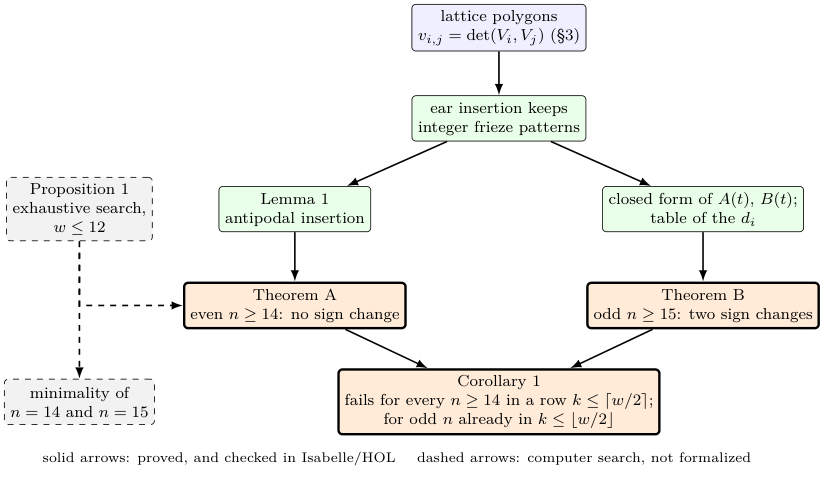
Map of the note. Blue: model; green: lemmas; orange: results; grey: computation. The arrow from Proposition 1 to Theorem A records where the base pair of \(n = 14\) was found.
In the reading \(s^-\) (zeros deleted) the answer is negative much earlier: there are integer pairs with \(s^- = 2\) in row \(3\) of width \(6\), and pairs whose non-zero differences all have the same sign in widths \(7\) and \(8\); for example \(a = (1,2,2,3,3,2,1,3,4,1,5)\) and \(b = (1,3,1,5,4,1,2,2,3,2,3)\) give, in row \(3\) of width \(8\), \(d = (0,2,1,0,0,0,0,1,0,0,0)\), with \(s^- = 0\), \(s^+ = 8\) and \(E = 10\). These examples all have zeros.
↳ Not used by another result of the paper.
🛡️ Evidence & scope
Program: the pair of width 8 recomputed: both frieze patterns, row 3 difference (0,0,2,1,0,0,0,0,1,0,0). lab/integer_frieze_sign_changes_lab.py
3 Frieze patterns as lattice polygons
A frieze pattern of width \(w = n - 3\) with positive entries is the same as a sequence of vectors \(V_0, V_1, \dots , V_{n-1} \in \mathbb {R}^2\), up to \(\mathrm{SL}(2,\mathbb {R})\), with \(\det (V_i, V_{i+1}) = 1\), \(\det (V_0, V_{n-1}) = 1\) and \(\det (V_i, V_j) {\gt} 0\) for \(0 \leq i {\lt} j {\lt} n\); extended by \(V_{i+n} = -V_i\), the entries are \(v_{i,j} = \det (V_i, V_j)\) [ . The quiddity is \(a_i = \det (V_{i-1}, V_{i+1})\), and \(V_{i+1} = a_i V_i - V_{i-1}\). For an integer frieze pattern one may take \(V_0 = (1,0)\), \(V_1 = (0,1)\), and then all \(V_i\) lie in \(\mathbb {Z}^2\); the entries are the continuants \(v_{i,j} = K(a_{i+1}, \dots , a_{j-1})\), where \(K() = 1\), \(K(x_1) = x_1\) and \(K(x_1, \dots , x_r) = x_r K(x_1, \dots , x_{r-1}) - K(x_1, \dots , x_{r-2})\) (so \(K(x, y) = xy - 1\), \(K(x, y, z) = xyz - x - z\)). In particular row \(k\) is \(v_{i,i+k+1} = K(a_{i+1}, \dots , a_{i+k})\), \(i = 0, \dots , n-1\); we write \(r_k(a)\) for this row of the frieze pattern with quiddity \(a\), listed from \(i = 0\), so that \(d = r_k(b) - r_k(a)\). Two facts are used throughout, both immediate from the bilinearity of the determinant:
Ear insertion. Inserting \(V_j + V_{j+1}\) between \(V_j\) and \(V_{j+1}\) gives again an integer frieze pattern, of width \(w + 1\); in the triangulation, this glues a triangle on the side \((j, j+1)\).
New entries. The entries between old vectors do not change, and an entry involving the new vector is a sum of two old ones: \(\det (V_j + V_{j+1}, V_x) = \det (V_j, V_x) + \det (V_{j+1}, V_x)\).
4 Proof of Theorem A
Let \(n = 2h\). The middle row consists of the diameters \(D_i = \det (V_i, V_{i+h})\), \(0 \leq i {\lt} h\).
Insert ears after the positions \(j\) and \(j + h\). The diameters of the new polygon are the old ones, in the same cyclic order, together with one new diameter between the two new vertices, of value
Hence if \(D_i(U) {\lt} D_i(V)\) for all \(i\) and \(S(U, j) {\lt} S(V, j)\), the strict order survives the insertion.
Isabelle · oursshow
dia_ins2 · Isabelle/AFP/Integer_Frieze_Rows/Integer_Frieze_Rows.thy, line 347 — the diameters after the insertion
lemma dia_ins2:
  assumes ev: "even (length V)" and j: "Suc j < length V div 2" and i: "i < Suc (length V div 2)"
  shows "dia (ins2 V j) i =
    (if i \<le> j then dia V i else if i = Suc j then S V j else dia V (i - 1))"
dominated_ins2 · Isabelle/AFP/Integer_Frieze_Rows/Integer_Frieze_Rows.thy, line 384 — the strict order survives when S(U, j) < S(V, j)
lemma dominated_ins2:
  assumes D: "dominated V W" and ev: "even (length V)" and j: "Suc j < length V div 2"
    and SS: "S V j < S W j"
  shows "dominated (ins2 V j) (ins2 W j)"
ins_frieze · Isabelle/AFP/Integer_Frieze_Rows/Integer_Frieze_Rows.thy, line 132 — inserting an ear keeps an integer frieze pattern
lemma ins_frieze:
  assumes F: "frieze V" and j: "Suc j < length V"
  shows "frieze (ins V j)"
Trust base: 🔒 kernel only. Isabelle: 3 results, no oracles
Proof: in this note·Formalized: Isabelle/HOL, by the author (public formalizations repository)·Covers: the whole statement·Cite: Lemma 1, p. 4, doi:10.5281/zenodo.23656979
↳ Used in: Theorem A
A new diameter between two old vertices \(x, x'\) has one new vertex on each side, so \(x'\) is the old antipode of \(x\) and the value is the old one. The only other diameter joins the two new vertices (Figure 3).
💡 In plain words (commentary, not part of the paper)
Gluing a triangle on a side of a triangulated polygon adds a vertex; in vectors, the new vertex is the sum of the two vectors at the ends of that side, so no old entry changes. Glue two triangles at opposite sides of an even polygon. Every old diameter still joins two opposite vertices of the bigger polygon, because one new vertex lands on each of its sides; the only new diameter joins the two new vertices. So comparing two polygons after the gluing only needs one new number, \(S\), and the lemma reduces Theorem A to an inequality between two values of \(S\).
🖼️ Figure 3
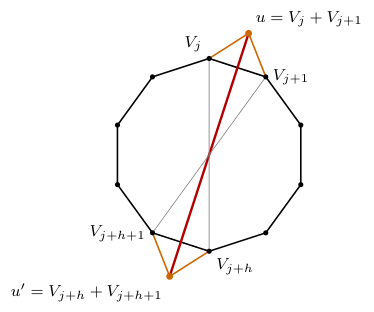
Antipodal ear insertion. The old diameters (grey: two of them) keep their values; the only new diameter is \((u, u')\) (red), of value \(S = \det (V_j + V_{j+1}, V_{j+h} + V_{j+h+1})\).
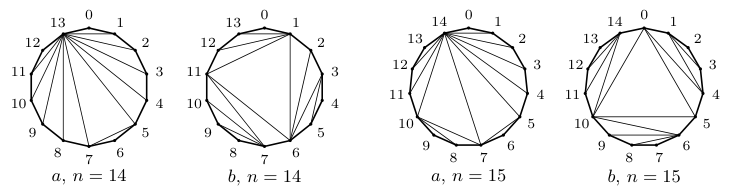
Start from the pair of \(n = 14\),
whose middle rows \(D_0, \dots , D_6\) are \((6,6,6,6,6,6,2)\) and \((7,7,8,7,7,7,3)\) (Figure 2, left; each repeated twice along the period \(14\)), and insert antipodal ears at \(j = 0\), \(t\) times (\(t \in \mathbb {Z}_{\geq 0}\)). Write \(n_t = 14 + 2t\) and \(h_t = 7 + t\). Along the family \(V_0\) and \(V_{h_t}\) keep their coordinates (the index \(h_t\) grows), while \(V_1\) and \(V_{h_t+1}\) move by \(V_0\) and \(V_{h_t}\) at each step, so \(S\) is a quadratic polynomial in \(t\):
and \(S(b(t),0) - S(a(t),0) = t^2 + 16t + 16 {\gt} 0\). Lemma 1 and induction on \(t\) give Theorem A. In terms of quiddities, for \(t \geq 1\) (with \(2^r\) standing for \(r\) consecutive \(2\)s),
5 Proof of Theorem B
Let \(t \geq 0\), \(n = 15 + 2t\), \(h = t + 7\), so \(n = 2h + 1\) and row \(k = h - 1 = \lfloor w/2 \rfloor \) consists of the \(n\) entries
the second form by the glide symmetry. Consider the two lattice polygons, each made of five pieces (a block of fixed vectors, an arithmetic progression of \(t + 1\) vectors, five fixed vectors, a progression of \(t + 1\) vectors, five fixed vectors), with \(0 \leq s \leq t\):
For \(t = 0\) their quiddities are
(Figure 2, right), and inserting ears first after the position \(t + 8\) and then after the position \(2\) turns \(A(t)\) into \(A(t+1)\) and \(B(t)\) into \(B(t+1)\): each progression gains a new first vector. Hence all \(A(t)\), \(B(t)\) are integer frieze patterns, by induction. For \(t \geq 1\) their quiddities are
Each \(e_i\) is the determinant of two vectors that depend affinely on \(t\) and on the position, so the differences \(d_i = e_i(B(t)) - e_i(A(t))\) are explicit. For every \(t \geq 1\) they are given by the following table, in which \(s\) is a parameter local to each line and \(u = t - s\):
|
positions \(i\) |
\(d_i\) |
|
\(0,\ 1\) |
\(1,\ 2\) |
|
\(2\) |
\(25t + 7\) |
|
\(3 + s\), \(0 \leq s {\lt} t\) |
\(25u^2 - 4u - 12 \ \ (u \geq 1)\) |
|
\(t + 3,\ \dots ,\ t + 7\) |
\(1, 1, 1, 1, 9\) |
|
\(t + 8\) |
\(5 - 13 = -8\) |
|
\(t + 9\) |
\(2t - 9\) |
|
\(t + 10\) |
\(25t - 18\) |
|
\(t + 11 + s\), \(0 \leq s {\lt} t - 1\) |
\(25u^2 - 29u - 26 \ \ (u \geq 2)\) |
|
\(2t + 10,\ \dots ,\ 2t + 14\) |
\(4, 7, 3, 2, 1\) |
The two quadratics are positive in their ranges:
and \(25t - 18 {\gt} 0\) for \(t \geq 1\), while \(2t - 9\) is negative for \(t \leq 4\), positive for \(t \geq 5\) and never zero. So for \(t \geq 5\) the only negative entry is \(d_{t+8} = -8\); for \(1 \leq t \leq 4\) the only negative entries are \(d_{t+8}\) and \(d_{t+9}\), which are adjacent; and for \(t = 0\) a direct computation gives
In every case \(d\) has no zero and one block of negative entries, hence exactly two cyclic sign changes. Figure 4 shows the pattern, and Figure 5 the whole family for \(t \leq 8\).
🖼️ Figure 4
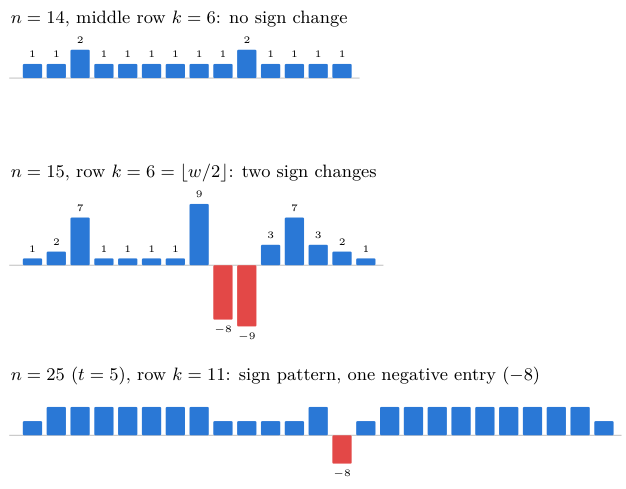
The differences \(d_i = r_k(b)_i - r_k(a)_i\) along the period, blue for \(d_i {\gt} 0\) and red for \(d_i {\lt} 0\). Top and middle: actual values. Bottom: only the sign (bar height \(1\) if \(|d_i| = 1\), else \(2\)), since the entries grow quadratically; the single negative entry is \(-8\) for every \(t \geq 5\).
🖼️ Figure 5
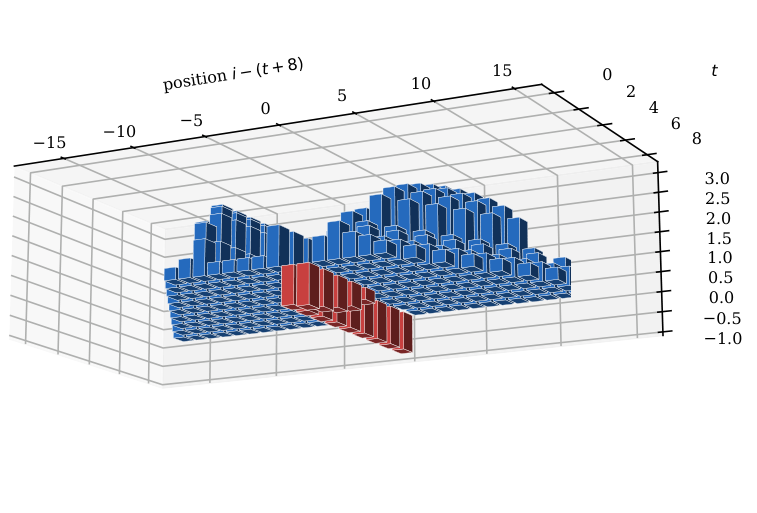
The differences \(d_i(t)\) of Theorem B for \(t = 0, \dots , 8\), centred at the negative entry \(i = t + 8\), on a signed logarithmic scale (\(\operatorname {sign}(d)\log _{10}(1 + |d|)\)), seen slightly from below. Blue: \(d_i {\gt} 0\); red: \(d_i {\lt} 0\). Along the whole family a single column (two for \(t \leq 4\)) stays negative.
6 The search
Proposition 1 was obtained by enumerating all integer frieze patterns of width \(w \leq 12\) (one for each triangulation of the labelled \(n\)-gon, a Catalan number of them: \(742\, 900\) for \(w = 12\)) and, for every row \(k \leq \lceil w/2 \rceil \) and every unordered pair, computing \(Z\), \(c\) and \(E\) on a GPU; the exact value of \(s^+\) was computed for the candidates with \(Z + c \leq 3\). The pairs found were checked again by three independent constructions of the frieze patterns: from the quiddity by continuants (with \(M = -\mathrm{Id}\) for the monodromy, \(\sum a_i = 3n - 6\), positivity, and the closing rows of \(1\)s and \(0\)s), by the diamond rule in exact arithmetic, and by the search code itself. Those rechecks confirm the pairs found, not that the search missed nothing; the exhaustiveness rests on the program, which loops over every unordered pair of distinct labelled frieze patterns. As controls, the number of frieze patterns of each width is the Catalan number; for \(w \leq 8\) the minima of \(s^-\), \(s^+\) and \(E\) in every row agree with an independent tabulation; and in rows \(k \leq 5\) of width \(12\) the same code reports no pair with fewer than four sign changes. The rows are stored as 64-bit integers; the largest entry in the rows examined is \(377\) for \(w = 12\) (computed over all frieze patterns), so every product \(d_i d_{i+1}\) is below \(377^2\) in absolute value and no overflow occurs. The programs and their complete outputs are in the supplement. The family of Theorem A was found by inserting antipodal ears into a pair of \(n = 14\), and that of Theorem B by inserting pairs of ears at the same positions into pairs of \(n = 15\), keeping those that preserved two sign changes, and reading off a fixed rule.
7 Formal verification
Theorems A and B are proved in Isabelle/HOL for all \(t\), in the lattice-polygon model of Section 3: Integer_Frieze_Rows (Theorem A, with the bridge to continuants of the quiddity) and Odd_Frieze_Rows (Theorem B, built on the first). They check that every polygon of each family is a frieze pattern, the value of every entry of the row, and the count of sign changes; the cases \(t \leq 4\) of Theorem B are evaluated by the simplifier. The pairs of \(n = 14\) and \(n = 15\) are also certified in Lean 4 by kernel computation (decide), with propext as the only axiom. The search behind Proposition 1 is not formalized.
The files are in https://github.com/karlesmarin/formalizations, commit b9f258c: the Isabelle sessions Integer_Frieze_Rows and Odd_Frieze_Rows under Isabelle/AFP/ and the base pairs in Isabelle/FriezeDominance/ (built with Isabelle2025-2 and Isabelle2026, isabelle build -D dir); the Lean modules Formalizations/Combinatorics/Frieze/IntegerDominance.lean and TwoSignChanges.lean (Lean v4.35.0 with Mathlib, lake build). The formal statements are about the lattice-polygon model of Section 3; the equivalence with triangulations and with the diamond rule is the classical one and is not formalized, and the function quid of Integer_Frieze_Rows gives the quiddity at the interior positions \(1, \dots , n-2\) only, which are the ones its theorems use.
8 The companion site
This note has a companion website, its blueprint, at https://karlesmarin.github.io/blueprints/integer-frieze-sign-changes/. It shows the note as a whole: what it proves, how its results depend on each other, and what exactly has been checked. There one finds:
The statements. Every numbered statement, copied verbatim with its number (2 theorems, 1 proposition, 1 lemma, 1 corollary and 1 remark), each with its proof, where it has one, a click away.
The dependencies. For each statement, what it uses and where it is used, as a list and as a graph.
The map. One page with the main results, the tools they rest on and the fields they feed.
What was checked, and how. Besides the written proof, the site says for each statement what else was checked: 3 statements are proved in Isabelle/HOL (8 theorems) and 2 have a part (the base pairs) verified in Lean 4, all linked by name to the public repository karlesmarin/formalizations; 4 statements are corroborated by programs of the supplementary material, each named with what it computes.
Labs. Next to Theorem B and Proposition 1, a form runs the computations of the note in the reader’s browser (Python, nothing to install) for values the reader chooses: the family of Theorem B member by member (Figures 4 and 5), and any pair of quiddities, with the triangulations, the sign changes in the three readings and the two frieze patterns as relief maps in 3D.
The note itself. Its PDF, opened at the right page from every statement.
The site is a reading aid, not a part of the proofs: the statements and proofs are those of this note, whose text prevails, and a formal or computational check is reported for exactly the part it covers.
9 Questions
In which rows \(k \leq \lfloor w/2 \rfloor \) do four sign changes fail, besides the row \(\lfloor w/2 \rfloor \) of Theorem B? For \(w \leq 12\) in no other (in the readings \(s^+\) and \(E\)).
↳ Not used by another result of the paper.
In particular, is there an even \(n\) with a counterexample inside the printed range, and is there, for each fixed \(k \geq 3\), a width beyond which four sign changes fail in row \(k\)? Both families have long runs of \(2\)s in their quiddities.
↳ Not used by another result of the paper.
Is there a structural description of the pairs with fewer than four sign changes? The infinitesimal version holds for every \(k\) [ , around the constant frieze pattern with quiddity \(q_n^* = (2\cos \frac{\pi }{n}, \dots , 2\cos \frac{\pi }{n})\).
↳ Not used by another result of the paper.
How large is
(when such pairs exist), the distance from the constant frieze pattern at which four sign changes first fail for integer frieze patterns?
↳ Not used by another result of the paper.
Bibliography
🧠 How it works
How the paper gets to its results: its strategy, techniques, key ideas, tools, the claims and their status, where it was hard, what to know before, exercises, and the questions it leaves open. Items marked commentary are ours, not the paper's.
Strategy
Techniques (3)
A frieze pattern is a polygon of vectors
With $\det(V_i,V_{i+1})=1$ every entry is $\det(V_i,V_j)$; gluing a triangle on the side $(j,j+1)$ inserts $V_j+V_{j+1}$, and by bilinearity no old entry changes.Grow a counterexample by a fixed insertion rule
Insert ears at the same positions in both members of a pair; for even $n$ at antipodal positions, so that only one diameter is new; for odd $n$ at the positions $2$ and $t+8$, so that each arithmetic progression of vectors gains a first term.Affine pieces make every entry a polynomial
When the polygon is a few fixed vectors and arithmetic progressions, each determinant is a polynomial of degree at most two in the step $t$ and the position, and the sign pattern of the row is read from a short table.Algorithms and computations (1)
The exhaustive search behind Proposition 1
- Enumerate the integer frieze patterns of width $w$ (one per triangulation of the labelled $(w+3)$-gon) by their quiddities.
- For every row $k \le \lceil w/2 \rceil$ and every unordered pair, compute on a GPU the zeros $Z$, the strict sign changes $c$ and $E$ of the difference.
- For the candidates with $Z + c \le 3$, compute $s^+$ exactly.
- Recheck every pair found by continuants, by the diamond rule in exact arithmetic, and by the search code.
Tools (2)
Isabelle/HOL (Isabelle2025-2 (the version of the Archive of Formal Proofs) and Isabelle2026)
Theorems A and B for every n, in the lattice-polygon model; the base pairs by evaluationLean 4 and Mathlib (Lean v4.35.0)
the base pairs n = 14 and n = 15, by kernel computation (decide)Where it was hard, and what was avoided (1)
Before reading (3)
- Triangulations of a convex polygon and the Conway–Coxeter correspondence (§1).
- Determinants of 2×2 integer matrices and their bilinearity (§3).
- To read the formal proofs: Isabelle/HOL (lists,
nth,deton pairs of integers).
Open questions (3)
open
For which pairs $(w, k)$ with $k < \lfloor w/2 \rfloor$ do four sign changes fail? For $w \le 12$ they never do (readings $s^+$ and $E$). Is there, for each fixed $k \ge 3$, a width beyond which they fail?open
Both families have long runs of $2$s in their quiddities. Is there a structural description of the pairs with fewer than four sign changes?open
The infinitesimal version holds for every $k$ (Tabachnikov 2018); at what distance from the constant frieze pattern does it stop holding for integer frieze patterns?📊 Tables
Every table of the paper, in its order: click one to unfold it, with where the paper cites it, how its numbers were checked, and its data as CSV. The typeset table is one click away, on its page of the PDF.
Table 1. The differences $d_i$ of Theorem B for every $t \geq 1$ ($s$ local to each line, $u = t - s$).
| positions $i$ | $d_i$ |
| $0,\ 1$ | $1,\ 2$ |
| $2$ | $25t + 7$ |
| $3 + s$, $0 \leq s < t$ | $25u^2 - 4u - 12 \ \ (u \geq 1)$ |
| $t + 3,\ \dots,\ t + 7$ | $1, 1, 1, 1, 9$ |
| $t + 8$ | $5 - 13 = -8$ |
| $t + 9$ | $2t - 9$ |
| $t + 10$ | $25t - 18$ |
| $t + 11 + s$, $0 \leq s < t - 1$ | $25u^2 - 29u - 26 \ \ (u \geq 2)$ |
| $2t + 10,\ \dots,\ 2t + 14$ | $4, 7, 3, 2, 1$ |
verifica_V173.py, familia_impar_cerrada_vec.py (research code of the note)Isabelle/AFP/Odd_Frieze_Rows/Odd_Frieze_Rows.thy