For m ≥ 2, every m×3 biquadratic sum of squares is a sum of 2m squares
At a glance
What the paper contributes
The exact sum-of-squares rank of biquadratic forms of width three: every $m\times3$ biquadratic sum of squares is a sum of $2m$ squares of bilinear forms, and some need $2m$. This answers the question of Qi, Löfberg and Chen on the exact values of $\mathrm{BSR}(m,3)$; the cases $m=2,3$ were known, $m\ge4$ is new.
- $\mathrm{BSR}(m,3)=2m$ for every $m\ge2$ (Theorem 1); in particular $\mathrm{BSR}(4,3)=8$.
- An integer point where the map of $2m$ squares is a submersion, in every size (Lemma 2).
- A rank inequality for Hankel multipliers without simple tensors: rank at least the support plus one (Lemma 5), replacing the Gorenstein classification of the boundary strategy of Blekherman, Dunbar and Sinn.
- An explicit form needing $2m$ squares (Lemma 6).
🚀 Start here: Theorem 1: BSR(m,3) = 2m for every m ≥ 2.
Main results:
- Theorem 1: BSR(m,3) = 2m for every m ≥ 2
🗺️ Map of the results (click a box to go to it)
Dependencies in the written proof: an arrow A → B means that this proof of B uses A. Every result rests on its written proof; the tags record what was checked besides, and each statement's “Evidence & scope” block says how far. The colour of a box is its strongest tag, in the order above; the tags in the box give the rest. Boxes with a thick border are the main results; click a box to read the statement.
📐 Setting (copied from the paper, §§1–2)
Write \(x=(x_1,\dots ,x_m)\), \(y=(y_1,y_2,y_3)\). A biquadratic form is a real form of bidegree \((2,2)\) in \((x,y)\), and \(\mathrm{BSR}(m,n)\) is the least \(r\) such that every biquadratic sum of squares in \(m+n\) variables is a sum of \(r\) squares of bilinear forms. Let \(A=\mathbb R^m\), \(B=\mathbb R^3\), \(V=A\otimes B\) (bilinear forms), \(R_2\) the biquadratic forms, of dimension \(N=3m(m+1)\), \(\Phi _k(h_1,\dots ,h_k)=h_1^2+\dots +h_k^2\), \(\Sigma _k=\Phi _k(V^k)\) and \(\Sigma \) the cone of sums of squares. To \(\lambda \in R_2^*\) corresponds \(H_\lambda (u,v)=\lambda (uv)\), with the Hankel symmetry \(H(x\otimes b,x'\otimes c)=H(x\otimes c,x'\otimes b)\).
1 The result
For every \(m\ge 2\), \({\mathrm{BSR}}(m,3)=2m\).
Isabelle · ours · partshow
Only a part is in Isabelle: partly: the lower bound 2m (Lemma 6, for the witness with slopes 0, …, m−1), the algebraic core of Lemma 2, and for the case e = 1 the second-variation identity in adapted coordinates and the trace contradiction under symmetry, L ⪰ 0, full support, rank ≤ a + 1 and a negative direction (L ⪰ 0 is equivalent to the second-order condition for every variation of the family); outside the formal part: the passage from a representation to the summands x₀ ⊗ y_j in adapted coordinates, Proposition 3, Lemma 5, the case e ≥ 2 and the assembly of the upper bound
bsr_width_three_lower · Isabelle/BSRWidthThree/BSR_Width3_Lower.thy, line 352 — the lower bound: if every m × 3 sum of squares is a sum of N squares, then 2m ≤ N (no hypothesis)
theorem bsr_width_three_lower:
  assumes "bsr_le m 3 N" shows "2 * m \<le> N"
width_three_trace · Isabelle/BSRWidthThree/Width3_Final.thy, line 196 — the case e = 1 of the induction: no multiplier satisfies the second-order condition, full support, rank at most a + 1 and a negative direction
theorem width_three_trace:
  fixes h :: "nat \<Rightarrow> nat \<Rightarrow> nat \<Rightarrow> nat \<Rightarrow> real"
    and W C :: "nat \<Rightarrow> nat \<times> nat \<Rightarrow> real"
  assumes hs: "\<forall>p q l l'. h q p l l' = h p q l l'" and bs: "\<forall>p q l l'. h p q l' l = h p q l l'"
    and L: "\<forall>u. 0 \<le> lform a h u u"
    and supp: "\<And>x. (\<forall>j<3. \<forall>w. hform a h (blk j x) w = 0) \<Longrightarrow> \<forall>l<a. x l = 0"
    and rank: "\<forall>p<3. \<forall>q<3. \<forall>l<a. \<forall>l'<a. h p q l l' = (\<Sum>t<Suc a. W t (p, l) * C t (q, l'))"
    and neg: "hform a h u0 u0 < 0"
  shows False
Trust base: ⚠️ not checked. Written proof, read in full and audited by two independent readings; the theorem as a whole is not machine-checked: Isabelle/HOL checks, without sorry, the lower bound 2m (Lemma 6), the algebraic core of Lemma 2 and the case e = 1 (second variation and trace bound); Lemma 5, the case e ≥ 2, Proposition 3 and the assembly are not formalized
Proof: in this note·Formalized: Isabelle/HOL, by the author (public formalizations repository)·Covers: part: the lower bound 2m (Lemma 6, for the witness with slopes 0, …, m−1), the algebraic core of Lemma 2, and for the case e = 1 the second-variation identity in adapted coordinates and the trace contradiction under symmetry, L ⪰ 0, full support, rank ≤ a + 1 and a negative direction (L ⪰ 0 is equivalent to the second-order condition for every variation of the family); outside the formal part: the passage from a representation to the summands x₀ ⊗ y_j in adapted coordinates, Proposition 3, Lemma 5, the case e ≥ 2 and the assembly of the upper bound·Cite: Theorem 1, p. 1, doi:10.5281/zenodo.24051362
🆕 Classical and new: the paper: «The statement is new for m ≥ 4» (m = 2 by BPSV and BSSV Theorem 1.4; m = 3 by BSSV Theorem 1.5).
↳ Used in: Corollary 7, 1
We prove \(\Sigma _{2m}=\Sigma \) by strong induction on \(m\ge 2\). Suppose not, and take \(F,H\) as in Proposition 3; fix a representation \(F=\sum _{i\le 2m}h_i^2\) and \(W=W_h\). By Corollary 4 and Lemma 5, \(a+1\le r\le m\); as \(H\ne 0\), \(a\ge 1\), so \(1\le a\le m-1\). Let \(A=A'\oplus A''\) orthogonally, \(e=m-a\).
Case \(e\ge 2\). Write \(w=w'+w''\) with \(w'\in A'\otimes B\), \(w''\in A''\otimes B\). Since \(A''\otimes B\) lies in the radical of \(H\) and \(W\subseteq \ker H\), the projection \(W'\) of \(W\) to \(A'\otimes B\) lies in the kernel of \(H|_{A'\otimes B}\), which has dimension \(3a-r\). An orthogonal change of the \(2m\) summands moves all the components in \(A'\otimes B\) into at most \(s=\dim W'\le 3a-r\) of them; the other \(2m-s\) summands are bilinear forms in the \(e\) variables of \(A''\), and their sum of squares is a sum of squares in \(e\times 3\) variables. As \(2\le e{\lt}m\), by induction it is a sum of \(2e\) squares. Hence \(F\) is a sum of at most \(3a-r+2(m-a)=2m+a-r\le 2m-1\) squares, against Corollary 4.
Case \(e=1\). Then \(a=m-1\) and \(r=m=a+1\), so \(W=\ker H\) and \(A''\otimes B\subseteq W\); let \(x_0\) span \(A''\). The coefficient map \({\mathbb {R}}^{2m}\to W\) of the representation is an isomorphism (Corollary 4); choosing an orthonormal basis of the preimage of \(x_0\otimes B\) and completing it, an orthogonal change of the summands gives \(h_i=x_0\otimes y_i\) \((i=1,2,3)\) for a basis \(y_1,y_2,y_3\) of \(B\). Write \(H_{jl}\) for the blocks of \(H|_{A'\otimes B}\) in this basis (symmetric, with \(H_{jl}=H_{lj}\) by (1)) and \(S=H_{11}+H_{22}+H_{33}\). For \(v_1,v_2,v_3\in A'\) let
with \(\varepsilon \) the alternating symbol. Then \(\sum _ih_iD_i=\sum _{i,j,p}\varepsilon _{ijp}(x_0\otimes y_i)(v_p\otimes y_j)=0\) by antisymmetry in \(i,j\), and \(\sum _i\varepsilon _{ijp}\varepsilon _{ilq}=\delta _{jl}\delta _{pq}-\delta _{jq}\delta _{pl}\) gives
By Proposition 3(2) this is nonnegative for all \(v\), that is \(L:=I_3\otimes S-H|_{A'\otimes B}\succeq 0\) in the block order. The three diagonal blocks of \(L\) sum to \(3S-S=2S\), so \(S\succeq 0\). If \(Sx=0\), the three nonnegative numbers \(L(x\otimes y_j,x\otimes y_j)\) sum to \(2x^\top Sx=0\), so \(L(x\otimes y_j,\cdot )=0\) and hence \(H(x\otimes y_j,\cdot )=0\) for all \(j\); by the choice of \(A'\), \(x=0\). So \(S\succ 0\). The congruence by \(\operatorname {diag}(S^{-1/2},S^{-1/2},S^{-1/2})\) turns \(H|_{A'\otimes B}\) into \(\widetilde H\) with \(\widetilde H\preceq I_{3a}\), \(\operatorname{tr}\widetilde H=\operatorname{tr}(S^{-1/2}SS^{-1/2})=a\), \(\operatorname{rank}\widetilde H=a+1\) and the same positive and negative inertia indices as \(H\), which by Proposition 3(3) has a negative eigenvalue. Then \(\widetilde H\) has at most \(a\) positive eigenvalues, each at most \(1\), and a negative one, so \(\operatorname{tr}\widetilde H{\lt}a\): a contradiction.
For \(m=2\) only \(e=1\) occurs, so the induction starts without hypothesis.
💡 In plain words (commentary, not part of the paper)
1. A biquadratic form in \(x\in \mathbb R^m\), \(y\in \mathbb R^3\) that is a sum of squares of bilinear forms can always be written with \(2m\) squares, and some forms need all of them. Before this note one knew \(2m\le \mathrm{BSR}(m,3)\le 2m+1\); the theorem removes the last unit. 2. Why: if some form needed more, a generic form on the edge of the set of sums of \(2m\) squares (still inside the cone) would carry a linear functional, the Hankel multiplier, satisfying first and second order conditions. Lemma 5 says such a multiplier has rank larger than its support in the \(x\) variables; this either saves a square by induction on \(m\), or leaves one row outside the support, where a second variation built from the alternating symbol contradicts a trace count. 3. New and not new, as the paper says: the statement is new for \(m\ge 4\); \(m=2\) follows from [BPSV] and [BSSV, Theorem 1.4], \(m=3\) from [BSSV, Theorem 1.5]; the strategy is that of Blekherman, Dunbar and Sinn [BDS]; the question is asked in [QLC, §9]. 4. The lower bound \(2m\) comes from \(\mathrm{qp}(\mathbb P^{m-1}\times \mathbb P^2)=m\) [Mar, Theorem 1] and from the explicit form of Lemma 6.
🛡️ Evidence & scope
Program: numerical search: every sampled m×3 form with m = 4, 5, 6 is a sum of 2m squares; the witness F_m is not a sum of 2m − 1 (a control). supplement.zip: search_width_three.py
Program: the claims of the two language tabs (N = 60, 78 − 18 = 60, the bound 9 before, F_4 with 8 squares, rank 60 at the regular point), with two controls that must fail. lab/comprueba_pestanas.py
🧪 Lab: The Gram spectrahedron of a form and its point of rank 2m
Choose \(m\) and a seed. The lab builds \(F\), a sum of \(3m\) random squares of bilinear forms; its Gram matrices \(G\) (\(v^\top Gv=F\) with \(v=x\otimes y\), \(G\succeq 0\)) form a convex set, the Gram spectrahedron, and \(F\) is a sum of \(r\) squares exactly when it contains a matrix of rank at most \(r\). The lab finds one of rank \(2m\), as Theorem 1 says, and draws the plane through the full-rank point \(G_0\) and that point \(G^*\) (one axis is a \(2\times 2\)-minor direction, which does not change \(F\)), coloured by rank, and the boundary of a three-dimensional slice. It also searches rank \(2m-1\) and says what it finds: a random form may need fewer squares; the theorem bounds every form, and Lemma 6 gives one that needs exactly \(2m\).
🔤 Read this theorem in another mathematical language
Commentary, not part of the paper. Take \(m=4\). Every biquadratic form in \(x_1,\dots ,x_4\), \(y_1,y_2,y_3\) that is a sum of squares of bilinear forms is a sum of \(8\) of them. Before, the parallel-line bound gave \(4\cdot 3-\max (4,3)+1=9\), so the question was \(8\) or \(9\). The form \(F_4=\sum _{i=1}^4x_i^2\big((y_2-iy_1)^2+y_3^2\big)\) is written with its \(8\) squares and needs all of them (Lemma 6).
Commentary, not part of the paper. The same statement for matrices, \(m=4\): forms correspond to \(12\times 12\) symmetric matrices (a \(78\)-dimensional space) modulo the \(18\)-dimensional span of the matrices of the \(2\times 2\) minors, and \(78-18=60\) is the dimension of the forms. The theorem says: every positive semidefinite \(12\times 12\) matrix can be changed by such a combination of minor matrices into a positive semidefinite matrix of rank at most \(8\). At the integer point of Lemma 2 the map of \(8\) squares has full rank \(60\).
2 Setting
No numbered statement in this section.
It is prose only (no statement, figure or table): read it in the paper (PDF).
3 A regular point and a boundary point
For every \(m\ge 2\) there are \(h\in V^{2m}\) with integer coefficients at which \(d\Phi _{2m}\) is onto. In particular \(\Sigma _{2m}\) has nonempty interior.
Isabelle · ours · partshow
Only a part is in Isabelle: the linear algebra: a Hankel multiplier vanishing on ker[I P Q] is zero (regular_point_hankel); the duality from there to «dΦ onto» is on paper
regular_point_algebra · Isabelle/BSRWidthThree/Regular_Point.thy, line 151 — the algebraic core: with P cyclic and Q = DPᵀ, the three block symmetries force M = 0; the passage from a Hankel multiplier vanishing on ker C to these symmetries is in regular_point_hankel
theorem regular_point_algebra:
  assumes m: "2 \<le> m"
    and sym: "\<forall>i<m. \<forall>j<m. M j i = M i j"
    and h1: "\<forall>i<m. \<forall>j<m. mmul m M (cycP m) i j = mmul m (mtr (cycP m)) M i j"
    and h2: "\<forall>i<m. \<forall>j<m. mmul m M (cycQ m) i j = mmul m (mtr (cycQ m)) M i j"
    and h3: "\<forall>i<m. \<forall>j<m. mmul m (mmul m (mtr (cycP m)) M) (cycQ m) i j
                         = mmul m (mmul m (mtr (cycQ m)) M) (cycP m) i j"
  shows "\<forall>i<m. \<forall>j<m. M i j = 0"
regular_point_hankel · Isabelle/BSRWidthThree/Regular_Point_Hankel.thy, line 102 — Lemma 2 in its linear-algebra form: a Hankel multiplier (symmetric blocks, H_jl = H_lj) vanishing on ker[I P Q] is zero
theorem regular_point_hankel:
  assumes m: "2 \<le> m"
    and hk: "hankel m h"
    and ker: "\<forall>x. (\<forall>i<m. Cx m x i = 0) \<longrightarrow> (\<forall>j<3. \<forall>i<m. Hx m h x j i = 0)"
  shows "\<forall>j<3. \<forall>l<3. \<forall>i<m. \<forall>i'<m. h j l i i' = 0"
Proof: in this note·Formalized: Isabelle/HOL, by the author (public formalizations repository)·Covers: part: the linear algebra: a Hankel multiplier vanishing on ker[I P Q] is zero (regular_point_hankel); the duality from there to «dΦ onto» is on paper·Cite: Lemma 2, p. 2, doi:10.5281/zenodo.24051362
↳ Used in: Theorem 1, Proposition 3
Identify \(V\) with \(A^3\) by the three columns (\(y_1,y_2,y_3\)). Let \(P\) be the cyclic permutation matrix of size \(m\), \(D=\operatorname {diag}(1,\dots ,m)\), \(Q=DP^{-1}\) and \(C=[\, I\ \, P\ \, Q\, ]\colon A^3\to A\). Take for \(h\) the integer basis \((-Pe_i,e_i,0)\), \((-Qe_i,0,e_i)\), \(1\le i\le m\), of \(\ker C\), so \(W_h=\ker C\). By (2) we must show that a symmetric \(H\) with (1) and \(\ker C\subseteq \ker H\) vanishes. Such an \(H\) is \(C^\top MC\) with \(M\) symmetric, with blocks \(M\), \(MP\), \(MQ\), \(P^\top MP\), \(P^\top MQ\), \(Q^\top MQ\). Symmetry of the off-diagonal blocks gives \(MP=P^\top M\), \(MQ=Q^\top M\) and \(P^\top MQ=Q^\top MP\). Then \(P^\top MQ=P^\top Q^\top M\) and \(Q^\top MP=Q^\top P^\top M\), so \((PQ-QP)^\top M=0\), that is \(M(PQ-QP)=0\). Now \(PQ-QP=PDP^{-1}-D\) is diagonal with entries \(d_{\sigma (i)}-d_i=\pm 1\) or \(\pm (m-1)\), hence invertible, and \(M=0\).
💡 In plain words (commentary, not part of the paper)
1. There is an explicit choice of \(2m\) bilinear forms with integer coefficients at which small changes of the forms move their sum of squares in every direction: the set of sums of \(2m\) squares has interior. 2. Why: a direction that no change reaches would be a symmetric matrix \(M\) commuting with \(P\) and \(Q\) in the sense \(MP=P^\top M\), \(MQ=Q^\top M\), \(P^\top MQ=Q^\top MP\), which forces \(M(PQ-QP)=0\); with \(P\) cyclic and \(Q=DP^{-1}\) the commutator is diagonal and invertible. 3. This replaces the quaternions used for \(4\times 3\) in an earlier version of the argument; it works in every size. 4. The lab computes the rank of the differential for \(2\le m\le 6\) modulo \(1000003\); the scripts check \(2\le m\le 7\), and the control \(Q=P\) loses rank.
🛡️ Evidence & scope
Program: rank of dΦ equal to N for 2 ≤ m ≤ 7; with Q = P the rank drops (m = 4: 56 < 60). supplement.zip: check_proof_steps.py
🧪 Lab: The regular point of Lemma 2, in your browser
Choose \(m\). The lab takes the integer basis of \(\ker [I\ P\ Q]\) with \(P\) cyclic and \(Q=DP^{-1}\), multiplies each form by every monomial \(x_iy_j\) and computes the rank of these products modulo \(1000003\) in the space of biquadratic forms, of dimension \(N=3m(m+1)\). Rank \(N\) means that \(d\Phi _{2m}\) is onto there. With \(Q=P\) the two matrices commute, the argument fails and the rank drops: a control.
Suppose \(\Sigma _{2m}\ne \Sigma \). Then there are \(F\in \Sigma _{2m}\) in the interior of \(\Sigma \) and \(\lambda \in R_2^*\setminus 0\), \(H=H_\lambda \), such that for every \(h\in V^{2m}\) with \(\Phi _{2m}(h)=F\):
\(W_h\subseteq \ker H\) and \(\lambda (F)=0\);
\(\sum _iH(D_i,D_i)\ge 0\) for every \(D\in V^{2m}\) with \(\sum _ih_iD_i=0\);
\(H\) is indefinite;
the \(h_i\) have no common zero \(([x],[y])\in X({\mathbb {C}})\).
Proved by: this note, by the argument of Blekherman–Dunbar–Sinn [BDS, Propositions 2.2 and 3.3]·Covers: not formalized·Cite: Proposition 3, p. 3, doi:10.5281/zenodo.24051362
🆕 Classical and new: the paper: «This is the argument of [BDS, Proposition 2.2 and Proposition 3.3]».
↳ Used in: Theorem 1, Corollary 4
This is the argument of [ 2 , Proposition 2.2 and Proposition 3.3 ] ; we give it in our setting. Let \(\Omega \) be the interior of \(\Sigma \). The set \(\Omega \cap \Sigma _{2m}\) contains a nonempty open set (Lemma 2 and the submersion theorem), and \(\Omega \setminus \Sigma _{2m}\) is open, and nonempty because \(\Sigma \setminus \Sigma _{2m}\) is a nonempty relatively open subset of \(\Sigma =\overline\Omega \). Fix a semialgebraic stratification of \(R_2\) compatible with \(\Sigma _{2m}\) and \(\Omega \) and satisfying the frontier condition [ 1 , § 9 ] . A generic segment in the convex set \(\Omega \) joining the two open sets avoids every stratum of dimension at most \(N-2\) and meets the strata of dimension \(N-1\) transversally; where it leaves \(\Sigma _{2m}\) it crosses a stratum \(S\subseteq \partial \Sigma _{2m}\) of dimension \(N-1\) with \(\Sigma _{2m}\) on one side and its complement on the other. On a small ball \(U\) around the crossing point only \(S\) and open strata meet, each component of \(U\setminus S\) lies inside or outside \(\Sigma _{2m}\), and there is a smooth \(\rho \) on \(U\) with \(\rho =0\) on \(S\cap U\), \(d\rho \ne 0\) and \(\rho \ge 0\) on \(\Sigma _{2m}\cap U\).
We choose \(F\in S\cap U\) outside the set \(Z\) of forms in \(\Omega \) that are singular at a point of \(X({\mathbb {C}})\). A form in \(\Omega \) is positive on \(X({\mathbb {R}})\), and a singular point \(p=([x],[y])\) has no real factor: if \([x]\) is real, take a real representative \(x\ne 0\) and write \(F(x,y)=y^{\mathsf T}M_F(x)\, y\); since \(F\) is positive on \(X({\mathbb {R}})\), \(M_F(x)\) is positive definite, and singularity at \(p\) would require \(M_F(x)y=0\), impossible also over \({\mathbb {C}}\) (symmetrically if \([y]\) is real). So \(p\) and \(\bar p\) differ in both factors. After complex changes of coordinates \(p,\bar p\) become \((e_1,f_1),(e_2,f_2)\); singularity at \((e_i,f_i)\) forces to vanish, in the chart \(x_i=y_i=1\), the coefficients of \(x_i^2y_i^2\), \(x_ix_jy_i^2\) \((j\ne i)\) and \(x_i^2y_iy_l\) \((l\ne i)\), which are \(m+2\) conditions, and the two lists are disjoint. For real forms this is \(2(m+2)\) real conditions, while \(p\) moves in \(2(m+1)\) real dimensions; hence \(\dim Z\le N-2{\lt}\dim S\).
Put \(\lambda =d\rho _F\). For a preimage \(h\), \(\rho \circ \Phi _{2m}\ge 0\) near \(h\) and vanishes at \(h\), so it has a local minimum there: the first order condition is \(\lambda \circ d\Phi _{2m}(h)=0\), which is (1) by (2), and \(\lambda (F)=\sum _iH(h_i,h_i)=0\). For \(D\) in the kernel of \(d\Phi _{2m}(h)\) the second derivative of \(\rho \circ \Phi _{2m}\) along \(D\) is \(d\rho _F(d^2\Phi _{2m}[D,D])=2\sum _iH(D_i,D_i)\), which is nonnegative at a minimum: this is (2). If \(H\) or \(-H\) were positive semidefinite, \(\lambda \) or \(-\lambda \) would be nonnegative on \(\Sigma \) and vanish at the interior point \(F\), so \(\lambda =0\); this proves (3). A common complex zero of the \(h_i\) is a singular point of \(F\), excluded by \(F\notin Z\): this is (4).
💡 In plain words (commentary, not part of the paper)
1. If not every sum of squares were a sum of \(2m\) squares, the set of sums of \(2m\) squares would have an edge inside the cone. At a generic point \(F\) of that edge there is a linear functional \(\lambda \), vanishing on the directions the map can reach and nonnegative on the second order directions; it is the Hankel multiplier \(H\). 2. Why: the edge is locally a smooth hypersurface with the sums of \(2m\) squares on one side; its defining function, composed with the map, has a minimum at every preimage of \(F\), and the first and second derivatives give (1) and (2). A semidefinite \(H\) would make \(\pm \lambda \) a positive functional vanishing at an interior point, so \(H\) is indefinite. 3. This is the argument of Blekherman, Dunbar and Sinn [BDS, Propositions 2.2 and 3.3]; the count that avoids complex base points (\(2(m+2)\) real conditions against \(2(m+1)\) parameters) is written here for \(X=\mathbb P^{m-1}\times \mathbb P^2\). 4. Not formalized: it uses semialgebraic stratification; in the planned Isabelle formalization it is the explicit hypothesis.
In the situation of Proposition 3, for every representation \(F=\sum _{i\le 2m}h_i^2\) the \(h_i\) are linearly independent, \(F\) is not a sum of fewer than \(2m\) squares, \(r:=\operatorname{rank}H\le m\), and \(\operatorname{im}H_{\mathbb {C}}\) contains no nonzero simple tensor \(x\otimes y\).
Proof: in this note·Covers: not formalized·Cite: Corollary 4, p. 3, doi:10.5281/zenodo.24051362
↳ Used in: Theorem 1
This is [ 2 , Lemma 3.4 and Proposition 3.3(4) ] in our setting. If the \(h_i\) were dependent, an orthogonal change of the \(2m\) summands (which does not change \(F\)) would make \(h_{2m}=0\); then \(D=(0,\dots ,0,v)\) satisfies \(\sum h_iD_i=0\) for every \(v\), and Proposition 3(2) gives \(H(v,v)\ge 0\) for all \(v\), against (3). A representation with fewer squares, completed with zeros, would be dependent. So \(\dim W_h=2m\) and \(\operatorname{im}H\subseteq W_h^\perp \) has dimension at most \(3m-2m=m\). Finally \(\operatorname{im}H_{\mathbb {C}}\subseteq (W_h)_{\mathbb {C}}^\perp \), and \(x\otimes y\in (W_h)_{\mathbb {C}}^\perp \) means \(h_i(x,y)=0\) for all \(i\), excluded by (4).
💡 In plain words (commentary, not part of the paper)
1. At such an edge point every representation by \(2m\) squares uses \(2m\) independent forms, so the multiplier, which kills them, has rank at most \(3m-2m=m\); and its image contains no simple tensor, because that would be a common zero of the forms. 2. Why the forms are independent: otherwise a rotation would make one of them zero, and changing only that one is allowed by the first order condition, so the second order condition would make \(H\) semidefinite. 3. These are the two facts the induction uses: \(r\le m\) and no simple tensor in the image.
4 The support of a multiplier
Let \(H\ne 0\) be symmetric with (1) and support of dimension \(a\) in the first factor. If \(\operatorname{im}H_{\mathbb {C}}\) contains no nonzero simple tensor, then \(\operatorname{rank}H\ge a+1\).
Proof: in this note·Covers: not formalized·Cite: Lemma 5, p. 4, doi:10.5281/zenodo.24051362
↳ Used in: Theorem 1
Restrict to \(A'\otimes B\), complexify and write \(H(u,v)=J(Tu,Tv)\) with \(T\colon A'_{\mathbb {C}}\otimes B_{\mathbb {C}}\to E\) onto, \(\dim E=r=\operatorname{rank}H\), and \(J\) a nondegenerate symmetric bilinear form on \(E\). Put \(T_bx=T(x\otimes b)\). Trivial radical means \(\bigcap _b\ker T_b=0\), and (1) reads
A line gives a simple tensor. If \(x\ne 0\) and \(T_bx=\beta (b)e\) for a linear form \(\beta \ne 0\) and \(e\ne 0\), choose \(c\) with \(\beta (c)=1\); by (3), \(J(e,T_bv)=\beta (b)\, J(e,T_cv)\) for all \(v\in A'\), \(b\in B\). The left side, as a linear form in \(v\otimes b\), lies in \(\operatorname{im}H_{\mathbb {C}}\) (\(T\) is onto, \(J\) nondegenerate) and is nonzero; the right side is the simple tensor \(\beta \otimes J(e,T_c\, \cdot )\). So it suffices to find such an \(x\) when \(r\le a\).
Assume \(r\le a\). Choose \(b\) with \(s=\operatorname{rank}T_b\) maximal, \(U=\operatorname{im}T_b\), \(N_0=\ker T_b\). For every \(c\),
Orthogonality follows from (3) with \(x\in N_0\). For \(T_c(N_0)\subseteq U\), write \(T_b\) as an identity block of size \(s\) and zeros; the coefficient of \(t\) in an \((s+1)\)-minor of \(T_b+tT_c\) bordering that block is an entry of \(T_c\colon N_0\to E/U\), and maximality of \(s\) forces it to vanish.
If \(s=r{\lt}a\), then \(U=E\), \(U\cap U^{\perp _J}=0\), and (4) gives a common kernel \(N_0\ne 0\), a contradiction. If \(s=r=a\), \(T_b\) is invertible; complete \(b\) to a basis \(b,c,d\). The operators \(T_b^{-1}T_c\), \(T_b^{-1}T_d\) are self-adjoint for \(J(T_b\, \cdot ,T_b\, \cdot )\) by (3), and (3) for the pair \(c,d\) makes their product self-adjoint as well, so they commute; a common eigenvector \(x\ne 0\) gives \(T_cx,T_dx\in {\mathbb {C}}\, T_bx\), a line. If \(s{\lt}r\), put \(R=U\cap U^{\perp _J}\); then \(\dim N_0=a-s\ge r-s\ge \dim R\). If \(R=0\) there is again a common kernel. Otherwise \(T_c|_{N_0},T_d|_{N_0}\colon N_0\to R\) form a pencil: if \(\dim N_0{\gt}\dim R\) every member has a kernel, and if the dimensions agree the binary form \(\det (\sigma T_c+\tau T_d)|_{N_0}\) is zero or of positive degree, so it vanishes at some \([\sigma :\tau ]\in {\mathbb {P}}^1({\mathbb {C}})\). Either way there is \(x\in N_0\setminus 0\) with \(T_bx=0\) and \(T_cx,T_dx\) dependent, not both zero; they span a line. In all cases the first paragraph gives a contradiction.
💡 In plain words (commentary, not part of the paper)
1. A Hankel multiplier whose image avoids the simple tensors cannot be small: its rank is at least one more than the number \(a\) of \(x\) directions it actually uses. 2. Why: if \(r\le a\), linear algebra over \(\mathbb C\) produces a vector \(x\) whose three images \(T_{y}x\) lie on one line, and the Hankel symmetry turns that line into a simple tensor in the image. The three cases are: a common kernel; commuting self-adjoint operators with a common eigenvector; or a square pencil that is singular at some point of \(\mathbb P^1(\mathbb C)\). 3. With Corollary 4 this gives \(a+1\le r\le m\), the inequality that drives the induction; in [BDS] this place is taken by the classification of Gorenstein ideals. 4. A numerical search over Hankel matrices of rank at most four in size \(4\times 3\) found no counterexample, and found the case rank four, support three, no simple tensor, so the last case of the induction is not empty.
🛡️ Evidence & scope
Program: search for counterexamples among Hankel matrices of rank ≤ 4 (4×3): none; the case rank 4, support 3, no simple tensor occurs. supplement.zip: search_support_lemma_4x3.py
5 Induction and second variation
No numbered statement in this section.
It is prose only (no statement, figure or table): read it in the paper, p. 4.
6 The lower bound
The form \(F_m=\sum _{i=1}^mx_i^2\big((y_2-iy_1)^2+y_3^2\big)\) is a sum of \(2m\) squares of bilinear forms and of no fewer.
Isabelle · ours · partshow
Only a part is in Isabelle: the witness with slopes 0, …, m−1 (F_wit): its 2m squares and the lower bound 2m; the paper’s F_m uses slopes 1, …, m, and the change y₂ ↦ y₂ − y₁ that carries one to the other (with the conservation of the SOS length) is not formalized
wit3_sos · Isabelle/BSRWidthThree/BSR_Width3_Lower.thy, line 93 — F_m is the sum of its 2m displayed squares
theorem wit3_sos: "sos_form m 3 (2 * m) wit3 x y = F_wit m x y"
wit3_length · Isabelle/BSRWidthThree/BSR_Width3_Lower.thy, line 241 — every representation of F_m has at least 2m squares (Bessel inequality on 2m orthonormal vectors)
theorem wit3_length:
  assumes rep: "\<forall>x y. sos_form m 3 s c x y = F_wit m x y"
  shows "2 * m \<le> s"
Proof: in this note·Formalized: Isabelle/HOL, by the author (public formalizations repository)·Covers: part: the witness with slopes 0, …, m−1 (F_wit): its 2m squares and the lower bound 2m; the paper’s F_m uses slopes 1, …, m, and the change y₂ ↦ y₂ − y₁ that carries one to the other (with the conservation of the SOS length) is not formalized·Cite: Lemma 6, p. 5, doi:10.5281/zenodo.24051362
↳ Used in: Theorem 1
The displayed expression has \(2m\) squares. Write any representation as
The coefficient of \(x_i^2\) gives \(M_i^\top M_i\) of rank two with kernel spanned by \(b_i=(1,i,0)\). For \(i\ne j\) the coefficient of \(x_ix_j\) vanishes, so \(M_i^\top M_j\) is antisymmetric; it kills \(b_j\) on the right and \(b_i\) on the left, hence, being antisymmetric, \(b_i\) and \(b_j\) on the right. An antisymmetric \(3\times 3\) matrix with two independent vectors in its kernel is zero. So the images of the \(M_i\) are \(m\) planes, pairwise orthogonal in \({\mathbb {R}}^s\), and \(s\ge 2m\).
🧪 Lab: The form that needs 2m squares
Choose \(m\). The lab writes \(F_m=\sum _ix_i^2\big((y_2-iy_1)^2+y_3^2\big)\) as the sum of its \(2m\) displayed squares and checks the identity coefficient by coefficient. The 3D view shows the kernels \(b_i=(1,i,0)\) of the blocks \(M_i\): any two are independent, which is why \(M_i^\top M_j=0\) and the images are pairwise orthogonal planes.
7 Larger widths
For \(m\ge 4\), \({\mathrm{BSR}}(m,4)\le 3m\). In particular \(11\le {\mathrm{BSR}}(4,4)\le 12\).
Isabelle · ours · partshow
Only a part is in Isabelle: the implication only: Theorem 1 enters as a hypothesis (bsr_width_four, bsr_upper_three), and Theorem 1 is itself only partly formalized; the comparison identity is fully formalized
bsr_width_four · Isabelle/BSRWidthThree/Width_Four.thy, line 89 — Corollary 7 from Theorem 1 (taken as hypothesis): BSR(m,3) ≤ 2m implies BSR(m,4) ≤ 3m
corollary bsr_width_four:
  assumes Theorem_1: "bsr_le m 3 (2 * m)"
  shows "bsr_le m 4 (3 * m)"
bsr_upper_three · Isabelle/BSRWidthThree/Width_Four.thy, line 96 — the general bound mn − max(m,n) for m, n ≥ 3, from Theorem 1 for every number of rows
theorem bsr_upper_three:
  assumes Theorem_1: "\<And>p. 3 \<le> p \<Longrightarrow> bsr_le p 3 (2 * p)"
    and m: "3 \<le> m" and n: "3 \<le> n"
  shows "bsr_le m n (m * n - max m n)"
bssv_wins_from_five · Isabelle/BSRWidthThree/Width_Four.thy, line 129 — the identity of the comparison and its sign: for min(m,n) ≥ 5 the bound of [BSSV, Theorem 2.1] is already at most mn − max(m,n)
lemma bssv_wins_from_five:
  fixes M s :: int
  assumes s: "5 \<le> s" and M: "3 \<le> M"
  shows "M * (M + 1) * s * (s + 1) < 2 * (M * (s - 1) + 1) * (M * (s - 1) + 2)"
width_four_wins · Isabelle/BSRWidthThree/Width_Four.thy, line 147 — in width four [BSSV, Theorem 2.1] allows 3m + 1: Corollary 7 is better
lemma width_four_wins:
  fixes M :: int
  assumes M: "2 \<le> M"
  shows "2 * (3 * M + 1) * (3 * M + 2) < M * (M + 1) * 4 * 5"
Proof: in this note·Formalized: Isabelle/HOL, by the author (public formalizations repository)·Covers: the implication only (Theorem 1 enters as a hypothesis (bsr_width_four, bsr_upper_three), and Theorem 1 is itself only partly formalized; the comparison identity is fully formalized)·Cite: Corollary 7, p. 5, doi:10.5281/zenodo.24051362
🆕 Classical and new: the paper: the previous upper bound in width four was the covering bound 3m + 1 (for m = 4 also [BSSV, Theorem 2.1], 13); for n ≥ 5 the general bound mn − max(m,n) is not better than [BSSV, Theorem 2.1]. The lower bound 11 is [QC, Theorem 3.1].
↳ Used in: 1
We prove more generally \({\mathrm{BSR}}(m,n)\le mn-\max (m,n)\) for \(m,n\ge 3\); for \(n=4\le m\) this is \(3m\). This is the argument of [ 7 , Theorem 9 ] with Theorem 1 in place of width two. Let \(m\ge n\) and \(f=\sum _{k\le r}b_k^2\); let \(v_{ij}\in {\mathbb {R}}^r\) be the coefficient vector of \(x_iy_j\) in \((b_1,\dots ,b_r)\). The vectors \(v_{ij}\) with \(j\ge 4\) span a space \(W\) of dimension at most \(m(n-3)\). After an orthogonal change of the \(r\) coordinates, which does not change \(f\), \(W\) lies in the first \(\dim W\) of them, and the remaining coordinates give bilinear forms in \(x\) and \(y_1,y_2,y_3\) only. Their sum of squares is an \(m\times 3\) biquadratic sum of squares, hence a sum of \(2m\) squares by Theorem 1. So \(f\) is a sum of \(m(n-3)+2m=mn-m\) squares. For \(m{\lt}n\) exchange the roles of \(x\) and \(y\). The lower bound \({\mathrm{BSR}}(4,4)\ge 11\) is [ 8 , Theorem 3.1 ] .
💡 In plain words (commentary, not part of the paper)
1. Every \(m\times 4\) biquadratic sum of squares is a sum of at most \(3m\) squares; for \(4\times 4\) this is \(12\), and Qi and Cui showed that \(11\) are sometimes needed, so \(11\le \mathrm{BSR}(4,4)\le 12\). 2. Why: in any representation, rotate the squares so that the coefficients of \(y_4\) live in at most \(m\) of them. The other squares do not see \(y_4\): they form an \(m\times 3\) sum of squares, which Theorem 1 rewrites with \(2m\) squares. Total \(m+2m=3m\). 3. The same rotation gives \(mn-\max (m,n)\) for all \(m,n\ge 3\). It is new only when \(\min (m,n)=4\): for \(\min (m,n)=3\) it is Theorem 1 itself, and for \(\min (m,n)\ge 5\) the bound of [BSSV, Theorem 2.1] is as good or better (for \(6\times 6\): \(29\) against \(30\); but for \(4\times 5\) ours gives \(15\) against \(16\)). The lab draws the three bounds. 4. The rotation is the one of our earlier note [Mar, Theorem 9], which used width two and gave \(3m+1\).
🛡️ Evidence & scope
Program: where mn − max(m,n) beats the covering bound and [BSSV, Theorem 2.1] for 3 ≤ n ≤ 7, m ≤ 40 (only n = 3, where it is Theorem 1, and n = 4); controls 13 for 4×4 and 29 for 6×6. supplement.zip: compare_upper_bounds.py
🧪 Lab: Three upper bounds for BSR(m,n): where Theorem 1 helps and where it does not
Choose \(m\) and the width \(n\). The lab compares the covering bound \(mn-\max (m,n)+1\), the bound of [BSSV, Theorem 2.1] (the largest \(p\) with \(\binom {p+1}2{\lt}\binom {m+1}2\binom {n+1}2\)) and the bound \(mn-\max (m,n)\) obtained with Theorem 1, and draws the three minus \(mn\) for \(m=3,\dots ,30\). When \(\min (m,n)=4\) the bound with Theorem 1 is the lowest (Corollary 7, with \(x\) and \(y\) exchanged if needed); when \(\min (m,n)\ge 5\) it ties or loses against [BSSV, Theorem 2.1]; when \(\min (m,n)=3\) it is Theorem 1.
🖼️ Figure 1
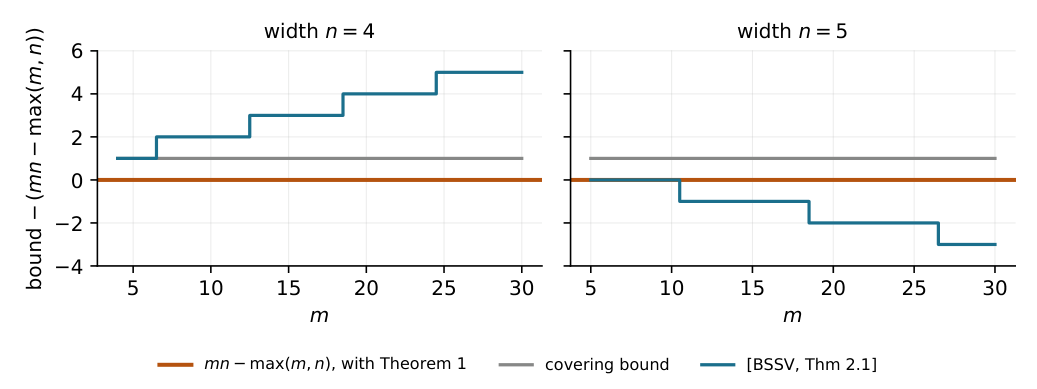
Upper bounds for \({\mathrm{BSR}}(m,n)\) minus \(mn-\max (m,n)\), the bound obtained with Theorem 1: the covering bound of [ 4 , Corollary 2.15 ] and the bound of [ 4 , Theorem 2.1 ] . In width four both lie above for every \(m\ge 4\) (Corollary 7); in width five, the BSSV bound equals \(mn-\max (m,n)\) for \(5\le m\le 10\) and is lower for every \(m\ge 11\).
8 Checks and formal status
No numbered statement in this section.
It is prose only (no statement, figure or table): read it in the paper (PDF).
The companion site
No numbered statement in this section.
It is prose only (no statement, figure or table): read it in the paper, p. 7.
Questions
Does the method give \({\mathrm{BSR}}(m,4)\)? For \(m\ge 4\), our earlier note and Corollary 7 give \(\lfloor 8m/3\rfloor \le {\mathrm{BSR}}(m,4)\le 3m\). In width four, if the kernel of the multiplier \(H\) contains \(k\) linearly independent summands, its rank is at most \(4m-k\), and the second variation would have to come from a structure replacing the alternating symbol on \({\mathbb {R}}^3\).
Cite: Question 1, p. 7, doi:10.5281/zenodo.24051362
↳ Not used by another result of the paper.
💡 In plain words (commentary, not part of the paper)
1. In width four the value is open: \(\lfloor 8m/3\rfloor \le \mathrm{BSR}(m,4)\le 3m\) for \(m\ge 4\), and \(11\le \mathrm{BSR}(4,4)\le 12\). 2. The method of this note would need two things in width four: a rank inequality for the multiplier, and a second variation. In width three the second variation came from the alternating symbol on \(\mathbb R^3\), which has no analogue of the same kind on \(\mathbb R^4\).
Acknowledgement
No numbered statement in this section.
It is prose only (no statement, figure or table): read it in the paper (PDF).
References
- 1
J. Bochnak, M. Coste, M.-F. Roy, Real Algebraic Geometry, Springer, 1998. 🔎 find it
- 2
G. Blekherman, A. Dunbar, R. Sinn, Pythagoras numbers for ternary forms, arXiv:2410.17123v2.
- 3
G. Blekherman, D. Plaumann, R. Sinn, C. Vinzant, Low-rank sum-of-squares representations on varieties of minimal degree, Int. Math. Res. Not. IMRN 2019, no. 1, 33–54. 🔎 find it
- 4
G. Blekherman, R. Sinn, G. G. Smith, M. Velasco, Sums of squares and quadratic persistence on real projective varieties, J. Eur. Math. Soc. 24 (2022), 925–965; statement numbers as in arXiv:1902.02754v2.
- 5
G. Blekherman, R. Sinn, M. Velasco, S. Zhang, Spurious local minima in nonconvex sum-of-squares optimization, arXiv:2411.02208.
- 6
J. Löfberg, L. Qi, Second order Zarankiewicz number, arXiv:2608.30555v3.
- 7
C. Marín, Quadratic persistence of Segre varieties and a linear gap between biquadratic SOS rank and Zarankiewicz bounds, Zenodo, doi:10.5281/zenodo.24036320, 2026.
- 8
L. Qi, C. Cui, The second-order augmented Zarankiewicz number, arXiv:2610.04448v1.
- 9
L. Qi, J. Löfberg, Y. Chen, Exact and asymptotic values for weak limited augmented Zarankiewicz numbers in the \(m\times 3\) case, arXiv:2608.06050v3.
- 10
Y. Xu, C. Cui, L. Qi, Narrowing the gap: SOS ranks of \(4\times 3\) biquadratic forms and a lower bound of 8, arXiv:2602.21570.