17 The γ atlas: decay measured across 42 models
Where we are. In Ch. 15 we learned to measure (and to predict) a model’s decay exponent γ. The natural question: if we can measure it in one, let’s measure it in many. That’s the γ atlas —79 measurements over 42 unique models, from four architecture families (Marín 2026)— and it’s something no other manual has: a common map where to place any transformer by how it attends across distance. This chapter explains the map calmly, what it tells us, and —with the same honesty as always— what we cannot conclude from it.
17.1 The idea in one sentence
With γ measured across 42 different models (79 measurements in total), a map emerges: most trained transformers look far (γ<1), with a median near —but below— the boundary γ=1.
17.2 Key concepts and their role in the transformer
Before getting into detail, we define this chapter’s terms and what each one is for inside a transformer:
- γ atlas. Definition: the decay exponent γ measured across 42 models from four architecture families, with 79 measurements in total (each model is measured on text and, almost always, also on random tokens). In the transformer: it turns γ from a property of one model into a common map where to place and compare them all.
- γ as a comparable coordinate. Definition: a single number that places very different models (dense MHA, GQA/MQA, MoE) on the same axis. In the transformer: it lets you compare how they attend across distance regardless of the details of the attention architecture.
- Phase A (γ<1) and Phase B (γ>1). Definition: a heavy tail that looks far (Phase A) versus attention that concentrates close (Phase B). In the transformer: it indicates whether the model exploits broad context or not — key for KV-cache compression (Ch. 20).
- Hagedorn boundary (γ=1). Definition: the line that separates the two phases. In the transformer: models cluster just below it (median ≈0.885), a pattern that doesn’t look accidental and is revisited in Ch. 21.
- Cross-architecture. Definition: that γ is the same kind of measurement for dense, GQA/MQA and MoE models, and for three different positional schemes (RoPE, ALiBi, learned). In the transformer: it’s what makes the atlas unique — it puts a GPT-2 with learned position and a Qwen2.5 with RoPE+GQA on the same axis. Mind the scope: γ is defined over the attention matrix, so the atlas covers transformers with attention; a Mamba (SSM) doesn’t belong here (see below).
- R² of the fit. Definition: how well
A(d)∝d^−γdescribes the real attention of each model (high = good fit). In the transformer: it signals when γ is a reliable summary and when it’s coarser (R² that can drop as low as ~0.64). - Raw γ vs. within-model control. Definition: comparing γ as-is across models mixes factors (θ, data, architecture); the clean experiment varies θ within the same model. In the transformer: the atlas describes the landscape but doesn’t isolate causes on its own.
In short: the atlas is a reproducible snapshot of the γ landscape, not an eternal law nor a causal proof.
17.3 What an atlas is for
Up to now γ was a property of one model. But measuring it across many turns it into a comparable coordinate: a single number that places models as different as a dense GPT-2 with learned position, a Mistral with GQA and RoPE, a BLOOM with ALiBi or an OLMoE Mixture-of-Experts on the same axis.
🧩 Analogy — the weather map. Measuring γ in one model is reading the thermometer of a city: a single reading. The atlas is the weather map of the whole country: same degrees, but now you see the fronts —where models cluster, who’s the exception, which boundary almost nobody crosses—. What’s interesting is never a point: it’s the pattern they all draw together.
17.4 The map
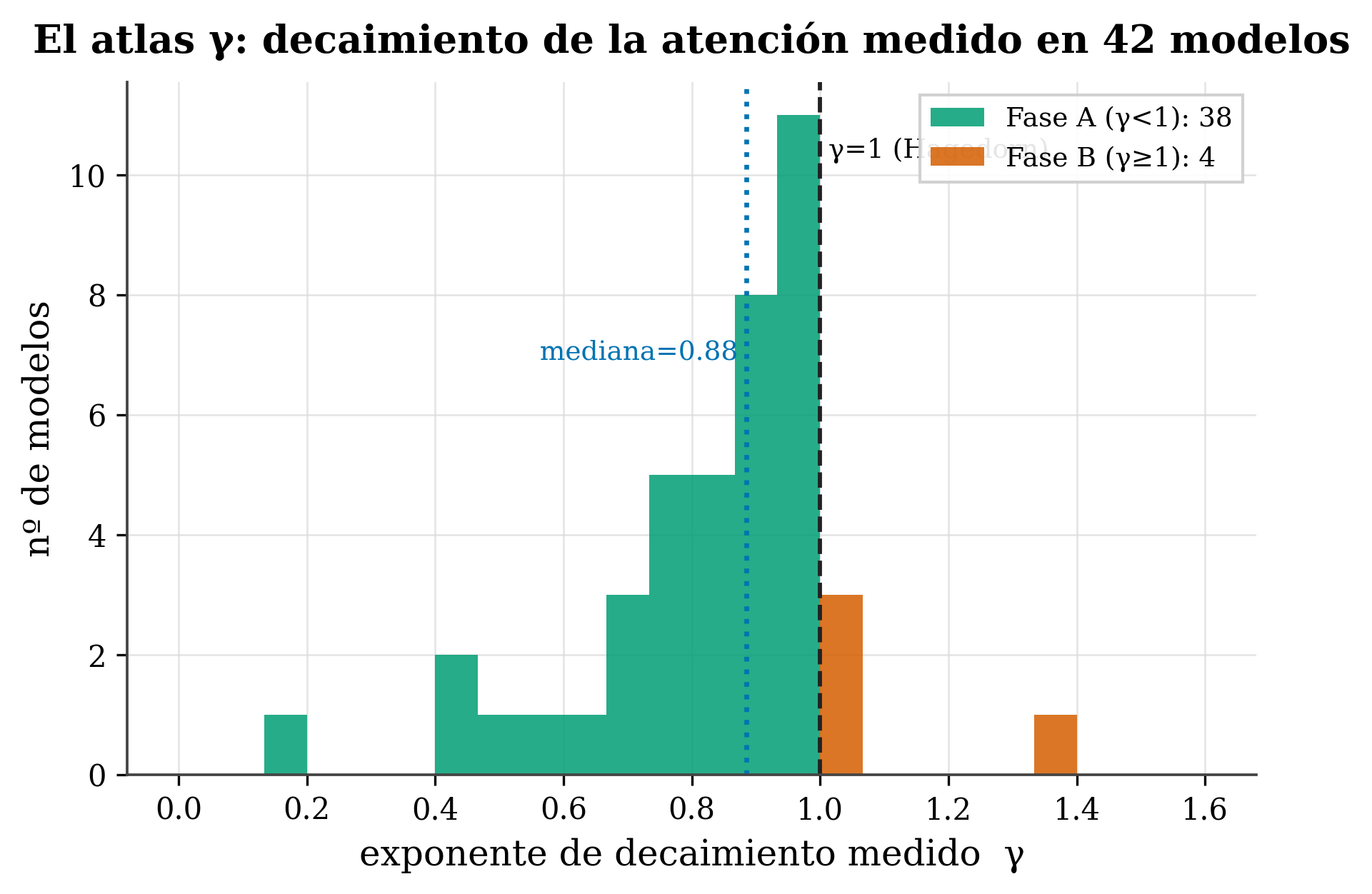
figures/make_fig16_atlas.py over data/gamma_atlas.csv.
And the same atlas, interactive: each point is a real model; hover over it to identify it and compare where each falls relative to the γ=1 boundary. Switch between the γ measured on text and on random tokens (the pure geometry, without the effect of training):
And in 3D (spin it with the mouse): the same models placed by their γ (X axis), their θ (Z axis, log) and the goodness of fit R² (Y axis). The orange plane marks γ=1:
17.5 What the map tells us (calmly)
Three readings, and what each one means:
1. Almost all look far (38 of 42 in Phase A, γ<1). This is telling. Recall (Ch. 15) that γ<1 means heavy tail: attention falls off slowly with distance, so the model also spreads weight to far-off tokens. That the vast majority of trained models end up there suggests that exploiting broad context is the norm, not the exception —transformers, left to their own devices, tend toward the long gaze, not tunnel vision—.
2. The median (γ≈0.885) is near the boundary, but below it. Models don’t distribute at random: they cluster just below γ=1. It’s as if training pushed them toward the edge of the “look far” regime without quite crossing it. That closeness to the boundary (the “Hagedorn transition” of Ch. 21) is no coincidence and we’ll revisit it.
🧩 Analogy — at the cliff’s edge. Picture a crowd in a meadow that slopes down to a cliff (the γ=1 boundary). They don’t spread across the meadow: almost everyone ends up right at the edge, peering over without falling. Transformers do the same with γ: training drags them until they graze the “look far” boundary (median ≈0.885), as if the good spot were precisely at the brink.
3. There’s real diversity (range γ ≈ 0.15 → 1.34). Not all are alike: there are very heavy-tailed models (γ≈0.15, extremely long gaze) and a few in Phase B (γ>1) that concentrate close. That range is what connects with practical decisions: how much context a model truly exploits, how much its KV-cache can be compressed (Ch. 20).
17.6 The unique piece: it’s cross-architecture
What makes the atlas special is not just the number of models, but that γ is the same kind of measurement for very different architectures —dense MHA, GQA/MQA, MoE— and for three positional schemes that look nothing alike (RoPE, ALiBi, learned position). Few diagnostics let you put a GPT-2 and a long-context Qwen2.5 on the same axis. γ does.
The 42 models in the atlas are transformers with attention. And it has to be that way: γ is obtained by fitting A(d)∝d^−γ over the attention weights averaged by distance (R4), so a model without an attention matrix —an SSM like Mamba, or an RWKV— has no A(d) to fit and does not appear in this atlas. Mamba and RWKV do enter our work through another door: through the residual transplant protocol that locates the critical layer \(L_{crit}\) (Ch. 42) —which only needs the residual stream, not attention— and through the predictions tafagent makes from the config.json. That’s a different map. That γ is cross-architecture means “it cuts across the attention families and the positional-encoding families”, not “it also cuts across architectures without attention”.
Three cautions, so as not to over-interpret: 1. Comparing raw γ across very different models mixes factors. Two 7-8B models can differ in γ because of their θ, their data and their architecture all at once (the decomposition of Ch. 15). The clean experiment —which does control everything— is to vary θ within the same model (we’ll see it with sinks, Ch. 17). The atlas describes; it doesn’t isolate causes on its own. 2. The quality of the fit varies —and it’s worth looking at. The law d^−γ fits very well in general (R²>0.95 across 64 of the 79 measurements; median R²=0.98), but the real floor drops to R²≈0.64 (pythia-2.8B), and —let’s be honest— several of the most extreme γ values that carry the narrative have only mediocre fits: the γ≈0.15 “extremely long gaze” (deepseek) sits at R²≈0.85. Where the R² is weak, γ is a coarser summary: use it with the reservation its fit dictates. We indicate it model by model (the R2 column of the dataset). 3. It’s a snapshot, not a universal law. 42 models (79 measurements) at a given moment; an atlas gets expanded and corrected. The data are published so anyone can reproduce it and discuss it.
17.7 Where the data come from
The atlas is measured with a reproducible procedure (fitting A(d)∝d^−γ over the real attention of each model) and is published as an open dataset —so you don’t have to take anything on faith: it can be downloaded, reproduced, criticized—. (The detail of how to measure your own γ is in the reference cookbook, R4.)
How to count the atlas. There are 42 unique models and 79 measurements: 44 on text and 35 on random tokens (the “pure geometry” control, without the effect of training). 32 of the 42 models have both measurements; the rest, only the text one. When this chapter says “42 models” —the figure, the median, the 38 of 42— it is averaging per model; when Ch. 23 says “79 measurements” it is counting each fit separately. They are the same table (data/gamma_atlas.csv) counted two ways.
tafagent has a Phase diagram mode that places a panel of models on the γ axis (Phase A vs Phase B), and when you profile your model it tells you where in the atlas it falls. It’s the atlas made interactive: add yours and compare it.
17.8 Summary
- The γ atlas measures the decay exponent across 42 unique models (79 measurements: 44 on text, 35 on random tokens) from 4 families —a cross-architecture coordinate nobody else has—.
- Reading: 38 of 42 in Phase A (γ<1, look far) → exploiting broad context is the norm; median ≈0.885 (they cluster just below the γ=1 boundary); range 0.15–1.34 (real diversity).
- Unique: γ puts dense, GQA/MQA and MoE —and RoPE, ALiBi and learned position— on the same axis. It does not cover models without attention (Mamba, RWKV): with no attention matrix there’s no
A(d)to fit. - Honest: raw cross-model γ mixes factors (the clean control is within-model, Ch. 17); the R² varies; it’s a reproducible snapshot, not an eternal law.
Next (Chapter 17): one of those “raw readings” is misleading —concentration (sinks)—. We’ll see it’s independent of γ, with the clean experiment that controls everything: the θ-rescale within the same model.
17.9 Exercises
- Reading the map. If 38 of 42 models have γ<1, what do trained transformers tend to do: look far or concentrate close? Why?
- The median. What’s striking about models clustering just below γ=1 instead of spreading across the whole range?
- Honesty. Why is comparing the γ of two different models not enough to say “this one looks farther because of its architecture”? What experiment would isolate it?
- Fit. If a model has R²=0.85 in its γ fit, how much confidence would you place in its γ versus another with R²=0.98?
The complete γ atlas and the per-model data on which this chapter is based are open: Predicting How Transformers Attend (Zenodo).